Showing posts with label LAHS. Show all posts

Saturday, 25 May 2019

Local books local people

This week I've treated myself to perusing some of the books about Loughborough I have on my bookshelves and also some in the Local and Family History Centre, in the public library. And what a fascinating experience it's been!

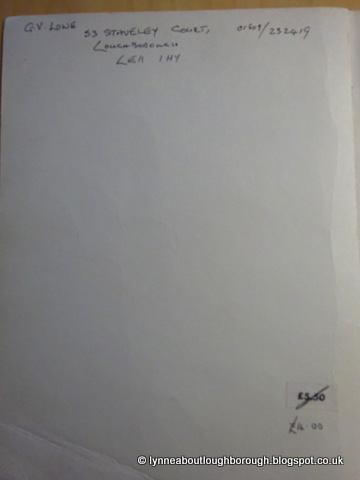
'The story of Loughborough: 1888-1914' by W. Arthur Deakin, and published by the Echo Press in 1979, is a well-thumbed tome that contains extracts from the local newspapers, and is accompanied by plenty of photographs. What's particularly interesting is that my copy was once owned by George Lowe, who was at one time curator of the Old Rectory Museum, interesting because as a member of the Loughborough Archaeological and Historical Society, I volunteer at the ORM! In addition, it's also interesting that at the time he owned this book, George lived in Staveley Court, interesting because Christopher Staveley was an architect who, around 1799-1800, undertook repairs to the ORM, as well as to the parish church in 1815.


In a booklet on non-conformist Loughborough, it was interesting to note that there are so many different Paget families:


Other publications reveal other names. So, for example, in a revision to the rules of the Co-operative Society of Wood Gate, Loughborough, there are several groups of names mentioned:


And in one of the Bulletins of the Loughborough and District Archaeological Society (now the Loughborough Archaeological and Historical Society) there's an interesting list of members:


Interestingly, George H. Green, listed above in connection with the Bulletin, wrote a book about the Loughborough market and the fair, when he was the Markets Manager:


Being very keen on Wales, as well as Loughborough, it's wonderful that my book 'Wild Wales' by George Borrow, was once owned by George Green, as seen by the dedication he wrote inside it:


A lovely little map (not sure of the date) is rather tall and narrow, unlike most which are much squarer. I'm guessing because this was produced specially for Mr Mather:


And the final treat I unearthed was a copy of a book called 'Recipes and wrinkles'! I've always associated that last word with age lines on a face, but apparently, it has another meaning, as discovered in the Oxford English Dictionary: 'A piece or item of useful information, knowledge, or advice; a helpful or valuable hint; a tip'. Hence, as can be seen from the contents page, the last seciton of this book includes household tips, although I'm not quite sure what this has to do with Suffragettes!


Thank you for stopping by!

You are welcome to quote passages from any of my posts, with appropriate credit. The correct citation for this looks as follow:

Dyer, Lynne (2019). Local books local people. Available from: https://lynneaboutloughborough.blogspot.com/2019/05/local-books-local-people.html [Accessed 25 May 2019]

Take down policy:
I post no pictures that are not my own, unless I have express permission so to do. All text is my own, and not copied from any other information sources, printed or electronic, unless identified and credited as such. If you find I have posted something in contravention of these statements, or if there are photographs of you which you would prefer not to be here, please contact me at the address listed on the About Me page, and I will remove these.
Thank you for reading this blog. 

Lynne 


Sunday, 22 January 2017

Swithland slate gravestones

So, 2016 now seems a long time ago, but it was in early December that I wrote about the use of Swithland slate for a variety of purposes - roofing tiles, hearths, milestones, plinths, window sills - but did not have time to elaborate on the use of such slate for gravestones (by which I mean, tombstones, headstones or memorial stones).

At the December meeting of the Loughborough Archaeological and Historical Society (LAHS) Roger Willson came along and talked to us about gravestones that are found in Leicestershire, many of which, from the period up until about 1880, were made from Swithland slate. The heyday was around 1853, and the last quarry closed around 1887, competition from cheaper Welsh slate probably being one reason for the demise of the local material.

There are so many variations in Swithland slate gravestones that it is possible to outline chronological developments in its use. This ranges from the early, small, square headstones, through headstones with no margin and varying sized inscription, through double-paneled headstones used usually for husband and wife, through more elaborate lettering, to headstones quoting verses from the Bible, those including the occupation of the deceased, and those with the sculptor's name and the apprentice's practice alphabets. 

Swithland slate headstones often include much symbolism: urns, skulls, hourglasses, anchors, doves, olive branches, angels, crowns, and cherubs. Another unique feature of Swithland slate headstones is what's known as the Belvoir angels, so a highly stylised depiction of an angel with its face in the middle and wings coming out of either side. I believe these Belvoir angels appeared on the earlier headstones from about the 1690s to 1750s.

One of the other distinctive features of Swithland slate gravestones is that the front of the stone is completely smoothed, whilst, unlike Welsh slate, the reverse is left rough. This may have something to do with the way Swithland slate was split with a hand saw. 

There are many examples of Swithland slate headstones in our local churches, and I do here a few pictures of ones I've been lucky enough to see over the years. Unfortunately, although I can picture some of the churches I can't for the life of me remember what the names of all the villages were. Also, as I have a new pc I can't find a way to reduce the resolution of them, so they will take forever to load, so I will post these another week.
If you would like to read more about Belvoir angels here are a few interesting websites:

A report of a talk at Keyworth & District Local History Society in 2008
An article on tombstones on the Wolds Historical Organisation website
A report in the Nottingham Evening Post 
The website of St Mary's at Bottesford

You are welcome to quote passages from any of my posts, with appropriate credit. The correct citation for this looks as follow:

Dyer, Lynne (2017). Swithland slate gravestones. [Online] Available from: http://lynneaboutloughborough.blogspot.com/2017/01/swithland-slate-gravestones.html [Accessed 22 January 2017]


Sunday, 11 January 2015

Needlemaking and other Loughborough connections

This week the Loughborough Archaeological and Historical Society held their members event which sees members of the society give presentations on things they've been researching that would be of interest to others. This year, I decided to give it a go, and presented a short talk on archaeology - my kind, not the trench-digging, field-walking kind - with examples of artefacts I've found on my travels that have informed my research.

If you would like to see the presentation, I've uploaded the slides , and I've included the transcript below.

Archaeology and the fundamental interconnectedness of all things (with thanks to DA)

In late 2012, when I responded to an advert for members of the public who were interested in the history of Loughborough to enrol on a 6-month course in Leicester on learning how to lead a guided walk, little did I know what was actually in store for me!

At the first session of the course I felt like a complete interloper! Almost everyone else there was attached to a museum  - The Old Rectory, The Abbey Pumping Station, The Space Centre, The GCR, Newarke Houses etc. – so I attached myself to the unattached chap next to me and we got on like a house on fire, which was great as he was a retired fire officer!

As a daughter of the grim industrial areas of South Wales, what exactly did I think I had to offer to people who might be interested in the history of our little market town – and probably knew more about it than I did anyway!

Well, to cut a very long story short, I may have known very little about Loughborough at the start of the course, but many years of researching significant (that’s significant to me) areas of Wales, and endless hours of pouring over census returns and bmd records in a quest to complete the family tree, all held me in good stead. And maybe, just maybe, being a librarian by day was also a bit of help!

So, I passed the tour guiding course, and have shared some of my knowledge on guided walks. But when I read on Twitter about 18 months ago that some people viewed Loughborough as a rubbish town, I decided to try and do something to raise the profile of the town. Thus, the blog, lynneaboutloughborough was born. Each Sunday evening I write a piece about, or related to, our wonderful town, and share this on the internet for anyone to read.

Articles are prompted by my own interests, by things people have said to me, by events happening in and around the town, and by chance finds.

I know the Loughborough Archaeological and Historical Society started life as the Loughborough and District Archaeological Society, and although I was daunted at the prospect of joining such a prestigious group, I paid my subs and showed up at meetings. Now, I know nothing about archaeology except what I’ve seen on television programmes like Time Team, and in truth, I have a bit of an aversion to getting dirty, but I bit the bullet and went on a fieldwalking event, and thoroughly enjoyed walking through a recently ploughed field looking for bits of debris that might be a flint arrowhead, or some kind of pottery. Problem was though, having been brought up in South Wales I could easily recognise slate, and had there been any granite I would have recognised that too, from regular holidays in Cornwall. But, I didn’t find anything significant, and was really rather more interested in the 19th century horseshoe I spotted!

So, if digging trenches and walking ploughed fields isn’t quite my kind of archaeology then what is?

Well, antique and junk shops are! Charity shops are! 2nd hand bookshops are! The internet is!

So, I dig around all of these, looking for clues, usually about something specific, but equally often just picking up things that might be of interest. Everything I see of buy helps me to build up a picture of what I’ve been researching into and helps me to understand more about social history.  

Take this postcard. A picture of Leicester, sent to someone in Loughborough and bought over 100 years later from Lichfield. To me, this is all hugely significant: My journey from home to town takes me along Albert Street, and I’ve always been fascinated by the engineering factory on the corner. Research revealed that it had once been a needlemaking factory, one of the ones run by the Grudgings family, at least one of whom died during WW1, and at least one other who survived (and whose WW1 diary is tweeted via the Carillon Museum). And here I am holding a postcard sent to Flo Grudgings, an elementary school teacher and a member of that needlemaking family. The card was posted in 1903.

And then, of course, there’s the Lichfield connection. Wasn’t Lichfield Cathedral once the cathedral associated with our town? And at least some of the current bells were cast by Taylor’s Bell Founders in 1947. It was Taylor’s, of course, who cast the bells for our beautiful war memorial, which can still be heard on Sundays when the carillon is played.

I did a spot of volunteering at the Carillon Museum this year, just before my grandmother died. How strange then to learn at her funeral that a long lost uncle who emigrated to the States in the ‘60s, regularly plays the carillon in his home town of Morristown, New Jersey.

But, back to archaeology! Earlier, I said I could recognise slate and granite, but perhaps I should also add alabaster to that list. I first met Ray State in the local studies library about a week after I’d written an article on spar ornament makers of Loughborough, so it was a real pleasure to come along and hear him talk, just before Christmas. Curiously, also a couple of weeks before Christmas, we had a sale of unwanted goods at work: We’re trying to raise money to train a guide dog, and for the huge sum of 50p I bought this alabaster egg. I got the feeling people thought I was a bit mad, but I’m now so glad I did buy it! Needless to say, I have been scouring the shops for other alabaster ornaments, but I don’t think I’ll ever find any! But, who knows, I might yet be surprised …

… as I was on another recent shopping trip looking for suitable Christmas presents!

Imagine my total astonishment and excitement when I stumbled across this trunk! Ok, so it’s a steamer trunk, but not just any old steamer trunk! Fortuitously, the last luggage label had been left on: This trunk belonged to Charles Knight Deeming, he, latterly of One Ash House, the former owner of the current Odeon (aka The Empire, The New Empire, The Curzon, The Reel), and the now demolished Victory Cinema, which stood in Biggin Street on the site now occupied by a card shop, Games Workshop and Bonkers.  

Ironically, I’m a little bit interested in cinema and theatre and had been researching the family tree of Charles Deeming. Unfortunately, at £165 the trunk was too expensive for me to buy – so no prop to show you!

Finally, it was a visit to a 2nd hand bookshop in Warwickshire that led me to this publication,  Needlemaking, and the list of places to visit in the back. This included Forge Mill Needlemaking Museum in Redditch. This, of course, takes us back to the Grudgings family where we started, unless we want to explore these connections further, for Bordesley Abbey was on the same site as the needlemaking museum and there is a strong connection to Garendon Abbey and has been the subject of a community dig.

So, our archaeologies are fundamentally interconnected, but I must stop here, otherwise I could carry on connecting for a very long time!

Thanks for listening!

Sunday, 17 August 2014

The Old Rectory Museum

A visit to the Old Rectory Museum

If you live in Loughborough, it's possible that you might have heard of the Old Rectory Museum: In fact, you might even have played in the grounds when you were a youngster! If, however, you're a student, or you're just visiting then it's possible you might have missed this treasure, tucked away in the old part of Loughborough, near All Saints with Holy Trinity Church, close to the former Manor House, the former Guildhall, and what is probably the oldest pub in town!!

The Old Rectory is, as its name suggests, the former rectory associated with what was at the time probably known as the church of St Peter and St Paul, later All Saints, and now combined with the Holy Trinity Church (which is situated on the corner of Moor Lane and Trinity Street and is now an independent school). 

It's quite possible that there was a rectory in this place from about the early 1100s, but in the late 19th century the building looked quite different, being a substantial family home. When a new vicar was installed, he deemed the rectory too big for his and his family's needs, so a new home was built, in about 1960. The Old Rectory was then scheduled for demolition, but in the process, the old stone building that you can see today was found inside the newer building. Such was the significance of this Old Rectory, that demolition was halted, and the stone building retained and turned into a museum.

I believe that the Old Rectory and the Warner Street School are the only stone buildings to remain in the town centre, although the school has now been demolished, leaving only the former headteacher's house. Some significant stonework from the school has been housed in the Old Rectory Museum.

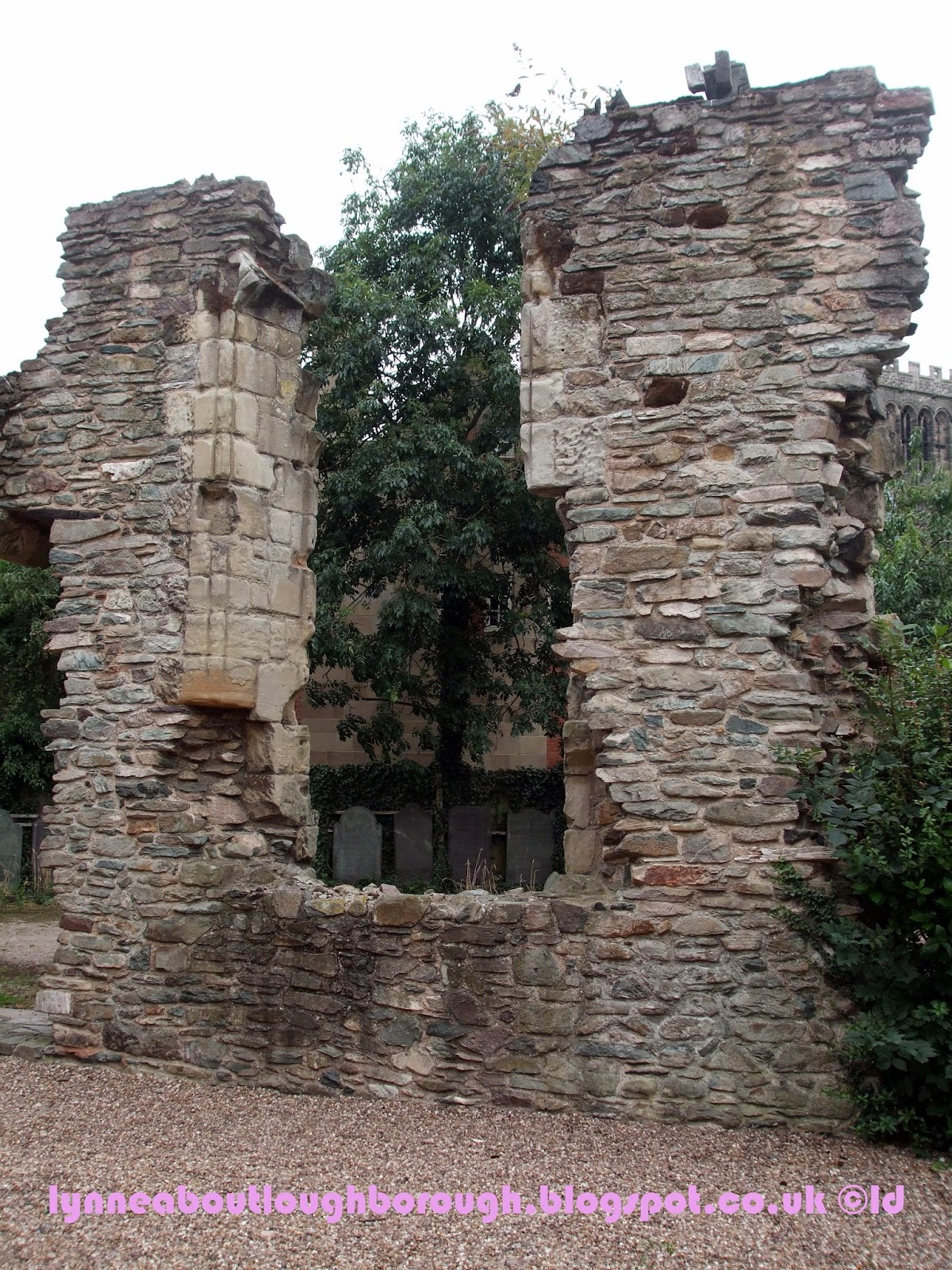
The Old Rectory was at one time a scheduled Ancient Monument, but is now a Grade II* listed building. The museum contains a large variety of artefacts, including archaeological finds, tiles from Garendon Abbey, has a variety of displays, including several on locally important people, and has an area devoted to an exhibition which changes each year. This year the exhibition is based around the Big Meadow in Loughborough, the oldest meadow in the country, dating back to 1762. This meadow is one of the few remaining lammas meadows in the country, and was chosen by Prince Charles to be one of the 60 coronation meadows to celebrate the Queen's reign. 

Below is a selection of photos I've taken of the Old Rectory Museum. These are probably the worst photos I've ever taken, but at least they will give you an idea of what to expect when you visit the museum, which is run by volunteers from Loughborough Archaeological and Historical Society, and which is open every Saturday from April to September, 11-3.   


Sunday, 19 January 2014

Loughborough, Luddites, Lace and much more!


Busy again! This week has seen me at a meeting of the Loughborough Archaeological and Historical Society, a meeting of the Friends of Charnwood Museum and a public meeting about a community hall!

The LAHS meeting was the members’ contribution meeting where, rather than having an external guest speaker, those members who are doing some interesting research present their findings to the group. And what a variety of research is going on! We were treated to some fascinating family history, from the Publicity/Secretary and Newsletter Editor, Alison Mott, who had discovered that one of her direct ancestors was one John Courtney, a Victorian playwright who wrote popular plays for the Victorian masses at a time when there was a huge demand for affordable entertainment. Although this ancestor is a recent discovery for Alison, it’s little wonder, then, that she has always felt she was meant to write!  

We also heard a fascinating tale from a member who was researching the history of the postal service in and around Loughborough. After briefly describing the evolution of our postal system there were lots of artefacts to handle, including painstakingly written information boards and photocopies of letters from / to local people which showed a fascinating insight into their personalities, which included a letter to Robert Bakewell.

If you live in the Leicestershire area you will know that the nearest National Trust properties are not in the county, so there is much interest in the National Trust’s acquisition of, and plans for the opening of Gimson’s house, Stoneywell. One of our members is now an NT volunteer guide for this house, having been a personal friend of the last owner of the house, Donald Gimson. The NT has plans to open the property during the summer of 2014,and you can follow the news related to Stoneywell on the blog.

We were also given an introduction to a proposed project which will create an online community archives hub for Loughborough and the surrounding areas. A grant has been given to the university, who hope to work in collaboration with local museums and heritage organisations to provide a one-stop-heritage-shop, a hub on the internet where you will be able to find out about all things heritage, rather like the one that has been developed in Hertfordshire. I’m really looking forwarding to supporting this initiative and the prospect of having all things heritage easily at my fingertips.


The tower of All Saints Church


Our final talk was about the WW1 project at All Saints Church which has been granted some heritage lottery funding to move the WW1 memorials from an obscure place in the church to somewhere more appropriate. I talked about this project in last week’s blogpost as this made the front page of the local paper. A public meeting is being held on Saturday February 8th at 7.30pm in the church - everyone welcome! 


Charnwood Museum

Wednesday evening saw a packed Charnwood Museum for the Friends of Charnwood Museum talk on Luddites and Lace-makers, delivered by Tony Jarram. Tony was involved in the 2007 discovery of the tunnels in Lantern House, the house on Leicester Road, which was owned by John Heathcoat, lace-maker, who developed a lace-making machine and established his factory in Loughborough.


Tony described the background to the development of lace making machines, and how Heathcoat came to be living and working in Loughborough. Once we’d heard this we were able to appreciate why Heathcoat’s factory on Malt Mill Lane (now Market Street, in the vicinity of the current Iceland shop and the Varsity Bar) was a target for a Luddite attack in 1816.

This building was once a needle-makers,
but was it also once a lace-making factory?

Same building from the side


The group known as the Luddites (possibly named after a disgruntled Leicestershire inhabitant, “Ned Ludd”) attacked factories up and down the country where they perceived that machines were taking over the jobs that were currently undertaken by them and their families, thus depriving them of much needed wages.


These wages were of course needed to provide necessities like food for working families, and lack of, or reduction in wages may well have led to some of the food riots of 1812, in places like Sheffield. 


Another building that might possibly
have been a lace-making factory


The same building from the back


According to Tony, Heathcoat’s factory was a prime target because of the efficiency of his machines and the size of his business; at one time he owned about one twelfth of all the lace-making machines in the country. He suggested that Heathcoat would have been aware of the various attacks that had already taken place in other parts of the country and the tunnels in his house on Leicester Road were purposefully built in order to provide him with a refuge in the event of an attack on his house. Perhaps because of the modest size of this house, this was not the target of an attack, the Luddites preferring to launch an assault on the lace-making factory itself.  


Directly before the attack on the factory on 28th June 1816, the Luddites drank in the Packe Horse Inn (now the Organ Grinder pub), broke windows in the Black Bull pub on High Street (now Vice Versa) on their way to the Seven Stars, a drinking house on Shakespeare Street. Fuelled by so much drinking, they took a hostage in Market Street and then attacked the guard at the factory before setting fire to it, thus destroying about 55 lace-making machines. 


The outcome of this event was that many of the protagonists were hung, a couple were sent off to Australia, and a couple escaped. Heathcoat was offered compensation on the proviso that he stayed in the town and continued with his business, but he declined this offer and transferred his business activity to Tiverton in Devon, taking with him many of his workers from Loughborough. Although many workers settled in Tiverton, many ventured further afield, some emigrating to Calais, others to Australia.    

One thing I haven’t mentioned is that Heathcoat had a partner in his Loughborough business, a man called John Boden. He followed Heathcoat to Tiverton, but the partnership was dissolved in 1821 when Heathcoat’s patent for the lace-making machine ran out. Boden then set up in Barnstaple with Heathcoat’s older brother, Thomas. And, here’s a picture of one of John Boden’s direct descendants at the exhibition in Charnwood Museum in 2007.   

I remember in 2007, going to a performance by the wonderful Mikron theatre group of a musical play about the Luddites, that took place in the Victoria Rooms in the Town Hall. This was unusual as whilst the company are performing they are based on the canals, and their usual Loughborough venue is the Swan in the Rushes. In 2012 they also created a play based on the Luddites and the cotton mills in Yorkshire. That play I didn’t see, but it’s interesting to hear that they created a song called "Nedd Ludd’s tune"!   And, just to finish off, here’s an article about Loughborough, the Luddites, the Charnwood Museum exhibition and the Mikron play!

This was a thrilling account of what was a notorious attack. And how fascinating to learn that Tony’s personal interest in Heathcoat came from being a direct descendant of John West, a Nottingham lace-makers who went to work in Calais, before returning to Loughborough!

Fearon Hall from Fearon Jitty


Finally, I spent a nice couple of hours at Fearon Hall, mingling with folk, with the aim of helping to come up with ideas for celebrating the hall’s 125th anniversary. This was a great afternoon, as although I don't use the hall myself, I re-acquainted myself with quite a number of people I have come to know over the years.


Fearon Hall


The hall was built in 1889 to celebrate the memory of Henry Fearon, Rector of All Saints, and Archdeacon of Leicester. He was a very popular character and it is him we have to thank for the first clean water to be supplied to the town, in about 1870. Archdeacon Fearon died in 1885, and Fearon Hall was built in his memory, from public subscription, and was extended in 1910.


During the 125 years of its existence, the hall has had a variety of uses -  Scout groups in the 1900s, patriotic entertainment during the WW1, a base for the Home Guard during the WW2, a base for Loughborough Art School during the 1960s, a home for Charnwood Theatre Group in the 1990s. Today, the hall is in regular use for amongst other things, exercise classes, a pre-school group, a lunch club, and a choir. Information on the running of the hall is available from the website, however, this is a little out-of-date. They also have a facebook page for you to follow.

I’d be misleading you if I said I had recently been on a trip on the Great Central Railway, but I did watch the Michael Portillo train journey programme this week when he went to Leicester, Syston and Loughborough, visiting the bellfoundry, and the Carillon! If you get a chance to watch it, it comes highly recommended! It’s probably on iplayer for a while!