Showing posts with label The Blacksmith's Arms. Show all posts

Sunday, 3 December 2017

Ticklebelly, Lawrence and pubs

So, I still haven't tracked down that recent research I did, mostly because I've been a bit busy of late. Last night I went along to the Loughborough Archaeological and Historical Society meeting at which Ian Porter talked about his 200-mile walk to Tiverton, in commemoration of the same walk undertaken by about 150 Loughborough folk when they followed John Heathcoat to Tiverton to start a new life. You can read more about this - Luddites, Heathcoat and the Tiverton connection - over on the Old Rectory Museum and LAHS blog, where I've guest posted.

A couple of weeks ago I was in Newark, visiting the Civil War Centre. The permanent Civil War exhibition was great, but I also thoroughly enjoyed the medical exhibition, with its video of the way things used to be done. Also, there was a fantastic display over about 5 rooms, covering the life and work of T.E. Lawrence, relevant to Newark because I believe he was stationed there for a while after WW1. I must admit to not knowing much about him before visiting this exhibition, but as is often the case, his name came up in a number of places over the next week or so, and previously I probably wouldn't even have noticed.

One piece of research I've been re-visiting over the last couple of days is the history of the Blacksmith's Arms pub, which used to be called The Black Boy. You can guess that this pub name has now popped up in my world on several occasions since Thursday, including the news that the Black Boy in Leicester is again being proposed as flats. There's an interesting set of photos over on the Derelict Places website.


Yesterday I spent the day in Lincoln and came across a lovely little bakery I'd not seen before. I couldn't resist the look of the bread, so went in to buy a loaf. 20 minutes later I emerged, having had the courage to ask the owner about the origin of the name. It was an interesting story, something to do with a path that pigs used to walk along, and when the grass grew too long it used to tickle their tummies. Here's the story as they've told it on their website. Going out on a limb here, but was this how Ticklebelly Park got its name? Or is its origins more likely to come from similar pasts as talked about in these webpages:

http://sussexhistoryforum.co.uk/index.php?topic=2239.10;wap2

http://news.bbc.co.uk/1/hi/england/7812254.stm

http://www.bbc.co.uk/southerncounties/content/articles/2009/01/05/east_sussex_street_names_feature.shtml

http://www.kenthistoryforum.co.uk/index.php?PHPSESSID=h2tb9mb2luo9rmviuh9pohrgk4&topic=6658.0

Anyway, sorry for this week's brevity.

You are welcome to quote passages from any of my posts, with appropriate credit. The correct citation for this looks as follow:

Dyer, Lynne (2017). Tickleybelly, Lawrence and pubs. Available from: https://lynneaboutloughborough.blogspot.com/2017/12/ticklebelly-lawrence-and-pubs.html [Accessed 3 December 2017]

Take down policy:
I post no pictures that are not my own, unless I have express permission so to do. All text is my own, and not copied from any other information sources, printed or electronic, unless identified and credited as such. If you find I have posted something in contravention of these statements, or if there are photographs of you which you would prefer not to be here, please contact me at the address listed on the About Me page, and I will remove these.
Thank you for reading this blog. 

Lynne  


Sunday, 6 March 2016

Binns Family, The Blackamoors Head, The Blackboy, and the Burnaby Family

I've committed what I consider to be a cardinal sin: I've lost a couple of books, and I've lost a reference! Those of you who know will know that this has caused me considerable grief! How can I write a blog post with vague references to something I remembered reading a long while ago, without being able to tell you exactly where and exactly what was said?! Ah well, here goes, an ill-conceived, ill-prepared, ill-researched blog post on something I read somewhere and on a name that triggered a reminder of a blog post I was going to write, but hadn't quite got round to!

Last week I went on the Luddite walk that was arranged on facebook, and I had a really great time. I translated that walk into a virtual walk, so if you didn't manage to come along, you can experience a flavour of the walk over on my virtual Loughborough, Luddites and Lace Trail.

I think it was on this walk that someone mentioned the Burnaby family - or maybe I just dreamed that! But, it reminded me of some research I'd done in March last year, but never got round to posting! So, despite some very careful cataloguing and shelving of my books, I've lost most of the ones on local pubs and inns, apart from Billy Wells' one which is always close to hand! Eric Swift has gone missing, as has that lovely book on East Midlands pubs with lavender on the cover (although what that's got to do with the contents, I'm not sure).

Anyway, Burnaby's reminded me that I'd read somewhere that local pubs called The Blackboy were possibly named after something in the crest of the Burnaby family, and probably those Burnabys who lived at Baggrave Hall. You may already know that The Blacksmiths Arms in Ward's End, was previously called The Blackboy, being renamed around 1875. Well, I've done a bit of hunting around, and established that there are a number of theories associated with the name The Blackboy, and that there are still quite a few pubs around that still bear that name, for example in Shinfield Reading, in Knowle near Solihull, in Hungarton etc..
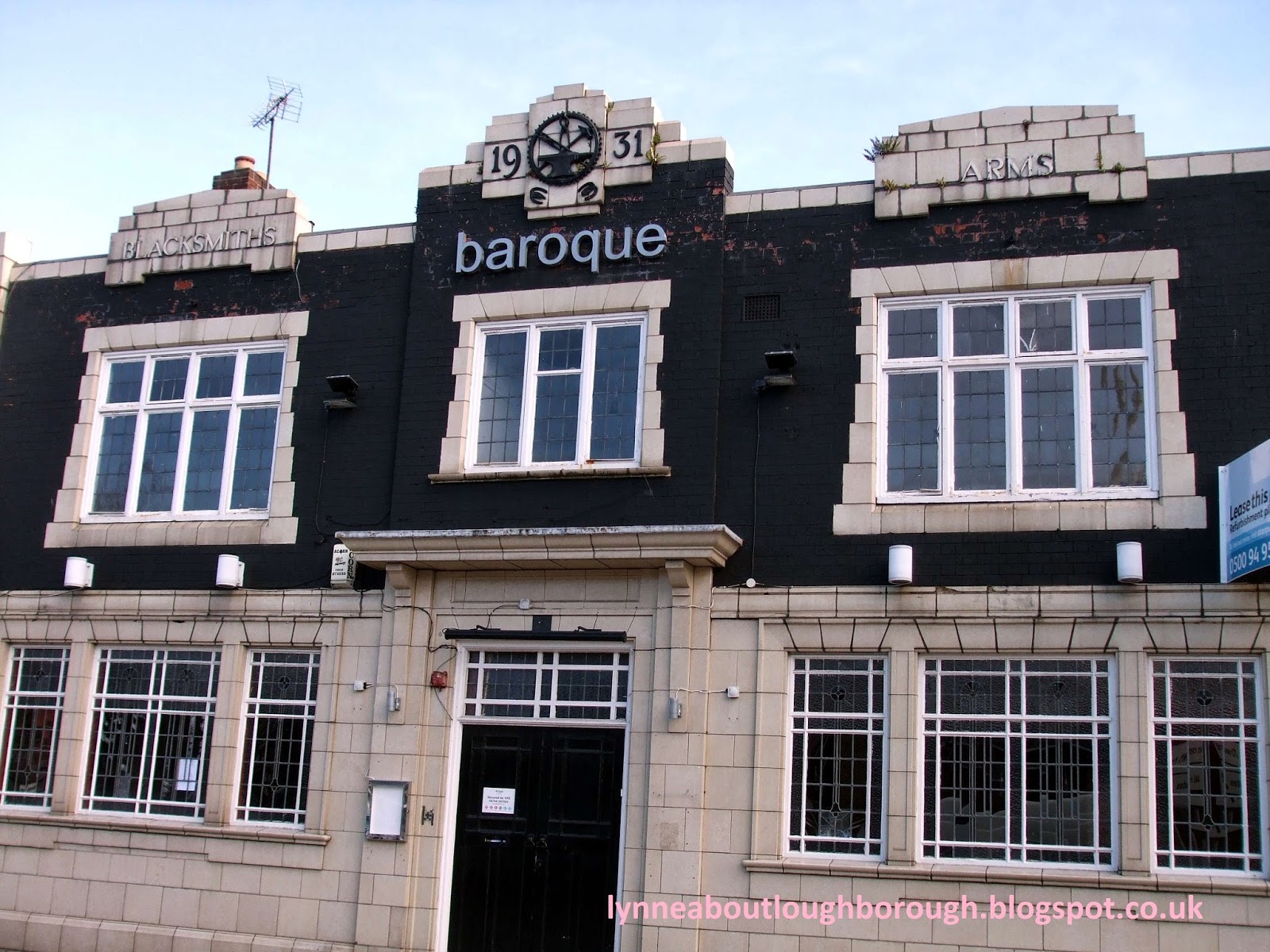
The Blacksniths Arms as Baroque
The theories around the origins of the name include the idea that they were:

  • named for people who worked in the coal mining industry
  • named after chimney sweeps
  • named after servants who worked for well-to-do families
  • named after Charles II, who was apparently quite dark skinned

Generally, I suppose these could all contain an element of truth, but it's also important to put the pub and its name into the local context: if your locality is not a mining area, then the first option listed above is probably not the likely source for the name of your pub!

If I could find my books, I'd be able to tell you where I read the idea that The Blackboy in Loughborough was named after the crest of the Burnaby family. Now that suggestion has sent me on a quest to find out about that particular family, but that research is in its infancy, and the link between the Robert Burnaby who is buried in Emmanuel churchyard, and after whom the city in British Columbia, Canada, is named, and the Burnaby family of Baggrave Hall, Leics., is yet to be proved (in my research, at least).
The memorial to Robert Burnaby
I've had a good hunt around, and I can find no information to support the idea that our Blackboy is in any way related to the Burnaby family, but, what I have found is that the crest of the Binns family in Yorkshire (and as soon as I heard that name I remembered from my late teenage years that there was a Binns House of Fraser in Harrogate, North Yorks.) does indeed include an image of a black person, although quite what the connection between a small market town in Leicestershire and a gentrified family in Yorkshire is, I don't know. 

Anyway, further investigation also reveals that the likely pub name associated with part of the Binns family crest is the Blackamoors Head, which was in the Market Place, next to the current Lloyds Bank. So perhaps this is more likely? If this is the case then what was the background to the naming of The Blackboy?

Answers on a postcard please!!

There are some similarities between our Blackamoors Head, and The Blackboy as both buildings were demolished in the 1930s and rebuilt. The Blackamoors Head is, of course, no longer there, but the Blacksmith's Arms is. 

Well, that's it for today!!

See you next week!  

Sunday, 17 January 2016

Loughborough pubs

The Windmill Inn on Sparrow Hill 


I recently caught sight of an article in the “LeicesterMercury” about pub names in Leicestershire towns. You’d have thought, as the county’s biggest town after Leicester, some Loughborough pubs would have made it into the article, wouldn’t you? But no, lots of others places mentioned, but not Loughborough. I suppose it was because the pub names they were referring to no longer exist in any Loughborough pubs.


The Old English Gentleman on Ashby Road


Ok, so fair dues, the article does say it’s going to look into the more interesting pubs names in the county, but I’m sure Loughborough must have had some of these! The newspaper goes into the possible meaning of the pub names, and their choice includes the following:

  • The Monkey Walk
  • The Globe (but not the Lamplighters)
  • The Cradock Arms
  • The Ram Jam Inn
  • The Gate Hangs Well
  • The Anne of Cleves
  • The Tin Hat
  • The Two Steeples
  • O’Neill’s
  • The Bull’s Head

The Black Lion, the Hobgoblin, now the Tap and Clapp

Then, the article moves on to a selection of pub names found, not just within the county, but across the country. Here they include:
  • The Red Lion
  • The Nag’s Head
  • The Black Horse
  • The Rose and Crown
  • The Golden Fleece
  • The Barley Mow


So, let’s have a quick look at those listed above and see if Loughborough has, or had any pubs with these names:

The Bull’s Head

The Bull’s Head [and Posting House] was a coaching inn on High Street (and there was one in Shelthorpe too), approximately where vice Versa, which is now a gym, is. The original signpost was one of those wonderful ones that stretched right across from one side of the road to the other. I haven’t got a photo of this, but here’s a link to one, and here’s a picture of something similar in St Ives, Huntingdonshire, taken in 2014.  

The Oliver Cromwell pub in St Ives, Hunts.
The Red Lion (the sign of John O’Gaunt)

Loughborough’s Red Lion pub was on Biggin Street. I’m not quite sure where exactly, but I think it was in the area now occupied by Timpsons, British Heart Foundation etc.. 

The Nag’s Head (an indication that the landlord kept horses, or a jibe at women?)

A pub with this name was on the site which is now occupied by Wilkinsons. Given that when the Co-op building was being built a hoard of clay pipes was found, maybe the Nag’s Head was the original smokers’ pub!

The Black Horse (was there a racing stables nearby, or is this an omen of death of a member of the royal family?)

There was a Black Horse (and commercial [inn]) in the 1800s on High Street, and also one on Woodgate. Between 1828 and 1841 the landladies were of the Mansfield family.
  
The Rose and Crown (the joining together of two of England’s most powerful emblems)

This pub has had a couple of incarnations. The original building, on Baxter Gate was replaced in the 1930s when Baxter Gate was widened, and has been the Custard Bar (and shamefully, I can’t remember if it still is called this).

The Golden Fleece (nothing to do with Jason!)

Loughborough town centre also used to have a pub called the Golden Fleece. There have actually been about three different buildings with this name, all in the general area of Cattle Market / Granby Street, the latest now being a restaurant and bar (possibly called Chapter One?). Since Loughborough was at one time part of the [wool] Staple of Calais, then I would agree that this pub name represents our involvement in the wool industry, way back.

The Barley Mow

Well, we certainly used to have a Barley Mow, on Market Street, in the double-fronted shop, one half of which is now a café. I wonder if this was called the Barley Mow because in the distant past this area was home to Loughborough’s malting industry? In order to use barley or other cereal grains in the brewing industry or for distilling, the grains first have to be malted  (basically, dried, re-hydrated and then sprouted). This would have happened in a building called a maltings, or a malthouse, or a malting floor. The area where Iceland is now, before it was occupied by Heathcoat’s laceworks, was, I believe, the site of the old malthouse, and was ideally sited because it is here that there are many little tributaries feeding into the Woodbrook which runs very close to Iceland, under the path. A friend tells me that although the area is now called Market Street, his mother still referred to it as either Mill Lane, or Malt Mill Lane. On a related note, there used to be a pub called The Maltings, on Knightthorpe Road, which is now a Co-op, that was a relatively recent build, and replaced an old barn: was this barn a malthouse?

Some of the more interesting pub names in Loughborough include:

Bishop Blaize – Bishop Blaize was the patron saint of the trade guild of woolcombers. The emblem usually associated with this pub name is a pair of candles, or a pair of combs. The pub was at the bottom of Woodgate.

Blue Boar – this pub was in Swan Street, and demolished when The Rushes was built. The sign of the blue boar is associated with the Tudors.

Dolphin – really? Initially I thought this might have been named ironically, rather like the Sea Around Us (on Ashby Road, now the Harvester), but I’ve now decided this uses a crest from a trade coat of arms – the dolphin being from that of fishmongers. The pub was on Church Gate: whether or not there was a fishmonger nearby, I’m not sure.

Dove and Rainbow (later Bucks Horn) – according to Bill Wells*, the Dove and Rainbow was on Pinfold Street / Buckhorn Square. The name could be a reference to Noah and the floods, or it could be that it’s connected with the dyeing industry, as the rainbow was the heraldic emblem of the Dyers’ Company and at one time there were many dyeworks in the town.

The study of pub names is a huge area of research, and there are often several suggested meanings for many names; however, some meanings are quite obvious. Some examples from Loughborough include those pubs with names related in some way to royalty or nobility. Here’s a few examples: 

Royal George on The Coneries / Nottingham Road, which was probably named after George, who was Prince of Wales, and Prince Regent in 1810 when the pub was first opened, and who became King George IV after the death of his father in 1820.

Similarly, the George the Fourth on Regent Street.

The Prince of Wales in Church Gate was opened prior to 1863: perhaps this was named in honour of Albert Edward, Prince of Wales, who later became Edward VII, on account of his being Prince of Wales from 1841 until 1901?

And perhaps the Clarence Inn (later the Jack O’Lantern) was named after the First Earl of Clarence, who was Prince Leopold, Queen Victoria’s fourth son.

Maybe the Duke of York (Nottingham Road, demolished and replaced by flats) was so named after Prince Frederick, Duke of York and Albany, the second son of George III?

The Marquis of Granby (which was on the corner of Wood Gate and Packe Horse Lane) was named after John Manners, the son of the Duke of Rutland.

Other pubs are named after the trade with which they were mostly associated, so, for example:

The Blacksmith’s Arms on Bedford Square, was so named because at one time the landlord was also a blacksmith.

The Cooper’s Arms on Barrow Street would have been frequented by barrel makers, and prior to this was named the Builder’s Arms.

The Three Tuns (now the Three Nuns) on Church Gate was a reference to the crest of the company of brewers.

The Wheatsheaf, now the Orange Tree
The Wheatsheaf (Bedford Square, now the Orange Tree) was a crest from the trade coat of arms of bakers.

The Green Man (Swan Street and under Carillon Court) was also an image used in heraldry, as the Company of Distillers used a pair of green men  (as in wild, or savage men)  as supporters in their coat of arms.

We’ve already mentioned Bishop Blaize and the Golden Fleece, the Dolphin and the Dove and Rainbow.


The Stag & Pheasant on Nottingham Road

Many pub signs are also named after animals, for example, the White Hart, the Unicorn, the Fox and Hounds, the Black/White Swan, the Black/White/Red Lion, the Black Horse, the Red Cow, Stag and Pheasant, Greyhound, Hare and Hounds/Pheasant, Peacock, etc.. Some of these origins are quite obvious, but others may be misleading, for example, I would think that the Peacock was named after the Dukes of Rutland, the Manners family, whose heraldic emblem is the peacock. Others, for example, the White Hart, have royal connections, this particular badge being that of Richard II.


Well, I could go on about this subject ad nauseam, so I shall stop here, but leave you with a thought: the Blacksmith’s Arms used to be called the Black Boy. This is thought to have been a reference to Charles II, but I have a slightly different thought about this, which I will share with you sometime! 

*Wells, Bill (2014). Billy's book of Loughborough boozers.    

Sunday, 1 March 2015

The Blacksmiths

The Blacksmiths - also known as the Blacksmith's Arms

Pubs were often named after an occupational group of people, perhaps because this was where people in that trade met to quench their thirst. Usually such pubs didn't have a sign, but if they did it would probably be taken from the Arms of the Worshipful Company. In the case of our Blacksmiths, you can see an anvil and hammer on the very top of the roofline, between the 19 and the 31 of the date. You can also see the original name on the roofline either side of the date in the middle.

It is thought that the original pub was actually called the Black Boy, but was changed to the Blacksmith's Arms.

The Blacksmiths in Wards End that we see today is the second incarnation of that particular pub, the first being opened in the mid-1800s, before being demolished in the early 1930s, to be replaced by this rather handsome art deco building that stands today.

Over the years the pub has had various names, and started life as The Blackboy, it's name changing to The Blacksmith's Arms in about the 1870s.  The Blacksmith's closed its doors as a traditional pub in the 1990s, and became known, amongst other things as, @The Office, Voodoo, an Indian restaurant (but the name escapes me), and Baroque, though I've probably missed some!

Today, The Blacksmiths has been renovated and now serves meals in its spacious rooms.

Click the picture to return to the pub quiz!


http://lynneaboutloughborough.blogspot.co.uk/2015/02/pub-quiz.html
The Blacksmiths in 2013 as The Baroque


Sunday, 11 August 2013

Bloomin' Loughborough! Loughborough enters the In Bloom competition!

Oh, hello there! Nice to see you again!!

Today’s post is all about Bloomin’ Loughborough!

So, my mission to ensure that Loughborough doesn’t make it to the list of 50 rubbish towns, today sees me focus on the towns in bloom competition!

Each year our town is decorated with hanging baskets, window boxes, towers of flowers and all manner of other interesting displays of flowers. And, each year, we seem to do better in the competition, so last year, like 2011, we managed to gain a Gold in the East Midlands in Bloom competition.

Now, it’s not my intention to explain what the competition is about, as this information is perfectly well explained elsewhere and I’ll give you some links at the end of this blog. Rather, what I’d like to do is share some pictures with you, so you get some idea of what’s around town at the moment. There are, however, a couple of things to say first: there are some stunning displays missing from my photos, because whenever I’ve been out and about with my camera it’s been too busy with cars to take even adequate photos. And, secondly, I am no David Bailey – I’ve come to the conclusion that I see beautiful things and take photos of them, whereas as a good photographer sees things and takes beautiful photos. So, my photos don’t do the actual blooms justice, but I hope they give you a sense of what’s going on. Finally, I have made a conscious decision not to include Queen's Park today: This park is looking so spectacular at the moment, that it truly deserves its own blogpost! Watch this space!!


So, let's start on the outskirts of town.


The small triangular planting area at the junction of Edelin Road, Park Road and Shelthorpe Road has been repaired and planted up with beautiful wild flowers, thanks to the hard work of some Loughborough residents.


A very similar area has also been planted up, but with a different selection of flowers. This is on the junction of Beacon Road and Beacon Drive, and has a matching area on the opposite side of the road. The Beacon pub, just up the road from here also has hanging baskets a-plenty!


Following Epinal way down in the direction of the university and Derby takes us to the roundabout on Forest Road. Here, there is a stunning display from Harry at his property tucked in on the left-hand side. This character made an appearance during last year's competition as an Olympic competitor, and also at Christmas-time. Here he is as a farmer, with his dog and Dolly the Sheep!


This is Harry's house, and, by George, he's made a real impression with his fantastic, thoughtful displays! I wasn't the only person taking photographs!


And this is the stunning display that Harry's house looks onto, just beside the Woodbrook. Hides a less lovely aluminium fence!


This fabulous display of beautiful pink flowers is on Forest Road near the pedestrian crossing, opposite the Woodbrook. It's one of the many displays by the university. If I can get to one of the others when the roads are less busy I'll show you that one too (I think I need to get up earlier to beat the rush!)


Leaving the outskirts and heading into town now, down Forest Road, and we enter past John Storer House. Just look at these displays, hiding the slightly less pretty 1960s building! Last year, JSH won an award for their displays!


To the right of this flowering display is a bench where you can sit and look at what used to be the Blacksmith's Arms!!


On New Street, the one that looks down onto the Carillon in Queen's Park, JSH have another little display.


Bedford Square itself is home to numerous flower towers and flower tubs, pictured here:


The entrance to Granby Street car park isn't short of a flower tower or two, either!!


And, looking down Granby Street towards the cinema (Empire, Essoldo, New Empire, Curzon, Reel, Odeon - you chose!!) you can see that Cattle Market is adorned as well.


Market Place has numerous flower towers, strategically placed so as not to interfere with the setting up of the regular markets.


The Town Hall looks festive with lots of hanging baskets of flowers, though they do look better than this photo shows!


Many of the banks have also joined in the fun with hanging baskets. Here's a picture of the HSBC - again this photo doesn't do it justice. 


And one of the NatWest (a building designed by Watson Fothergill).


And finally, if you need a drink after all that walking, you'll be pleased to know that the pubs are looking pretty jolly too!! Here's The Griffin.


I do hope you've enjoyed this little trip into Bloomin' Loughborough and that this little contribution nudges our town one step further down the list of the 100.

Here are those websites with information about the bloomin’ competition that I mentioned earlier: the Charnwood Borough Council website, the East Midlands in Bloom website and the Loughborough in Bloom community blog.

Bye for now!