Showing posts with label Garendon. Show all posts

Sunday, 7 December 2025

Goadby’s History of Loughborough Chapter 4

In this blogpost, we continue the story of Loughborough as presented by journalist Edwin Goadby back in 1864. In this chapter, chapter 4, Goadby discusses life – particularly trade and travel – in the fourteenth century.

As previously mentioned, for the most part, I've kept the text and the layout as it appeared in the original newspaper serialisation, although have split some of the text into separate paragraphs to aid reading. I've added a few explanatory notes at the end, if I think these might be useful. In the 160 years since the original publication appeared, there have been many more discoveries and revelations about Loughborough's history, and some terminology will have changed, so some of the information contained in this article will be wrong: I have not tried to amend these in any way, so reader, beware!


THE HISTORY OF LOUGHBOROUGH FROM THE TIME OF THE BRITONS TO THE MIDDLE OF THE NINETEENTH CENTURY.

Chapter 4 Trade and travelling in the fourteenth century.

In: Loughborough Monitor 13 October 1864, pg 5

Chapter IV The Feudal system oppressive to the Trading Class - No security for Person, Land, or Goods - Danger of being abroad after Curfew - Murder of William of Loughborough, in Leicester, etc. - A Specimen of a Trader's Grievance, in the case of Richard Calf, of Loughborough - Danger of Travelling on the King's Highway - A Merchant Robbed and Slain, returning from the Market - Bad state of the Roads in and about the Town - Dispute about the Repairing of Cotes' Bridges, and how settled.

____________________________________

The Feudal ages are stirring times to look at through some martial romance, read in a cosy nook by a bright fire on a frosty night, but they were miserable enough to live in, unless one were a mighty baron or a doughty retainer. The castles were bold, picturesque-looking objects, no doubt; the jousts and tourneys [1], excellent; adventures, daring and plentiful enough; and the women handsome, the men stalwart, the children hardy; but for all that it was not an agreeable period for an honest man to live in.

Provisions were cheap and pretty plentiful, and a man could build his own house, spin his own garments, grow his own corn, kill his own cattle, and brew his own beer if he pleased, subject to a few manorial imposts. And yet, being an honest man, he would find it a queerish age that he had been born into, and had to do a man's work in. "Honesty is the best policy," was a maxim as yet undiscovered. Many men tried hard to discover it, and failed. Indeed, how trade, excepting that concerned with eating and drinking, ever managed to struggle into a respectable existence at all in these days, is a puzzle to all our political economy. The trader did somehow vindicate his right to be, in this bickering Barondom [2], and we admire him for it, but he had to submit to robbery, spoliation, violence, and occasional incarceration for his imprudence. Now and then he thrived, and got patronised by the warriors, as a man who ought to have been a jolly baron but had missed his vocation. In the small towns this was painfully evident, but in larger ones it was not so bad. In fact, a burgess [3], who carried a short sword with him, as a final piece of constitutional law, was not a man to be spirited away at the sight of a suit of mail and a poleaxe [4].

Outside of a fortified town matters were different. A man wore side-arms just the same, but he rarely used them except to wound his neighbour in a drunken brawl. In the city, tradesmen were protected, but out of it they were treated as individuals expressly created for baronial experiments, in the spirit of that celebrated aphorism of Lord Orford's [5], which describes timber as "an excrescence on the face of the earth, placed there by Providence for the payment of (gentlemen's) debts". This may seem humour now, but was sternest fact then. Magna Charta [6] was a fine thing, but it did not cure the Barons of their injustice.

We have already hinted at one or two inconveniences resulting from this system, as to corn-grinding, market tolls, and the like. But matters did not end there, and we can never know the amount of petty tyranny our townsmen had to bear in their daily life and trade. A Loughborough tradesman of the thirteenth and fourteenth century was a happy man if he had no other grievances than those just named, and went to church in a thankful spirit, as became him, on the Sabbath Day, and sold his commodities, and reared his children honestly and well. But, unfortunately, there were others who had no honesty, and did no work, and they hung about him perpetually. After the curfew had sounded - and it is but a few years since it left off sounding - such villains stole from their hiding places and made their spoil of his property. If he ventured out of doors, they waylaid him, and if he stayed at home, they might burn him out of his house, and chuckle over his hard earnings and captured goods. If pursued, the thick forest sheltered them, and the game sustained them. It was a rare time for thieves and poachers.

No doubt the manorial Lord had some protective kind of an institution for the town in the shape of a watchman, who hung about the market cross, stamped along in thick-soled jackboots, and made weather notes, like an accomplished member of a meteorological society. But so long as the Lord himself claimed all the waifs, that is, the stolen goods, left or thrown away by the felon when pursued, his interest could not be said to be identical with that of his vassals [7] and tenants. Neither life nor property could be secure in this general lawlessness. It might be that your neighbour wanted a little more land, or a few heads of cattle, that the Lord's bailiff was short of money, or some noble baron found that his retainers were getting overfed and wanted exercise; all a man could do was to grin and bear it. We do not say there was no redress for these grievances, or that Loughborough was in any way worse off than other towns. One of the benefits derived from that local parliamentary representation which Simon de Montfort brought about, was a pretty direct communication of these evils to Parliament, and their amelioration, if possible; and as one of the Dispensers was his associate and confidant, there is good reason to suppose that, in his time at least, such evils would hardly exist. That they did, however, after his death, is easily shown by facts.

Such facts as have come down to us are not very extensive, but they suggest a great deal as to the actual conditions under which they could occur. Here is an adventure that happened to a townsman at Leicester. Now, Leicester was walled, well ruled, and garrisoned, and if such an affair could happen there, it plainly shows what a spirit of misrule would sway in a smaller town open to waste lands on every side, and with only a semblance of municipal government. The event happened in 1301, on the night of St. Stephen's. William of Loughborough was in Leicester, but whether occasionally or not, does not appear, and was proceeding, after the curfew had tolled, along the lane near to the Church of St. Martin, and had reached the Church of the Grey Friars, when he met one Adam, a groom in the service of Lady Pitchford, in company with Richard the Smith, of Leicester. No provocation or altercation ensued, yet Adam immediately drew his bow, shot William of Loughborough with a barbed arrow just above the belt, and then fled. His companion the Smith, then drew his sword, and struck the wounded man across the left hand, leaving his fingers hanging by the thumb. In a few hours the man received the last rites of the Church, and died. His wife, Hawys, who seems to have been in the town and opportunely informed of the disaster, raised the alarm at the town gates, but the murderer had already escaped, and the Smith alone was apprehended. He was taken to Warwick gaol, and there tried, but was strangely enough, acquitted. The very same year, Elias of Loughborough, with Richard of Quorndon, Alicia his wife, Walter of Langton, and William of Keythorpe, committed a robbery in Leicester, by night, upon the goods of Melicent of Quorndon, and were all tried, sentenced, and executed. Land, we have said, was also seized and appropriated, and the Parliamentary petitions enable us to record a case in which a Loughborough man was the thief. There was a bovate of land - that is, as much as an ox could plough in a year - situate in the township of Stanford, belonging to one Mabell, the sister of the grandfather of one "William, the son of William, the son of Adam, the clerk, of Stanford," which this last patriarchally designated person complained to the King, had been illegally seized upon by Robert Stier, of Loughborough, and sold to the elder Spencer, who was then Lord of the Manor of Loughborough. As the petition is on record, the complainant probably got redress, but it would be in a roundabout way.

A notable instance of how the poor merchants were experimented upon, is given us in another Parliamentary petition of one Richard Calf, a wool merchant of this place, in 1321-2. The original is in Norman-French, and so curious that we present a translation of it:

"To our Lord the King and his Council. Richard Calf, of Loughborough (Loughteburgh), merchant, showed, that on the Gules of August (August 1) last past, the Lord Ralph of Crophull came to Hemynton and Bonyngton; and the Wool of the same Richard -  which he had put in two chambers under a good lock, namely, four sacks of good Wool, of the value of XLiiii Li (£44) - he hath taken and carried away, and thereof hath done his will. And besides this, the goods and locks of the chambers aforesaid he hath broken in pieces, wrongfully, and against the peace of our Lord the King, and to the grievous damage of the afore-named Richard.

Wherefore, the same Richard prayeth to our Lord the King for his grace and a remedy, for the said Lord Ralph is 'of so great power in his country that no man can have recovery from him at the Common Law'".

We have purposely italicised the last clause of this petition; it speaks volumes. The petition was answered in the usual form - "Habeat Breve de gratia Regis" ("Let him have a brief by the King's grace"), and there can be little doubt that the issue of the trial would be in favour of the suffering merchant.

These are specimens of the indignities to which people, and especially harmless tradesmen, were liable in these remarkably "good old times," which seem so romantic in the chronicles of Froissart [8], or the novels of Scott [9], that sentimental young ladies and dreaming boys would sooner live in those days than be safe, successful, and matter-of-fact people in our own!

Travelling was not even then "a fool's paradise," as it has been called, much less a wise man's delight. One needed to have a navvy [10], a woodsman, and a couple of soldiers with one continually. Adventures with robbers were so common that any diarist would have been extremely short of materials to have made the most of the sight of half-a-dozen fierce-looking men and an arrow-stricken horse. Every wood had got stocked with banditti [11], just as every park had with game. Even the King's retainers varied their employment by a little occasional free-booting excursion for pocket-money. Before the year 1285 matters were so bad, that in that year a statute was passed, commanding that the highways leading from one market town to another should be increased in width, and that no trees or bushes likely to shelter an assailant should remain within 200 feet of the roadway. Whatever townships failed to carry out these orders were made responsible for the robberies that might be committed within their several jurisdictions. This measure might disclose an assailant, but did not much diminish the chances of robbery. It was a common practice to waylay a man returning from market with his goods, or the proceeds of his commodities.

Here is an instance. Robert of London, a mercer, had been to Loughborough market, and was returning to Leicester on the Thursday following the feast of St. Nicholas (i.e. December 13), 1322, and had proceeded as far as a part of Wanlip, then called Langdale, when he was suddenly shot at by some persons concealed near the wood, and wounded by an arrow underneath the left shoulder blade. He immediately fell to the ground, when an assailant, leaping out upon him, smote him on the head with a sword, inflicting a mortal wound. He was plundered of all his goods, and left on the road. He survived until the Monday following, when he died at his own house at Leicester, whither he had been conveyed. Thomas Fraunceys, of Ratby, John, son of Richard of London, of Quorndon, Richard Hart and Robert Duval, of Cropston, were concerned in the affair, but all of them escaped the hands of justice.

The roads were not only dangerous by reason of robbers, but by reason of their rugged unpaved condition. A ploughed field was comparatively smooth beside them. The roads were in ruts, widened and deepened year after year until they were like brooks in wet weather and ran mud. The old notion of roadmaking was, that you had only to make the sides of the road higher than the middle, and the rain would keep it in repair by washing down the gravel from the sides into the centre. This was the pre-Macadamite, concave system, [12] and had its enthusiastic believers for years, but unfortunately water was an element that would not disappear immediately it was done with, and so the traveller slipped about like a drowning man in a quicksand, only that he did not drown. And then huge blocks of stone lay about the road in the most ugly positions, and there were holes you went into before you knew what you were doing, that threatened to engulf man, horse, and waggon, for ever. Sir Walter Raleigh's cloak would have been of little use even in a civilised town.

Loughborough was no better than its fellows. Its streets were narrow, unpaved, boggy. Yea, blocks of stone as big as wheelbarrows lay about them as late as the end of last century. There were only two good through roads, the Leicester and Nottingham and the Leicester and Derby highway. Carriers went along these when they could collect goods enough, taking a good long day to reach any of the three places from Loughborough. Letters went seldom. A man did not exactly write his letters and take them himself, but he did very much like it. He must either send them by his own messenger, or wait for a passing pilgrim, whose rags sheltered him from assault. Pilgrims and minstrels were the only news-bringers, and what people found to talk about is one of those mysteries that Lord Dundreary [13] might appropriately consider past understanding. The Ashby turnpike only extended as far as Snell's Nook Gate, then called Highway End, and beyond it was an open waste. The Forest Lane Gate was about where the Woodbrook Bridge is now, and beyond that all was waste. The Meadow-lane was probably in existence, but would be nothing like so long as it is now, and all open to the fields.

The road to Nottingham appears to have been most important, and the bridges between Loughborough and Cotes the wonder of travellers. They were erected in some degree of substantiality in the second half of the thirteenth century, if not before, and probably upon piles. Very early in the fourteenth century we find that the question of their repair was agitated. A good deal of dispute was indulged in as to who ought to repair them. It was alleged that William Bosard, of Loughborough, and Robert Oseveyne, of Cotes, the keepers of the bridges, with the surrounding villages benefitted by them, Stanford, Cotes, Rempstone, and, we know not why, the Abbey of Garendon, were responsible for the proper repair of the bridges in question. This they denied.

The two bridge keepers were the representatives of the Lord of the Manor, and collected tolls upon the corn passing over it to the water-mills, but as they alone are mentioned as responsible, and not the Lord of the Manor for the time being, it is pretty clear that they paid him an annual sum for the tolls, and squeezed their profits out of their unfortunate neighbours who were obliged to take their corn to the mills or submit to unpleasant consequences. Private tolls, as we have good reason still to know over some bridges a few miles away, are very heavy affairs, and when men farmed them out like this for a living they were extremely likely to be extortionate, and probably Loughborough people were only retaliating when they said, "The bridge-keepers get more out of the bridges than anybody else; let them pay for their repairs".

The matter was sufficient to attract general attention. Probably the King was petitioned about it, as in 1322, an inquisition was held at Nottingham to settle the question. The Chartulary of Garendon Abbey fortunately preserved an account of this inquisition, or we should hardly have known of it. The inquiry was held in the presence of Lord Radulph de Neville, Lord John Sturmyn, Peter de Crete, William of Walton, and others of the King's Counsel. The whole matter was investigated by them, and the following witnesses examined upon oath:

William, Lord of Stanford, John, Lord of Rempstone, John Poutrel of Cotes, Thomas of Thorp, William, the son of Stephen of Prestwold, Robert the Juryman, of Loughborough, Thomas Marshall, Robert Pegg, of Loughborough, Robert Ingaram, of Walton, Henry Jordan of Burton, Roger Barkoff of Cotes, and Peter Herbert of Shenton. The result was they affirmed upon oath, that the said keepers, townships, and abbey ought not of themselves to repair the bridges, but that the work ought of right to be done by the free-offerings of the whole country, "as the sheaves of wheat in autumn (the tithes), the money given at the Sacrament, the various gifts and legacies of infirm folk, and the tolls asked and collected of the passengers by the bridge keepers". This toll was called ponting, from the Latin word for a bridge, and was chiefly paid by agriculturists and merchants, the clergy and the poorer peasantry being sometimes exempt. This appears to have settled the matter for some considerable time, until these and other bridges about the town were repaired out of the proceeds of the lands and tenements left by the town's great benefactor, Thomas Burton. And there can be little doubt that this inquisition shaped the proceedings of a later one in Henry VIII's time, when the charities were diverted from their originally religious uses to relieve the neighbourhood of this somewhat heavy burden.

Flooding on the A60 at Cotes Bridge, February 2020

____________________________________

NOTES

[1] A tourney is a tournament

[2] on the physical territory of, or under the rule of the local baron

[3] an inhabitant, or fully-fledged citizen

[4] a poleaxe is simply a battleaxe

[5] Probably Horace Walpole, 4th Earl of Orford, 1717-1797

[6] The Magna Carta was issued in June 1215 and was the first document to put into writing the principle that the king and his government was not above the law. It sought to prevent the king from exploiting his power, and placed limits of royal authority by establishing law as a power in itself. See: https://www.parliament.uk/magnacarta/

[7] landowners in feudal times

[8] A French-speaking poet and historian from the Low Countries

[9] Sir Walter Scott, author of such novels as ‘Ivanhoe’ and ‘Waverley’

[10] a general labourer

[11] gangs of robbers or outlaws

[12] Thomas Telford was probably a supporter of the concave road surface, and John Loudon McAdam was the proponent of the layer of soil with a crust of stone atop

[13] Lord Dundreary, a good-natured, harmless aristocrat, is a character in the 1858 play ‘Our American Cousin’, which was written by Tom Taylor.

____________________________________

Transcribed and presented here with the kind permission of the British Newspaper Archive. https://www.britishnewspaperarchive.co.uk/

____________________________________

Posted by lynneaboutloughborough

With apologies for typos which are all mine!

_______________________________________________

Thank you for reading this blog.

Copyright:

The copyright © of all content on this blog rests with me, however, you are welcome to quote passages from any of my posts, with appropriate credit. The correct citation for this looks as follows:

Dyer, Lynne (2025). Goadby’s History of Loughborough, Chapter 4. Available from: https://lynneaboutloughborough.blogspot.com/2025/12/goadbys-history-of-loughborough-chapter.html  [Accessed 7 December 2025]

Take down policy:

I post no pictures that are not my own, unless I have express permission so to do. All text is my own, and not copied from any other information sources, printed or electronic, unless identified and credited as such. If you find I have posted something in contravention of these statements, or if there are photographs of you which you would prefer not to be here, please contact me at the address listed on the About Me page, and I will remove these.

External Links:

By including links to external sources I am not endorsing the websites, the authors, nor the information contained therein, and will not check back to update out-of-date links. Using these links to access external information is entirely the responsibility of the reader of the blog.

Blog archive and tags:

If you are viewing this blog in mobile format, you will not be able to easily access the blog archive, or the clickable links to various topics. These can be accessed if you scroll to the bottom of the page, and click 'View Web Version'. Alternatively, there is also a complete list of posts, which when clicked will take you to the page you are interested in.

Searching the blog:

You can search the blog using the dedicated search box that appears near the top of the blog when viewed in the web version. Alternatively, you can search using your usual search engine (e.g. Bing, Google, DuckDuckGo etc.) by following this example:

site: https://lynneaboutloughborough.blogspot.com/ “Radmoor House”

NOTE – the words you’re actually looking for must be in “” and the first of these must be preceded by a space

Thank you for reading this blog.

Lynne

Monday, 20 March 2023

Letters to, from and related to Loughborough

I recently bumped into a postie friend of mine, and we got to discussing … ummm … post! Years ago, you’d have sent your friend or relative a postcard at, say 11 in the morning, and suggested meeting them in the park at 1 on the afternoon of the same day! Your postcard would have been quickly and safely delivered, and you’d have met your friend or relative in the park at 1pm as you’d suggested!

Writing letters and postcards was also important as a way of sharing news and updates, events, and feelings, and so on. If you were ‘important’ or your recipient thought highly of you, or considered your communications to be important to them, some of your letters and postcards might have been saved, and passed down through generations. This is particularly so with communications sent during troubled times, like during wartime. Eventually, your letters may have been donated to a record office, to be shared more widely, and someone might even collect your letters together and publish them.

These days the letterboxes [NOTE 1] are not filling as quickly as they used to. In fact, the letterboxes are barely filling at all. Lots of reasons for this, but possibly because many folk are using emails and social media apps to communicate, rather than putting pen to paper. If we did write more letters, what would we do with those we received in reply? Save them all? Save a selection? Throw them all out?

Hmmmm, so where am I going with this?? Ah, yes, connections with Loughborough!

Volumes 1 and 2 of Life and letters of Ambrose Phillippps de Lisle

As I mentioned above, sometimes people’s letters are saved, for a wide variety of reasons, which might include your being well-known, or popular, or a prolific and expert letter-writer. So, if you were the well-known poet, Philip Larkin, and you wrote regular letters to family, friends, and lovers, someone might have saved your letters, deposited them in some repository [Note 2], and someone else might have come along and gathered a selection together and published them [NOTE 3]. This, of course, did happen, and Larkin gives us a unique take on Loughborough, a place he came to, to visit his mother, his sister, her husband, and their child. 

In a letter dated 27 July 1949, which Larkin sent from the Lupton Hotel in Churston Ferrers, to his mother who was staying with his sister, Kitty, at 53 York Road, Larkin wrote:

“Mind you see a bit of life in Loughborough, always supposing there is any, which seems highly improbable to me, as Bruce [Montgomery, a friend of Larkin’s] wd say.”

If you were Ambrose Phillipps de Lisle (1809-1878), son of Charles March Phillips (who had attended Sherborne public school, as had James Bickham) and father of Ambrose Charles (the first of 16 children), you would have attended public school and Trinity College, Cambridge University, inherited the Grace Dieu estate, and later Garendon Hall and estate, from your father, converted from Anglican to Roman Catholic, commissioned a new hall to be built at Grace Dieu, and struck up a friendship with Augustus Welby Northmore Pugin [NOTE 4], and the Honourable George Spencer, son of the second Earl Spencer. All of which meant that you would have been a prolific letter-writer, with plenty to say, and someone would later collect a selection of your correspondence and publish it! [NOTE 5]

Names of de Lisle’s correspondents are both well-known and familiar – Lord Shrewsbury, the Duke of Rutland, Augustus Pugin, W.E. Gladstone, and more. Here are a couple of extracts, one a letter to the Duke of Rutland, the other to Mr Gladstone:

“GARENDON PARK, MAY 6, 1868.

MY DEAR DUKE [to the Duke of Rutland] – I thank you very much for your kind letter of the 1 st, from which I am delighted to find that you are so well and quite free from gout. This is specially agreeable to me to hear at such a critical moment in our National History …”

“GARENDON PARK, FEB. 28, 1877.

MY DEAR MR GLADSTONE – I little thought when I wrote to you, and when I was reading with so much interest and pleasure your kind answer to that letter, that I was on the eve of one of the greatest afflictions of my life. And yet sot it was , on the 6 th Feb. my poor dear son-in-law Arthur Strutt went to show a little niece of his the great wheel (Which his grandfather had invented) in the Family Mill at Milford, when by the mysterious permission of Divine Providence his foot slipped and he fell into the wheel, between the great outer one and the smaller cogg [sic.] wheel, and was instantly killed. Thus in one terrible and unlooked for moment a dear and affectionate son-in-law was carried off, and my favourite Daughter Alice was at a very early period of her Life plunged into all the grief and forlorn solitude of widowhood.”

Or, if you were Henry Alford, the Dean of Canterbury, with many friends amongst your contemporaries, and who had once been the vicar of Wymeswold, and were a personal friend of Loughborough’s Rector, Henry Fearon, a selection of your letters would have been saved, and later brought together to be published and read by succeeding generations [NOTE 6].

Below is an extract from one of the many letters Reverend Alford wrote upon the occasion of the death of his 10-year-old son, Ambrose, in 1850, this to Reverend Henry Fearon:

“TO THE REV. H. FEARON, RECTOR OF LOUGHBOROUGH.

I know, my dear Mr. Fearon, you are interested in us and ours, and therefore include you in the list of my friends to whom I have to announce the sad news of the death of our dearest and only boy. We only knew of his danger about an hour before, We had very few parting words, but those very sweet, it seemed like a dream. He died peacefully: so we have lost his happy voice and his bright promise from amongst us – a sad trial, but not, we hope, beyond the power of faith to see through in course of time.”

Or, if you were Richard Hurd, at one time Rector of All Saints Church in Thurmaston, before becoming Bishop of Coventry, then Lichfield, then Worcester, and had attended Emmanuel College, Cambridge University, at the same time as Loughborough’s Reverend James Bickham, and later had your portrait painted by Thomas Gainsborough, then your letters were sure to be saved and later published! [NOTE 7]

Interestingly, Hurd lived at Hartlebury Castle in Worcestershire, and, like Bickham, was a keen collector of books. He bequeathed his library to successive generations of clergy, and is still housed in the Castle, which I believe is open to the public.  

Here's an extract from Hurd’s letter to Thomas Balguy - who at the time of the correspondence was the Rector of North Stoke, near Grantham, and who later went on to become Archdeacon of Salisbury, then Archdeacon of Winchester – in which he mentions James Bickham:

Thurcaston, Jan. 29, 1762.

“I know nothing of the intrigues of the late Bishop of London [Dr. Hayter, died 1762]: and now they are of no concern to any body. Your prediction of him was, I fancy, accomplished somewhat sooner than you imagined. His successor you see is the Bishop of Carlisle [Dr. Osbaldeston, died 1764], to nobody’s joy, that I know of, expect Dr Browne’s; and he, I dare say, believes that I wish him no joy from it, in which however he is mistaken.

I had the greatest pleasure, as you would have, in the news of Mason’s preferments in the Church of York. I know nothing yet of the history of the Precentorship. The Residentiary’s place was owing to Lord Montague, for which I honour him.

Mr. Bickham is married, and is coming to reside at Loughborough in the spring, very early. Without doubt, as you say, he will be a good neighbour, but I am got into a way of living without any, which is much better.”

So, we’ve looked at a range of letters from across the years, including the 18th, 19th and 20th centuries! But, will there be any letters saved from the 21st century for future generations to enjoy?

____________________________________

NOTES

[NOTE 1] There is an extensive study of letterboxes in Loughborough, on this blog:

Part 1 https://lynneaboutloughborough.blogspot.com/2022/10/loughboroughs-letterboxes-pt-1.html

Part 2 https://lynneaboutloughborough.blogspot.com/2022/10/loughboroughs-letterboxes-pt-2.html

Part 3 https://lynneaboutloughborough.blogspot.com/2022/10/loughboroughs-letterboxes-pt-3.html

Part 4 https://lynneaboutloughborough.blogspot.com/2022/10/loughboroughs-letterboxes-pt-4.html

Part 5 https://lynneaboutloughborough.blogspot.com/2022/10/loughboroughs-letterboxes-pt-5.html

The case of the Burton Street pillar box https://lynneaboutloughborough.blogspot.com/2022/11/the-case-of-burton-street-pillar-box.html

[NOTE 2] The Larkin archive is held at the University of Hull

[NOTE 3] Edited by James Booth, and published in 2018, ‘Philip Larkin: letters home, 1936-1977’ is a volume of a selection of Larkin’s letters

[NOTE 4] Together, Ambrose Phillipps and Augustus Pugin were known as the two APs!

[NOTE 5] In 1900, a collection of de Lisle’s letters were published by Macmillan, in two volumes, and entitled: ‘Life and letters of Ambrose Phillipps de Lisle’. The author was Edmund Sheridan Purcell, and the volumes were edited by Edwin De Lisle.

[NOTE 6] From: ‘Life, journals and letters of Henry Alford, D.D. late Dean of Canterbury’, edited by his wife, and published by Lippincott in 1873.

[NOTE 7] The Rev. Francis Kilvert, collected together some of the work of Richard Hurd, in a volume entitled: ‘Memoirs of the life and writings of the Right Rev. Richard Hurd. D.D., Lord Bishop of Worcester’, which contained a selection from his correspondence and other unpublished papers. This was published in 1860, by Richard Bentley of New Burlington Street, London.

____________________________________

posted by lynneaboutloughborough

With apologies for typos which are all mine!

____________________________________

Thank you for reading this blog. The copyright © of all content on this blog rests with me, however, you are welcome to quote passages from any of my posts, with appropriate credit. The correct citation for this looks as follows:

Dyer, Lynne (2023). Letters to, from and related to Loughborough. Available from: [ URL e.g. https://lynneaboutloughborough.blogspot.com/2023/03/loughborough-and-isaac-newton.html] [Accessed: 20 March 2023]

Take down policy:

I post no pictures that are not my own, unless I have express permission so to do. All text is my own, and not copied from any other information sources, printed or electronic, unless identified and credited as such. If you find I have posted something in contravention of these statements, or if there are photographs of you which you would prefer not to be here, please contact me at the address listed on the About Me page, and I will remove these.

Blog archive and tags:

If you are viewing this blog in mobile format, you will not be able to easily access the blog archive, or the clickable links to various topics. These can be accessed if you scroll to the bottom of the page, and click 'View Web Version'. Alternatively, there is also a complete list of posts, which when clicked will take you to the page you are interested in.

Searching the blog:

You can search the blog using the dedicated search box that appears near the top of the blog when viewed in the web version. Alternatively, you can search using your usual search engine (e.g. Bing, Google, DuckDuckGo etc.) by following this example:

site: https://lynneaboutloughborough.blogspot.com/ “Radmoor House”

NOTE – the words you’re actually looking for must be in “” and the first of these must be preceded by a space

Thank you for reading this blog.

Lynne                               

Sunday, 4 December 2022

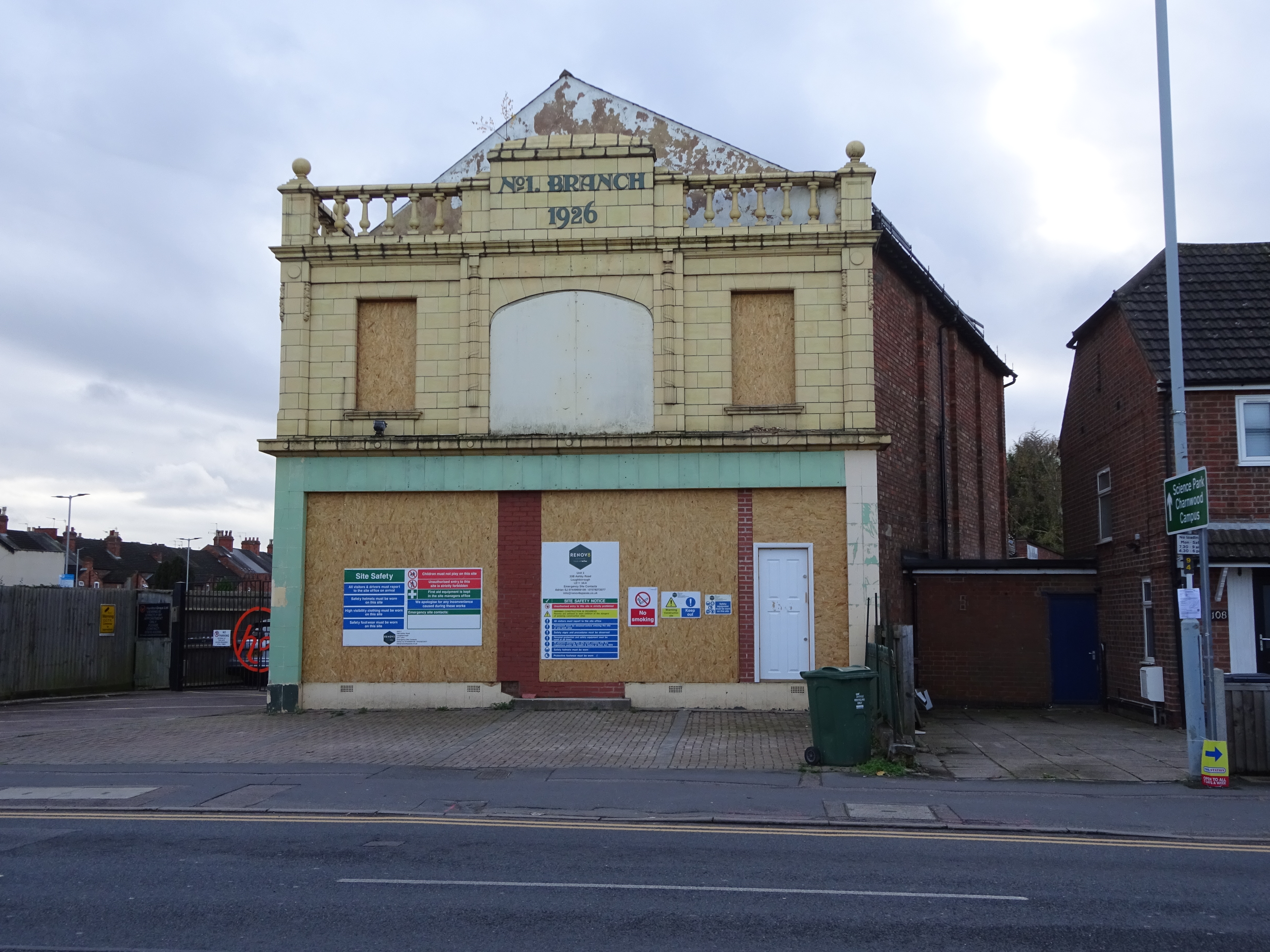
No.1 Co-op

Back in June 2021 (gosh, I thought I'd written that post only a couple of months ago, but it turns out to be nearly 18 months since it was done!) I wrote about the former No.1 Co-op store down on Derby Road, close to the new supermarket, the chip shop, and Belton Road. Before the Co-op was built, the land was close to the Charnwood Forest Railway, and adjacent to the Wood Brook. 

Pictured in 2020

Detail from 2020

I think it was sometime the year before, so, in 2020, that the former Co-op, which was then an Oriental restaurant, had been sold, and was being converted to flats: the June 2021 post was a record of progress with that conversion, but also a brief history of the Co-op stores, the movement having definitely been active in Loughborough from around 1866. The Derby Road Co-op, despite being called 'No.1' was not the first Co-op in Loughborough, that honour going to the store on Wood Gate, coincidentally, now an Oriental restaurant.

Detail of the Wood Gate store

At the time, it was a puzzle as to why the Derby Road Co-op was called the No.1 Co-op, having been built in 1926. 

Several theories had emerged:

*Was it the first Co-op in Knightthorpe? It could not have been the first Co-op store in Loughborough, as the store on Wood Gate opened in the 1860s

*Had the Loughborough Co-operative Society merged with another local society, and this was the first building to be built and occupied by the merged Society?

*Was it a road number? Perhaps intended to be the start of Alan Moss Road?

*Was it the first of Loughborough's buildings to be clad in Hathernware faience tiles?

*Was it the first to be built along the Charnwood Forest railway line, with others planned along the route?

*Was it the first self-service Co-op in the area?

A recent chance conversation on Facebook, about the No.1 Co-op in Farnborough, has led me to what I believe might be the answer. I might not quite have got the dates right, but I think it does all have to do with parish boundaries.


At one time Loughborough was surrounded by a number of different parishes, including Woodthorpe to the south, Knightthorpe, and Thorpe Acre cum, or with,  Dishley, the latter two being northwest of Loughborough. 

In 1871, Knight Thorpe is described in Wilson's 'Imperial Gazetteer of England and Wales', as "a township in Loughborough parish, Leicester; near Loughborough. Real property, £1,533. Population, 58. Houses, 12."

The same source describes Dishley-Cum-Thorpe Acre, as "a parish in the Loughborough district, Leicester; adjacent to the river Soar and the Midland railway, 1.5 miles NW of Loughborough. Post town, Loughborough. Acres, 890. Real property, £1,742. Population, 194. Houses, 54. Bakewell, the distinguished agricultural improver, lived and laboured here; and has bequeathed to the place marked benefits of his skill. The living is in the diocese of Peterborough. Value, £150. Patron, the Bishop of Peterborough. The church was built in 1845 [designed by William Railton]. A school has £11 from endowment, and other charities £11."

By 1925 this had all changed, as shown by the following extract from Kelly's 1925 directory. This explains that by an Order of the County Council, confirmed by Local Government Board Order, which came into operation on 25th March 1892, parts of the parishes of Knight Thorpe, and Dishley with Thorpe Acre were constituted the new parish of Knight Thorpe, and parts of the parishes of Garendon and Dishley with Thorpe Acre constituted the present parish of Dishley with Thorpe Acre, and parts of the parishes of Garendon, Knight Thorpe and Dishley with Thorpe Acre formed into the new parish of Garendon.

So, looking at a map of the municpal boundary, i.e. post-1888 when the borough became incorporated, it appears that the Knightthorpe boundary runs alongside the Wood Brook, down to part of what is now the university campus, and up past the site of the No.1 Co-op (X marks the spot), along what is now Belton Road.


As the No.1 Co-op built in 1926 on Derby Road, is on the Derby side of the Wood Brook, it might therefore follow that the store, being outside the boundary of Loughborough, was the first one to be built in Knightthorpe parish. But I could be wrong!

Anyway, over the years there have been, and indeed still are, various Co-op stores across town including, on Loughborough High Street and Swan Street, on Lansdowne Drive, on the site of the Maltings pub off Epinal Way, on Nottingham Road, on Derwent Drive and on Ashby Road.

And so the renovation continues ...

Photographed November 2022

____________________________________

posted by lynneaboutloughborough

With apologies for typos which are all mine!

_______________________________________________

Thank you for reading this blog. You are welcome to quote passages from any of my posts, with appropriate credit. The correct citation for this looks as follows:

Dyer, Lynne (2022). No.1 Co-op. Available from: https://lynneaboutloughborough.blogspot.com/2022/12/no1-co-op.html [Accessed 4 December 2022]

Take down policy:
I post no pictures that are not my own, unless I have express permission so to do. All text is my own, and not copied from any other information sources, printed or electronic, unless identified and credited as such. If you find I have posted something in contravention of these statements, or if there are photographs of you which you would prefer not to be here, please contact me at the address listed on the About Me page, and I will remove these.

Blog archive and tags:
If you are viewing this blog in mobile format, you will not be able to easily access the blog archive, or the clickable links to various topics. These can be accessed if you scroll to the bottom of the page, and click 'View Web Version'. Alternatively, there is also a complete list of posts, which when clicked will take you to the page you are interested in.  
 
Thank you for reading this blog. 

Lynne

Sunday, 17 January 2021

Loughborough cemetery Part 2

More memorials to World War Two PoWs


It appears there were over 1,000 Prisoner of War camps in Britain, and quite a few of these were in Leicestershire. Many are listed in this article and associated databank (2020) which includes the following:


o    Barkby Camp, Barkby Lane, Leicester, No.616 (previously a heavy anti-aircraft battery)

o   Farndon Road Camp, (Harrington Camp), Farndon Fields Farm, Market Harborough, No.49, (German working camp, standard type/caravan site)

o   Garendon Park, Loughborough, No.28

o   Gaulby Road, Billesdon, No.94 (German working camp, standard type)

o   Hathern Camp, Pear Tree Lane, Hathern, No. 590 (farmland)

o   Knightthorpe Camp, Loughborough, No.28 (German working camp)

o   Old Dalby Camp, Old Dalby Lane, Melton Mowbray, No.613 (large RAF depot with huts converted to accommodation)

o   Old Liberal Club, Charnwood Road, Shepshed, N0.152 (German working camp)

o   Quorn Camp, Wood Lane, Quorn, No.9/183 (Base camp, standard type)

o   Scraptoft, Thurnby, Leicester, No.4 (Base camp)

o   Shady Lane, Stoughton, Leicester, No.167 (Base camp)

There is, however, some debate as to whether or not Knightthorpe and Garendon were actually the same place: Garendon Hall was originally used as the headquarters for local munitions, but both seem to be known as Camp 28, with the main camp being towards the south of the estate lands. 

Last week we looked at some of the PoW camps close to Loughborough, and one in Stoughton which had a Loughborough connection. Let’s stay with the Leicester area, and a camp in Billesdon for a moment as there are more Loughborough connections, before moving closer to Loughborough.

A report in the Leicester Evening Mail of 6 October 1947 carried a report of the death of Peter Leugner. He was born on 17 September 1902 in the Ukraine, and died on 4 October 1947. Leugner was found hanging in a room at the Scraptoft PoW camp. The article says:

“It is understood that he was due for repatriation.”

Leugner has a memorial stone in Loughborough cemetery.


Earlier in 1947, an inquest took place in Market Harborough on the death of Corporal Konrad Schubert. Schubert was born on 30 July 1906 in Paszowice, Poland, and died on 19 January 1947 in the camp at Billesdon. According to a report in the Leicester Evening Mail of 23 April 1947, Schubert was depressed following the death of his mother and sister, and worried about his two children who were living in the Russian part of Germany. His own ill-health had meant that he had been unable to work on the farm, and this made him more unhappy, although his fellow PoWs had not ever heard him talk about taking his own life.  

Mr Tempest Bouskell, the coroner for South Leicestershire, pronounced that Schubert had committed suicide whilst the balance of his mind had been temporarily disturbed, and passed on his sympathy to Corporal Schubert’s fellow prisoners.

Schubert has a memorial stone in Loughborough cemetery.


We shall now leave these distant Leicestershire camps, and return closer to home, where we find a camp at Quorn which was used as such until about 1948. In the Nottingham Evening Post 12 August 1947, the following report appeared:

“A German prisoner-of-war, Baumann Hubert, died suddenly at the Quorn Camp yesterday. The body was removed to the Loughborough mortuary and the facts reported to the Coroner for North Leicestershire.”

Listed as Hubert Baumann on his memorial stone, Corporal Baumann was born 27 October 1924, died 11 August 1947, and has a memorial stone in Loughborough cemetery.


A report of a sad event appeared in the Daily Mirror of 18 September 1945:

COMEDIAN HANGED HIMSELF BECAUSE HE WAS LAUGHED AT.

A German giving evidence at a Loughborough, Leicestershire, inquest yesterday on a fellow prisoner of war who hanged himself at a camp said that the dead man had complained that other men in his working party made too much fun of his acting on the camp stage. He was a comedian.

Other prisoners said that the dead man, Sargeant Herbert Bruhn, 29, of Hamburg, had been unhappy for the last two weeks – they didn’t know why.

A police witness said he found no suggestion of either foul play or bullying. Recording a verdict that Bruhn hanged himself while his mind was disturbed, the coroner said it was difficult to understand the mind of a German, particularly a prisoner.”

Sergeant Herbert Bruhn, was born 28 January 1916 in Hamburg, died 16 September 1945, and has a memorial stone in Loughborough cemetery, but I have no idea which camp he was held in, nor in which camp he died.

The following report appeared in the Sunday Post 1 April 1945:

Allies sentence German boy to death. Karl Punzeler, of Monschau, 16-year-old boy, former leader of the local Hitler Youth, has been found guilty of espionage. Sentenced to death. This is an extract from ‘Die Mitteilungen’, the Allied newspaper, which is being distributed free in occupied Germany. It’s one of a list of sentences passed by Allied Military Government on civilians, and reported in the paper.”

The report continues with a list of misdemeanours, perpetrators, and punishments, in which we find the following:

“Franz Franke and Helmut Engel – for refusing to work as directed with a labour gang – 60 days.”

I believe Private Helmut Engel was born 30 April 1926 in Berlin-Neukolln, and died in Ankle Hill camp at Old Dalby, in Melton Mowbray, on 22 August 1947. The camp, which as well as housing over 3,000 soldiers, housed around 300 PoWs, during WW2. Quite why Helmut Engel has a memorial headstone in Loughborough cemetery, I’m not sure.  


I have been unable to trace much information pertaining to Dr Karl Theodor Reuter, other than that which appears on his memorial headstone in Loughborough cemetery. 

Dr Karl Theodor Reuter, was born 24 March 1914 in Herdecke, Ennepe-Ruhr-Kreis, Nordrhein-Westfalen, Germany, and died 11 December 1946 in Leicestershire, in the Thurnby Camp at Scraptoft.


Corporal Leonhard Rademacher was born on 24 May 1910 in Monchengladbach, died on 17 September 1946 in Garendon Park/Knightthorpe Camp, No.28, in Loughborough. He has a memorial headstone in Loughborough cemetery.


It will be noted from the death dates found on the memorial headstones that the majority of these eight people died in Britain after the end of the Second World War. There are likely to many and varied reasons why they still found themselves in Britain, rather than returned to their homeland: according to this article, published on the occasion of VE Day in May 2020, some stayed and integrated themselves into the British way of life because they had made good friends, or had fallen in love. Other reasons may have been that conditions in Germany were very difficult, and there was a delay in repatriation, but also perhaps because the British government resisted sending them home as the country was short of workers. Indeed, the final German PoW returned home as late as 1948.

The bridge at Shepshed watermill built by PoWs from Garendon Hall


The bridge at Shepshed watermill from a distance


Pear Tree Lane, approach from Derby Road


Site of the Pear Tree Lane PoW camp

Site of the Pear Tree Lane PoW camp

Site of the Pear Tree Lane camp


Posted by lynneaboutloughborough 17 January 2021

You are welcome to quote passages from any of my posts, with appropriate credit. The correct citation for this looks as follow:

Dyer, Lynne (2021). Loughborough cemetery part 2. Available fromhttps://lynneaboutloughborough.blogspot.com/2021/01/loughborough-cemetery-part-2.html [Accessed 17 January 2021]

Take down policy:
I post no pictures that are not my own, unless I have express permission so to do. All text is my own, and not copied from any other information sources, printed or electronic, unless identified and credited as such. If you find I have posted something in contravention of these statements, or if there are photographs of you which you would prefer not to be here, please contact me at the address listed on the About Me page, and I will remove these.

You can leave comments below, but do check back as my reply will appear here, below your comment.

Thank you for reading this blog. 

Lynne