Showing posts with label Nanpantan. Show all posts

Sunday, 17 May 2026

Now is the month of May

April was a busy month for the blog as I signed up to write 26 blog posts for the A-Z challenge. Here’s a link to the whole lot of them!

May is also shaping up to be a busy month, with so many anniversaries to celebrate, connections to share, and national days/weeks/months to contribute to, not to mention books to write! Where to start? Ok, let’s share a quick connection, first!

Yesterday, I was lucky enough to be singing in Coventry Cathedral (Mahler’s 8th Symphony, known as the Symphony of a Thousand), and during the rehearsal breaks I managed to get a photo of the wonderful Crittall window that forms part of the entrance to the cathedral. Coventry Cathedral is a Grade 1 listed building, and was designed by the architect Sir Basil Spence, who won the design competition in 1950. The foundation stone for the cathedral was laid in 1956, and the building completed and consecrated in 1962. Sir Basil Spence worked in collaboration with Arup Associates, an architectural firm who were later involved in the development of the engineering buildings on the campus of Loughborough University. Of course, there are many Crittall windows still to found in Loughborough town centre.  

There are a number of anniversaries in May, some of which have already passed, but I have blogged about in connection with Loughborough in previous years, like The Great Exhibition; the Festival of Britain; and VE-Day (have a look at how one street commemorated VE-Day during the lockdown of 2020).

Some of the national awareness months are worth mentioning, particularly Local and Community History Month, after all, what is this blog if now local history?! If you use the web view (scroll down to the bottom of the posts, if you’re reading this in mobile view, and click on ‘View Web Version’), you’ll be able to search this blog, look back at the archives, or click on a term that interests you.

National Walking Month is another awareness initiative of note, and there are a number of walks on this blog – like the Zeppelin Trail, the Three Towers Trail, the Sculpture, Art, and Architecture Trail, the Loughborough Plaque Trail – as well as countryside walks close to our lovely town, like the Nanpantan Reservoir, and The Outwoods.      

During Mental Health Awareness Week you might investigate ways to protect your own mental health, or you might want to read about people’s experiences from the past. This is a particularly harrowing case from the early twentieth century in Loughborough.

Learning at Work Week might be interesting for those who work, but if you don’t there’s always International Museum Day (18th - why not visit one of the ones in Loughborough?), or International Tea Day (21st – why not visit one of Loughborough’s independent teashops – ooops, I think we’ve lost many of these now!).

And then there’s other anniversaries – like 25 years since the formation of the Milestone Society. There are a few posts on this blog which feature milestones, one about the Pack Horse milestone , and one a comparison of our milestones with others I’ve spotted across the country.

Hmm, I think that’s enough rambling around Loughborough for one post!!!

My poor photo of the Crittall frame Great Screen, designed and etched by John Hutton

____________________________________

Posted by lynneaboutloughborough

With apologies for typos which are all mine!

_______________________________________________

Thank you for reading this blog.

Copyright:

The copyright © of all content on this blog rests with me, however, you are welcome to quote passages from any of my posts, with appropriate credit. The correct citation for this looks as follows:

Dyer, Lynne (2026). Now is the month of May. Available from: https://lynneaboutloughborough.blogspot.com/2026/05/now-is-month-of-may.html [Accessed 17 May 2026]

Take down policy:

I post no pictures that are not my own, unless I have express permission so to do. All text is my own, and not copied from any other information sources, printed or electronic, unless identified and credited as such. If you find I have posted something in contravention of these statements, or if there are photographs of you which you would prefer not to be here, please contact me at the address listed on the About Me page, and I will remove these.

External Links:

By including links to external sources I am not endorsing the websites, the authors, nor the information contained therein, and will not check back to update out-of-date links. Using these links to access external information is entirely the responsibility of the reader of the blog.

Blog archive and tags:

If you are viewing this blog in mobile format, you will not be able to easily access the blog archive, or the clickable links to various topics. These can be accessed if you scroll to the bottom of the page, and click 'View Web Version'. Alternatively, there is also a complete list of posts, which when clicked will take you to the page you are interested in.

Searching the blog:

You can search the blog using the dedicated search box that appears near the top of the blog when viewed in the web version. Alternatively, you can search using your usual search engine (e.g. Bing, Google, DuckDuckGo etc.) by following this example:

site: https://lynneaboutloughborough.blogspot.com/ “Radmoor House”

NOTE – the words you’re actually looking for must be in “” and the first of these must be preceded by a space

Thank you for reading this blog.

Lynne

Sunday, 30 March 2025

Exhibition about Nanpantan

A couple of weeks ago I mentioned that several of the projects I had been involved with recently were coming to their conclusion. In that post, I talked about the Focus on the Foundry photography programme, and since then the Bellfoundry Trust has included a brief review of the project on their website. 

Another local project, although my part in it is completed, isn’t yet live on the internet, so I’ll share that when it’s publicly available. Another project was a small exhibition, which ended up being hosted somewhere other than originally planned, and even smaller than intended: when I’ve seen it, I’ll share it with you!! Yet another project did result in an exhibition, so here’s a very short piece about it!!


On Monday evening, 24th March, an exhibition was held at Nanpantan Hall, which showcased the research about Nanpantan done by a group of volunteers working under the guidance of an experienced Victoria County History researcher, Dr Pamela Fisher, who has previously written a couple of guest posts for this blog [1]. Finded by the Charnwood Forest Geopark, meetings were held towards the end of 2024, and into early 2025, at Home Farm, where the volunteers learned skills and techniques for researching local history.

The volunteers put these skills to good use either at home or in the public library, and researched things like the pubs in Nanpantan, the school, the reservoir, the local farms, the local scout and guide groups, and so on, together gradually building up a picture of the area over time.

Although I had previously done some research on Nanpantan, some of which I wrote up in my ‘A-Z of Loughborough’, some in ‘Loughborough Pubs’, and some on this blog [2], for this project I researched some areas I wasn’t previously familiar with, and I have to admit it was rather good to be part of a team and to work with other people who were also researching.

As I said, the results of the research – well, a small amount of it! (there’s always far more information found than can be accommodated in a book, a journal article, a blog post, or even an A3 poster!) – was exhibited at Nanpantan Hall.


____________________________________

Notes

[1]

Mary Tate of Burleigh Hall 

Loughborough’s Second Workhouse  

[2]

Visit to Nanpantan Hall 

N is for Nanpantan 

Nanpantan and Temperance 

Nanpantan church stone 

____________________________________

Posted by lynneaboutloughborough

With apologies for typos which are all mine!

_______________________________________________

Thank you for reading this blog.

Copyright:

The copyright © of all content on this blog rests with me, however, you are welcome to quote passages from any of my posts, with appropriate credit. The correct citation for this looks as follows:

Dyer, Lynne (2025). Exhibition about Nanpantan. Available from: https://lynneaboutloughborough.blogspot.com/2025/03/exhibition-about-nanpantan.html [Accessed 30 March 2025]

Take down policy:

I post no pictures that are not my own, unless I have express permission so to do. All text is my own, and not copied from any other information sources, printed or electronic, unless identified and credited as such. If you find I have posted something in contravention of these statements, or if there are photographs of you which you would prefer not to be here, please contact me at the address listed on the About Me page, and I will remove these.

External Links:

By including links to external sources I am not endorsing the websites, the authors, nor the information contained therein, and will not check back to update out-of-date links. Using these links to access external information is entirely the responsibility of the reader of the blog.

Blog archive and tags:

If you are viewing this blog in mobile format, you will not be able to easily access the blog archive, or the clickable links to various topics. These can be accessed if you scroll to the bottom of the page, and click 'View Web Version'. Alternatively, there is also a complete list of posts, which when clicked will take you to the page you are interested in.

Searching the blog:

You can search the blog using the dedicated search box that appears near the top of the blog when viewed in the web version. Alternatively, you can search using your usual search engine (e.g. Bing, Google, DuckDuckGo etc.) by following this example:

site: https://lynneaboutloughborough.blogspot.com/ “Radmoor House”

NOTE – the words you’re actually looking for must be in “” and the first of these must be preceded by a space

Thank you for reading this blog.

Lynne

Tuesday, 16 April 2024

N is for Nanpantan

Heading out of Loughborough along Forest Road, in the direction of Charnwood Forest, you will see the road name changes to Nanpantan Road, and you will pass through Nanpantan itself. Like Loughborough, it’s an unusual name, and also like Loughborough, the origins of the name are subject to some interesting suggestions – and spellings!

Possibilities for the derivation of the name are that it might have been named after a woman called Nan Pantain, or after the Anglo-Saxon word for an enclosure – a plantain. There is certainly an area of Charnwood Forest called Nan Pantain’s, which appears on the 1754 map of the area. It also seems that the spelling of the name was only relatively recently formalised – well in the 1920s, which is not that long ago really – to Nanpantan, rather than Nanpanton!

So, what’s there to know about the area? Be warned, I’m keeping it brief!

On the lefthand side as you go out of Loughborough, you will pass the Nanpantan Scout hut, and if you happen to be passing in December, you’ll see the bright display of Christmas lights in the front garden of the house next door! Someone once told me that the house the other side of the Scout hut was once an isolation hospital, but I haven’t as yet verified that. I do know that a little further up on the same side, there used to be a Temperance Hotel, which was often a venue for annual church, workers, or schools outings. 

Then, still on the lefthand side, there are some cottages which were part of the Nanpantan Hall estate, and then what is now a care home, but was once known as Jackie Bennett’s Longcliffe Hotel. Now that you’ve reached the crossroads, you’ll see a lovely pub called The Priory, opened in 1936. You can’t miss it, as it looks like a fairytale French chateau, its towers not unlike that on a house you’ve just passed on the right, called Foxhills!!

If you were to turn left at this point you'd soon come to the Nanpantan Reservoir, Home Farm on the right, and eventually the Outwoods on the left, but instead, continue past the crossroads, up the hill, you’ll pass the little church of St Mary, which was once a mission hall, but is now a church for the parish. Although it is a tiny building, there is a war memorial outside, graves and memorials, and a nature trail. 

A little further on the left are the lodge houses at the entrance driveway to Nanpantan Hall, built for the Warner family of hosiers in 1870, although they never lived there, preferring to lease it out, before selling it on to the Paget family, in whose ownership it remained until the death of the last of the direct family line in the late 1980s. It’s now a venue for courses, for weddings, and the occasional public event.


____________________________________

This post is one in a series of posts for the ‘April A-Z Blogging Challenge


___________________________________

Posted by lynneaboutloughborough

With apologies for typos which are all mine!

_______________________________________________

Thank you for reading this blog.

Copyright:

The copyright © of all content on this blog rests with me, however, you are welcome to quote passages from any of my posts, with appropriate credit. The correct citation for this looks as follows:

Dyer, Lynne (2024). N is for Nanpantan. Available from: https://lynneaboutloughborough.blogspot.com/2024/04/n-is-for-nanpantan.html [Accessed 16 April 2024]

Take down policy:

I post no pictures that are not my own, unless I have express permission so to do. All text is my own, and not copied from any other information sources, printed or electronic, unless identified and credited as such. If you find I have posted something in contravention of these statements, or if there are photographs of you which you would prefer not to be here, please contact me at the address listed on the About Me page, and I will remove these.

External Links:

By including links to external sources I am not endorsing the websites, the authors, nor the information contained therein, and will not check back to update out-of-date links. Using these links to access external information is entirely the responsibility of the reader of the blog.

Blog archive and tags:

If you are viewing this blog in mobile format, you will not be able to easily access the blog archive, or the clickable links to various topics. These can be accessed if you scroll to the bottom of the page, and click 'View Web Version'. Alternatively, there is also a complete list of posts, which when clicked will take you to the page you are interested in.

Searching the blog:

You can search the blog using the dedicated search box that appears near the top of the blog when viewed in the web version. Alternatively, you can search using your usual search engine (e.g. Bing, Google, DuckDuckGo etc.) by following this example:

site: https://lynneaboutloughborough.blogspot.com/ “Radmoor House”

NOTE – the words you’re actually looking for must be in “” and the first of these must be preceded by a space

Thank you for reading this blog.

Lynne

Thursday, 10 August 2023

Henry Wills, Loughborough’s Most Renowned Publisher

I have known Kathy for quite a while, probably since I was invited by the Loughborough Library Local Studies Volunteers Group to become an Honorary Member, in 2016, since which time we have worked together in the library, and at local history events, and attended many of the same meetings. So, I was very pleased she agreed to write this fantastic guest blog post for me. Kathy Phillips takes us on a journey from the local building we heard about in the last guest post, to books, telling the story of the man behind a local publishing phenomenon! For the full story, read on!   

Perhaps Loughborough’s Most Renowned Publisher. 

But Who Was Henry Wills?

by Kathy Phillips

I can readily predict that there will be very few residents of Loughborough over a certain age, who will not be aware of the town’s connection to Ladybird Books. Over many years a significant number of Loughborough locals, including family members and acquaintances, have been linked to Ladybird Books in some way or another. The famous Ladybird brand name has its roots in a publishing partnership between Henry Wills and William Simpson Hepworth. Henry’s successful 19th-century bookselling, stationery and publishing business was built up over 30 years. The publisher name of “Wills & Hepworth” then continued for literally decades after Henry Wills retired in 1905, selling his interest in the company to William Hepworth and the two becoming partners by 1906. It was not until 1971 that “Wills & Hepworth Ltd.” officially changed its name to “Ladybird Books Ltd.”

Title page of an annual almanac
An almanac for the year 1901

Henry’s Forefathers

So, what was Henry Wills’ family background? Henry’s Grandfather, Daniel Wills, was a Leicestershire man born in Hinckley in 1783. He was a “setter-up of frames”. In the hosiery industry, after the blacksmith had made the ironwork of a framework knitting machine, Daniel would have been tasked with adjusting the various parts in preparation for use by the machine operator. In 1851 Daniel Wills died in Hinckley, aged about 68. He appeared to have lived in the place of his birth all his life – not so his son George Wills (Henry’s father), nor Henry himself.

Baptismal entry for George Wells
The baptism entry for George Wills, from the Independent Chapel, Chapel Street, Hinckley

George Wills was born in 1808 in Hinckley, to Daniel Wills and his first wife Susannah Johnson who was born c1785. Sadly Susannah died when George was a youngster and George was brought up by Daniel and his second wife Mary Wills (née Atkins) with his six step-brothers and sisters. By 1835, 27-year-old George Wills was established in his career as a schoolmaster. That year he married Henry’s mother Elizabeth Winifred Hill who was age 20. They were married in Southwell, a picturesque town in Nottinghamshire where Elizabeth was born in about 1815. She was a farmer’s daughter. Six years later by 1841, having chosen to live in Leicestershire, George (33), was running a school in Auburn Place in Narborough, accompanied by his wife Elizabeth (26) and their three children. George and Elizabeth continued to run their school, Auburn House, for almost three decades until, certainly by 1871, George had retired.

Auburn House School, Narborough

According to a Narborough 1849 Post Office Directory, Auburn House was described as a “boarding academy”. The school had a capacity of around 40 pupils at any one time, educating boys between the ages of 10 and 16. Over the years George was supported by up to three resident tutors while four live-in servants assisted Elizabeth on the domestic scene with their rapidly expanding family. The Wills moved out, leaving the school as a going concern – by 1873, the Principal of the Auburn House School was a Mr. Howard with a resident French Master Monsieur Lionnais. The school fees for that year were 30 guineas a term.

Henry’s Brothers and Sisters

Henry was one of 11 children, eight surviving, born to George and Elizabeth Wills, all raised in Auburn House School in Narborough. In 1841 George and Elizabeth’s three children were Edward Cooper Wills (born 1836), James Wills (born 1839) and Charlotte Wills (born 1841). Their son George Wills, born in 1838 between Edward and James, had died at the age of 21 months. More tragedy followed when in December 1842, James Wills died at just 3 years 8 months old. By 1851 the Wills family had expanded. Edward and Charlotte were joined by Elizabeth Wills (born 1843), Charles Wills (born 1844), Winifred Wills (1846), Alban William Wills (1848) and one year old Henry Wills (born early in 1850). Between 1853 and 1855, George and Elizabeth had another son Matthew Alfred Wills but sadly, Matthew died in 1856 and is buried in the churchyard of the Parish Church of All Saints, Narborough. In 1855 prior to Matthew’s death, George and Elizabeth had another daughter, Edith Mary Wills, whose birth completed their family. 

Following George’s retirement, by 1871 only their youngest daughter Edith Mary Wills (15) was still living at home. The family had moved to The Grange in Narborough and still enjoyed domestic help from a live-in servant. By 1876 George (68) and Elizabeth (61) were living in Croft House in Narborough. It was in 1879 that Henry’s father George Wills, a “Gentleman”, died at the age of 71 in Narborough. His Executors were John Spencer, a bookseller at 20 Market Place, Leicester, William Peck, a Nottinghamshire Grazier from Bothamsall, and William Poultney, a Leicester Sergeant of Police, living at 24 Walnut Street. George Wills left effects to the value of “under £9,000”. In the year following his father’s death, Henry’s mother Elizabeth Winifred Wills died at the age of 65 in Narborough. Both Henry’s parents are buried in the churchyard of the Parish Church of All Saints in Narborough.

Extract from a probate record
Probate record for George Wills, 1879

Henry Wills’ Printer Predecessor

John Henry Gray (1833–1873) was the son of Benjamin Gray, a well-to-do clockmaker with premises in the Market Place in Loughborough. As a young man, due to ill health, John Henry abandoned a career as a draper in London and returned home to Loughborough. He found work with a printer and bookseller in Swan Street and, following the proprietor’s retirement, Gray acquired the business. By 1857, Gray (24) had installed his printing machinery at the far end of Angel Yard off the Market Place in Loughborough and was working there as a general commercial letterpress printer. In that same year, he initiated the publication of the Loughborough Monitor, a weekly newspaper containing London and national news, parliamentary, police and market reports, and a limited amount of local news such as was available. In 1862, under the continuous strain of publishing a weekly newspaper, Gray continued to suffer with ill health and sold the Loughborough Monitor to his assistant William Rollings Lee for the sum of £45.

Henry Wills’ Career: The 1870s

In 1871 news of Henry Wills’ activities at the age of 21, reveals that he was a clerk lodging in Parkside, Knightsbridge, Westminster in London. It was two years later in 1873 that Henry Wills, acquired The Angel Press, Angel Yard, a bookselling and stationery business, following the death of its proprietor, John Henry Gray. In July 1875 Henry Wills (26), by then well-established as a stationer and bookseller in Loughborough, married Katherine Ellen Jones (born c1852, Bath), in the church of St. Andrew, Walcot, Bath. They lived at 5 Market Place, Loughborough where, in 1877 their daughter Winifred Frances Wills was born, closely followed in 1878 by the birth of their son Edward Wills. In Harry Wills’s Loughborough Almanac, Diary and Street Directory for 1878, Henry describes himself as proprietor of “The Library”. He is a printer, bookseller and fancy stationer. His address is listed as 5 Market Place. No other address in Loughborough for an “H. Wills” is to be found in the street directory – the family were living “above the shop”.

The 1880s and into the 1890s

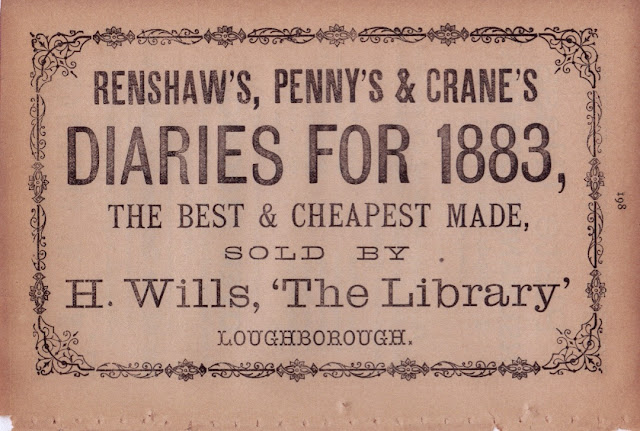
Late in 1880 Henry and Katherine’s daughter Dorothy Wills was born. By 1881 Henry (31) employed seven men, 12 boys and two girls in his bookselling and printing business. The family were by now living at numbers 4 and 5 Market Place. Henry’s wife Katherine was 29 and, assisted by two live-in domestic servants, had her hands full with daughter Winifred age 4, son Edward age 3 and baby Dorothy at just four months old. By 1882 the family had moved to 6 Park Street, Loughborough. The deeds to the property indicate that Henry Wills never owned the house so they must have rented. That same year a Mrs. Gray lived at 1 Park Street. This was the address of John Henry Gray’s residence at the time of his death age 40 in 1873 and Sarah Gray was his widow. Both the Wills’ family and Sarah Gray continued to reside in Park Street, as listed in H. Wills’s Loughborough Almanac, Diary, Trade and Street Directory for 1883, printed and published by H. Wills of “The Library”. 
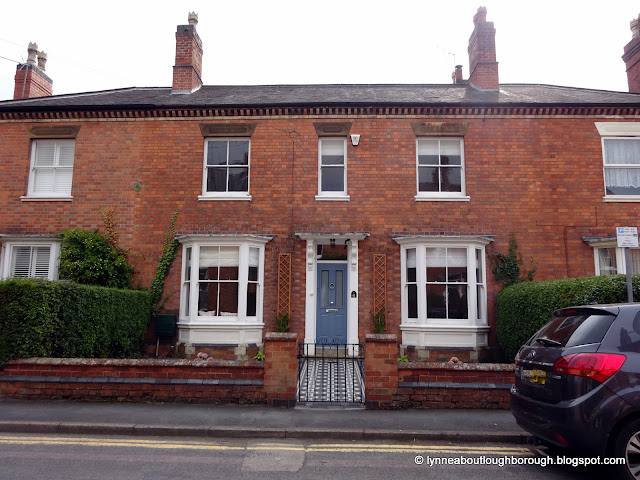
Red brick Victorian double-fronted house
No.6 Park Street in 2023

An advert for a diary sold by Henry Wills, 1883
An advert for goods sold by Henry Wills, 1883

By 1886 Henry and Katherine were still living at 6 Park Street when, in about 1888, their son Alban Noel Wills was born, completing their family. By 1890 the family was living in the area of Forest Road, designated as Nanpantan. In Wills’s Loughborough Almanac, Diary, Trade and Street Directory for 1890 Henry’s business is listed at 4 Market Place – he is a bookseller and fancy stationer and proprietor of “The Library”. The entry for Angel Yard is listed as lying between numbers 3 and 4 Market Place where Henry has a second listing as a gas power printer, lithographer, bookbinding, relief stamping, machine ruling and machine folding works. The 1891 Census reveals that Henry continued to employ two live-in domestic servants at their Forest Road home. The Enumerator describes this Census as covering “that part of the Parish not included in the Municipal Borough commencing at the Borough Boundary on Forest Road including Burleigh Hall, Mr. Wills’ House, The Firs, The Woodlands, The Widenings and the cottages on Forest Road”.

The 1900s

By 1901 Henry Wills (51), printer, bookseller and stationer and his wife Katherine (49), were still living in their house in Forest Road. Their children Winifred Frances (24), Dorothy (20) and Alban Noel (13) all lived at home but their son, Edward (23) had flown the nest. The 1901 Census also lists a visitor, Alfred Noel Hazlehurst age 26, an electrical engineer, born in Cheshire. Alfred was to become their son-in-law following his marriage to Dorothy Wills in 1906.

It was in the same year as the 1901 Census that their daughter Winifred Frances married Albert William Hanford, a hosiery manufacturer born in 1875 in Loughborough. As the decade progressed Winifred and Albert had three children: John William Andrew Hanford born in 1903, Katherine Winifred Elizabeth Hanford born in 1905 and Freda Mary Hanford born in 1906 – three grandchildren for Henry and Katherine Wills. Both John William Andrew and Freda Mary grew up to become school teachers – walking in the footsteps of their great-grandfather George Wills. In April 1907 Dorothy and Alfred Hazlehurst’s daughter Dorothy Beatrice Hazlehurst was born in Wimbledon Park, Surrey, providing Henry and Katherine with a fourth grandchild. Dorothy Beatrice grew up to become a nurse. Meanwhile, according to Kelly’s Directory for 1908, Henry Wills continued to be listed as resident in Forest Road, Nanpantan.

The 1910s

By 1911, six years after his retirement, Henry Wills (61) and his wife Katherine (59) were living with their son-in-law Alfred Noel Hazlehurst, manager of an electrical company manufacturing accumulators, their daughter, Mrs. Dorothy Hazlehurst and three-year-old granddaughter Dorothy Beatrice Hazlehurst. The household had three servants: a cook, a domestic servant and a nurse housemaid. They lived in Park View Terrace, Wimbledon Park Road in Wimbledon.

On 3rd June 1915 Henry and Katherine’s son Alban Noel Wills (27) of the 5th Battalion, The King’s Own (Yorkshire Light Infantry) was promoted to Second Lieutenant. Three years later, on 7th March 1918 Alban Noel Wills, by then Captain of the 1st/5th Battalion, The King’s Own Yorkshire Light Infantry, died of his wounds at Ypres at the age of about 30. Alban is buried in the Lijssenthoek Military Cemetery, Grave/Memorial Reference: XXVII. E. 21, Poperinge, West Vlaanderen, Belgium. At the time of this tragedy, Henry and Katherine although residing in Bath, were described as being “of Colwyn Bay”.

In 1919 Henry Wills died at the age of about 69 years while living in Colwyn Bay, Denbighshire. Henry left his effects to his widow Katherine Ellen Wills and to his son-in-law Albert William Hanford, the hosiery manufacturer [1]. On 21st December 1929 Katherine Ellen Wills, Henry’s widow, died at the age of about 77 years, while living in Colwyn Bay. Katherine left her effects to her nephew, Charles Richard Wills (47), a medical practitioner (son of Henry’s brother Charles) and to her son-in-law Albert William Hanford.

____________________________________

NOTES 

[1] Reporting on the property market on page 5 of its issue of 12th September 1919, the Loughborough Echo states that Messrs. Garton and Son had in the previous two weeks sold a number of what they describe as ‘business blocks’. One of these was done under the instruction of the executors of the estate of the late Mr Henry Wills, late of Loughborough. This particular ‘business block’ included No.4 Market Place and printing works in Angel Yard, which at the time were occupied by Messrs. Wills and Hepworth. Also included was Angel Yard itself, where Messrs. Lowater, Baines, and Lockwood had their business. Further, in the ‘business block’ there were also five cottages, Nos.50-54 on what was then known as Mill Street, but which is today called Market Street. Mr W.S. Hepworth was the purchaser of the whole ‘business block’.

____________________________________

Lynne writes:

I haven't really written much about Ladybird Books as there are plenty of people out there who know far more than me. There are, however, little bits of info on the following blogposts, and the Ladybird plaque appears in one of the virtual walks I've written:

The plaque walk

Loughborough firms

The Loogabarooga Festival

Ladybird Book illustrators

William Morris and Ladybird House  

____________________________________

About Kathy

Kathy Phillips is currently Chair of the Loughborough Library Local Studies Volunteers Group (LLLSVG), who are based in the library on Granby Street, Loughborough.

Following a BSc (Hons) in Physics, experience of working in industry, and a postgraduate Diploma in Library & Information Studies, Kathy qualified as an Associate of the Library Association [now the Chartered Institute of Library and Information Professionals] and gained experience in academic librarianship working at Loughborough University Pilkington Library. Kathy was the Information Scientist at the HUSAT (Human Sciences and Advanced Technology) Research Institute at Loughborough University for 19 years until 2002, and for two years at HUSAT’s successor, the Ergonomics and Safety Research Institute.

From 2004, Kathy worked part-time in the specialist library at WEDC (the Water and Engineering Research Centre), Loughborough University, and continued to volunteer at WEDC as an “Academic Visitor” until March 2018. Meanwhile, in 2010 Kathy began volunteering in Loughborough Library’s Local Studies section, becoming founder Chair of LLLSVG in January 2014. Since 2012 she has organised, or worked as a team member, on a significant number of displays at Loughborough Library. Kathy has considerable experience as a proof-reader, has edited a number of LLLSVG publications and has extensively researched the history of Ladybird Books Ltd., including the family histories of founders Henry Wills and William Hepworth, and Ladybird artist P.B. Hickling (Series 497 Animal Tales). With fellow enthusiast Ian Porter, Kathy is the LLLSVG co-expert on Ladybird Books.

____________________________________

Posted by lynneaboutloughborough

With apologies for typos which are all mine!

_______________________________________________

Thank you for reading this blog.

Copyright:

The copyright © of all content on this blog rests with me, or in the case of guest blogposts, with the named Guest Blogger. However, you are welcome to quote passages from any of my posts, with appropriate credit. The correct citation for this looks as follows:

Phillips, Kathy (2023). Henry Wills, Loughborough’s Most Renowned Publisher. Available from: https://lynneaboutloughborough.blogspot.com/2023/08/henry-wills-loughboroughs-most-renowned.html [Accessed 10 August 2023]

Take down policy:

I post no pictures that are not my own, unless I have express permission so to do. All text is my own, and not copied from any other information sources, printed or electronic, unless identified and credited as such. If you find I have posted something in contravention of these statements, or if there are photographs of you which you would prefer not to be here, please contact me at the address listed on the About Me page, and I will remove these.

Blog archive and tags:

If you are viewing this blog in mobile format, you will not be able to easily access the blog archive, or the clickable links to various topics. These can be accessed if you scroll to the bottom of the page, and click 'View Web Version'. Alternatively, there is also a complete list of posts, which when clicked will take you to the page you are interested in.

Searching the blog:

You can search the blog using the dedicated search box that appears near the top of the blog when viewed in the web version. Alternatively, you can search using your usual search engine (e.g. Bing, Google, DuckDuckGo etc.) by following this example:

site: https://lynneaboutloughborough.blogspot.com/ “Radmoor House”

NOTE – the words you’re actually looking for must be in “” and the first of these must be preceded by a space

Thank you for reading this blog.

Lynne

Sunday, 11 June 2023

Building Stone

Sadly, I missed a recent talk hosted by the Friends of Charnwood Museum, about stone, so, I had a look back over the blog to see what I’d already written. I must admit, I thought I’d done a piece on Coade stone, an artificial stone, but find I haven’t so I’ve only mentioned it in passing in some posts, like [quote blog posts]. So, let’s have a quick look at some real local stone, and where it’s been used.

Old Rectory, Rectory Place

The 13th-century building was once the home to the rectors of Loughborough, having been passed to the church around 1228 by the Cortlinstoke family. By the time it fell out of use, around 1959, it had been extended enormously, and would have been a substantial family home, however, once unoccupied the building fell into disrepair and was partially demolished, revealing its earlier core, which has been retained.

The building you now see is said to be made of Bromsgrove Sandstone; North Charnwood Diorite; Charnian (volcaniclastic breccia); Charnian (volcaniclastic sandstone); Swithland slate; and Charnian (banded tuff).


All Saints with Holy Trinity, Steeple Row

This church is a 14th century building, probably built on the site of an earlier church, and it is here that the rectors of Loughborough would have done most of their work. over the years the church has been subject to many alterations, most notably that by architect Sir George Gilbert Scott in the mid-19th century. 20th and 21st century renovations have included those to the pinnacles on the belltower, and various new stones in the fabric of the building. I've written more extensively on a very early blogpost.

Stone that has been used in the construction of the church includes Millstone Grit; Triassic Red Sandstone; North Charnwood Diorite; Upper Lincolnshire Limestone; Charnian (metasediments0; Swithland slate, and Mountsorrel Granodiorite.


Holy Trinity Church, Moor Lane 

This church is no longer a religious building, but was once a busy church serving the Leicester Road area of Loughborough, opened in 1878, to a design by William Arthur Blomfield. You can find out a bit more about its history on an earlier blogpost.

The range of natural stone used in the construction of the church is much less varied than the Old Rectory and Loughborough’s All Saints church, comprising only of Mountsorrel Granodiorite and Upper Lincolnshire Limestone.


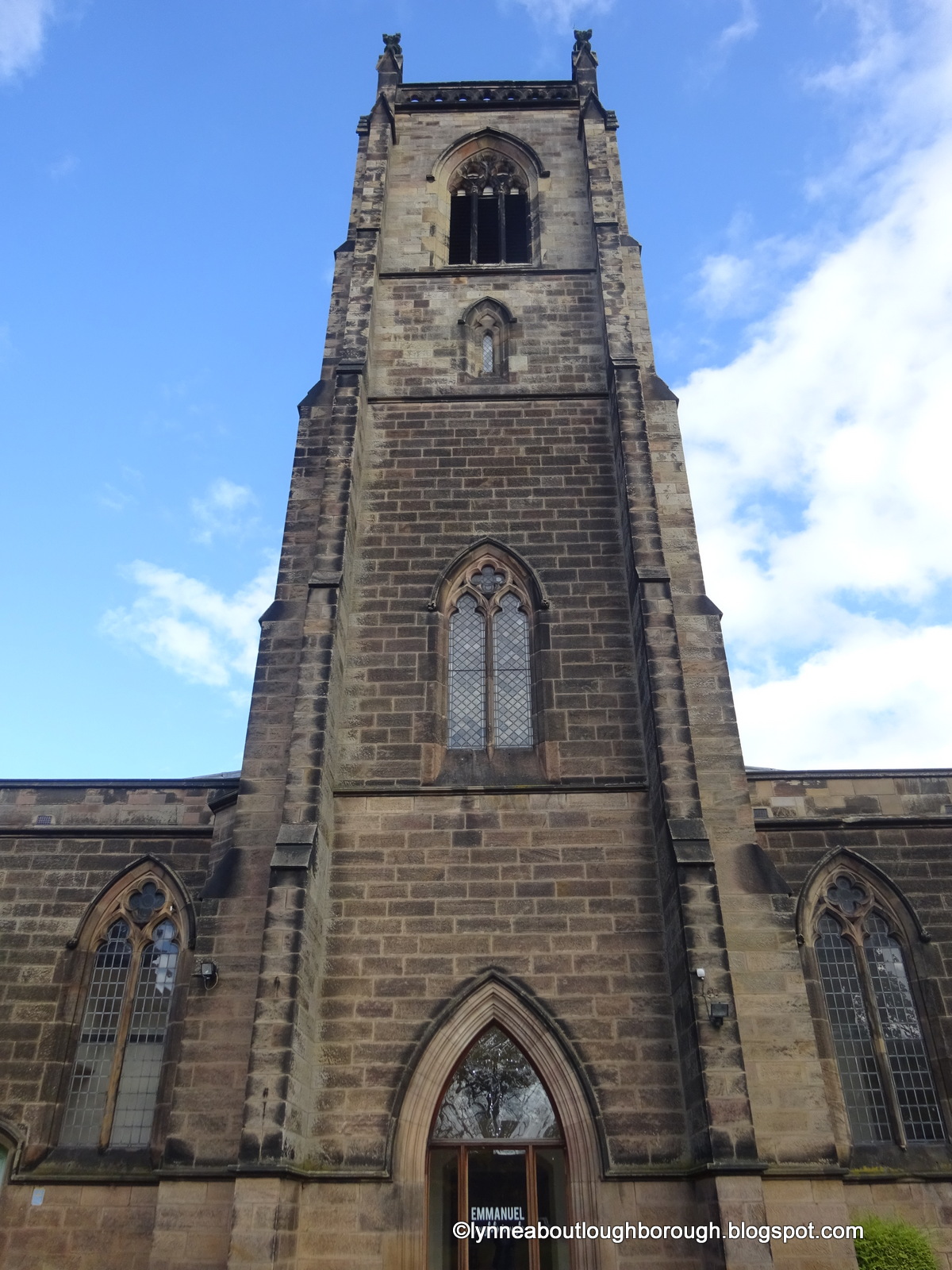
Emmanuel Church, Forest Road

The church was created around 1838, and its first rector was William Holme, who was also Rector of All Saints. The first Rector dedicated solely to Emmanuel was Reverend Bunch, who lived at the Emmanuel Rectory, on Forest Road, close to Mountfields House.  

I’ve not written much about Emmanuel church, but have done a couple of posts about the associated rectory. Part 1 and Part 2 

It appears that Emmanuel Church is constructed solely of Millstone Grit, but has a much later extension using other stone.


St Mary’s Nanpantan

St Mary’s church in Nanpantan started life as a Mission Hall, created by the Warner family of Nanpantan Hall, in 1888. Since 2015, St Mary’s has been a parish in its own right, so no longer connected to Emmanuel.

Using Charnian (volcaniclastic sandstone), St Mary’s is another church which is constructed only from one stone, that is until the 1960s when a granite Chapter House, with a flat-roofed vestry was built.


All Saints Thorpe Acre

This particular church is more usually known as Thorpe Acre church, and was built in 1845 to a design by William Railton, who was the architect responsible for the design of Nelson’s Column in London, and a number of other local Leicestershire churches. I've written extensively about Railton - here's one example post. The church, which replaced All Saints at Dishley (see below), is proud to have an east window, created in 1892 by Charles Eamer Kempe, and in the 1980s, the church was extended and joined to the school house.

All Saints, Thorpe Acre, was constructed using only Millstone Grit, until the extension was built.


All Saints Dishley

Dishley church is now a ruin, having been deconsecrated when All Saints Thorpe Acre was created in 1845. The ruins, which contain plaques to the agriculturalist, Robert Bakewell, are close to Dishley Grange Farm, which was part of the Garendon Estate.

The stone used in the construction of All Saints at Dishley includes Charnian (volcaniclastic sandstone); Diseworth Sandstone; Charnian (igneous); Triassic Red Sandstone; Cobbles (Bunter), and Bromsgrove Sandstone.  


_______________________________________________

posted by lynneaboutloughborough

With apologies for typos which are all mine!

_______________________________________________

Thank you for reading this blog.

Copyright:

The copyright © of all content on this blog rests with me, however, you are welcome to quote passages from any of my posts, with appropriate credit. The correct citation for this looks as follows:

Dyer, Lynne (2023). Building Stone. Available from: https://lynneaboutloughborough.blogspot.com/2023/06/building-stone.html [Accessed 11 June 2023]

Take down policy:

I post no pictures that are not my own, unless I have express permission so to do. All text is my own, and not copied from any other information sources, printed or electronic, unless identified and credited as such. If you find I have posted something in contravention of these statements, or if there are photographs of you which you would prefer not to be here, please contact me at the address listed on the About Me page, and I will remove these.

Blog archive and tags:

If you are viewing this blog in mobile format, you will not be able to easily access the blog archive, or the clickable links to various topics. These can be accessed if you scroll to the bottom of the page, and click 'View Web Version'. Alternatively, there is also a complete list of posts, which when clicked will take you to the page you are interested in.

Searching the blog:

You can search the blog using the dedicated search box that appears near the top of the blog when viewed in the web version. Alternatively, you can search using your usual search engine (e.g. Bing, Google, DuckDuckGo etc.) by following this example:

site: https://lynneaboutloughborough.blogspot.com/ “Radmoor House”

NOTE – the words you’re actually looking for must be in “” and the first of these must be preceded by a space

Thank you for reading this blog.

Lynne


Sunday, 31 October 2021

O is for Outwoods

O is for Outwoods – and another update for an entry in my book, ‘A-Z of Loughborough’!

I am thankful that I took the opportunity to go for a long walk in some of the areas surrounding Loughborough yesterday, on what was a beautifully sunny and clear afternoon, after a morning of heavy rain. Not only that, I’ve just read that the next phase of the project to return the Outwoods to its ancient woodland species is about to begin, and much of the Outwoods will be closed from 1st November until 24th November while many of the non-native trees, mostly conifers, are felled. I wrote about the first stage of this project in the book, so I’m keen to keep up with the progress of the work. There are some FAQs about the project on the council website, but essentially, the non-native trees are being felled to allow more oak trees to grow, and to encourage the growth of flora on the woodland floor.

On my walk, I took the path off Valley Road where it joins Belvoir Drive and headed up to the Outwoods. Along the way I passed the site of the new cemetery, which is beginning to take shape, and from the fields close by there were some lovely clear views of Loughborough.


Part of the new cemetery

Nanpantan Sports Ground


Reaching the Outwoods itself, I stumbled upon a memorial bench, and then took a very circuitous route, eventually ending up in the car park off Breakback Lane, where I saw all the work that’s been done on the ranger’s hut that is going to be a café.


Artwork in the wood


Then I followed the path that runs parallel to the road, before exiting onto the road, and then turning left into the bridleway that is Brook Lane. I walked all the way along Brook Lane, where there were some fabulous views back across Loughborough, and I noticed I could even see Stanford Hall from there.


Stanford Hall in the far distance


Looking back at the Outwoods from Brook Lane


Brook Lane came out at the junction in Woodhouse Eaves, where the Bull’s Head is on the corner, and after a quick cuppa in the local cafe, I walked to the village hall, but took the path just before the hall.  A new tree had been planted here, in honour of people who had died during the pandemic.


This particular path took me all the way to School Lane in Woodhouse, and I walked up past Pestilence Cottage, and stopped to look at the memorial at the church, and the new memorial bench in Woodhouse, which was close to the church.


Crows' nests


From here it was an easy walk through the village of Woodhouse, and at the end of the village I turned down the path to Beaumanor Hall, taking the right-hand path to come home via the path alongside Mucklin Wood, and then through the Grange Park Estate.


The Lodge to Beaumanor Hall, designed by William Railton,is currently for sale


Posted by lynneaboutloughborough 31 October 2021

You are welcome to quote passages from any of my posts, with appropriate credit. The correct citation for this looks as follow:

Dyer, Lynne (2021). O is for Outwoods. Available from:https://lynneaboutloughborough.blogspot.com/2021/10/o-is-for-outwoods.html  [Accessed 31 October 2021]

Take down policy:
I post no pictures that are not my own, unless I have express permission so to do. All text is my own, and not copied from any other information sources, printed or electronic, unless identified and credited as such. If you find I have posted something in contravention of these statements, or if there are photographs of you which you would prefer not to be here, please contact me at the address listed on the About Me page, and I will remove these.

You can leave comments below, but do check back as my reply will appear here, below your comment.

Thank you for reading this blog. 

Lynne