Showing posts with label needle-making. Show all posts

Thursday, 31 December 2015

Review of lynneaboutloughborough 2015

Review of 2015

2015 has, in many ways, been a momentous year for me. I’ve spent virtually the whole year working full-time, and lynneaboutloughborough has suffered a little for this. On a more personal note, daughter gained a First Class Honours degree in Mathematics from Reading, and we were all ablet o go to her Graduation Ceremony. One son successfully completed his first year at university, and the other started his first year at Queen Mary in London, in Chemistry. Mid-way through the year, my daughter and I celebrated her 21st birthday with a visit to Ascot Races, courtesy of her older brother. During a week-long summer holiday in St Ives, we became aware of health issues and undertook to loose some weight, eat more healthily and get fitter, a state of affairs that continues to this day. In September, my wonderful partner and I got married after 21 year together. 

In Loughborough, so many things have happened, it’s impossible to document them! I’m thinking along the lines of pedestrianisation of High Street, the conversion of several pubs into convenience stores, and work starting on the new cinema complex.

As for lynneaboutloughborough, blogposts have varied in quality, detail and subject matter, ranging from a pub quiz, posts about WW1, needlemaking, posts about people, events and parts of the town, and posts consisting solely of pictures.

Here’s a reminder of the most popular posts of 2015:


3rd: Pub Quiz


Joint 6th: Museums


The posts you viewed least in 2015 were:


Of the posts that were not the most popular, nor the least popular, these are my favourites:

A society wedding: a description of the marriage of Edward William Cradock Middleton, banker, to Augusta Sophia Vavasour, daughter of the Rev, Marmaduke Vavasour, vicar of Ashby

Never far from Loughborough: description of things that reminded me of Loughborough whilst I was on holiday in Wales (like Taylors Bellfounders, the De Lisle family, and Richard III)

Walking China and Loughborough: a photographic record of my walk from Shelthorpe to the GCR, past the old Ladybird factory, along School Street, Pinfold Gate and Coronation Way, past the Cherry Tree flats, Cottons factory and home via the Baxter Gate development.

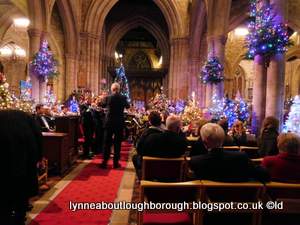
So, I do hope you all had a great break, and I wish you all a Happy New Year! Please enjoy these few photos from the Christmas tree service held at St Mary’s Church in Melton Mowbray, with Hathern Band.


Sunday, 15 February 2015

Grudgings the Needle-makers

The needle-makers of Loughborough

A couple of weeks ago you may remember I posted a couple of articles on needle-making and promised you a blog post on one specific Loughborough company of needle-makers, but before I introduce you to that family, here's a quick update on other needle-making firms that appeared in the 1872 Loughborough street directory:

  • Thomas Armstrong in Pinfold Gate and at 11 Leicester Road
  • J T & C Grudgings at 7 Woodgate and on Packe Horse Lane
  • W Hammond Bearded Needles & Sons, one factory on Havelock Street (factory demolished in the 1960s was on the site of the current Goods Yard Close) and another on Bridge Street, on the corner of Limehurst Avenue opposite the former Fire Station (now ATS Euromaster) and Bridge Street, probably demolished in the 1980s, though left derelict for sometime
  • William Hubbard in Union Street (now the tiniest little cul-de-sac off Ashby Road, opposite the Old English Gentleman pub)
  • There is also another potential needle-making factory, as yet unidentified (by me, at least) along the jetty leading from Duke Street to Meadow Lane, which in 1925 could be W & W Hubbard  
There are, of course, other trades related to the hosiery industry and needle-making but let's get back to the Grudgings!

The Grudgings family had at least three needle-making factories in Loughborough:
  • on Woodgate/Packe Horse Lane (opened in 1850-1 and certainly around in 1872) 
  • School Street (J T & C Grudgings - being Josiah, Thomas and Charles Cross) 
  • and Albert Street (Daniel & Bros.).


Grudgings, now GTG Engineering, Albert Street


If you've read my previous posts you'll know that the Albert Street factory is still standing and is used by GTG Engineering, a company which was established as long ago as 1959, and provides "precision engineering, mechanical testing and metallurgical specimens and equipment to the aerospace and allied industries."


Grudgings, now The Needleworks, on School Street
The other two factories have disappeared, one on Woodgate - with an entrance also on Packe Horse Lane - at number 7 Woodgate, next door to the Marquis Of Granby pub, which was on the opposite corner of Packe Horse Lane from the Old Packe Horse Inn (now the Organ Grinder) - and the other being partially demolished and re-built as flats (28 School Street).


The Grudgings family who owned and worked in needle-making factories in Loughborough originated from Ratby, where Daniel Grudgings (let's call him senior) was in the needle-making trade (as was his father, also Daniel). His son, also Daniel (let's call him junior), moved to Desford and took needle-making there, and some of his sons brought the work to Loughborough, and created the Grudgings needle-making factories mentioned above. Years later, one of Daniel junior's grandsons took needle-making to Kegworth.

Between 1871 and 1881, members of the Grudgings family, either needle-masters, or needle-makers, were living in various dwellings in Loughborough, including numbers 1 & 2 Albert Street, number 4 Albert Place, number 8 Bedford Street (which appears to be on the end of the terraced houses, exactly where Browns Lane now cuts through), 2 Southfield Road, and 58 Woodgate (approximately where the Print House is). In later years, members of the family can be found living on Paget Street, Herrick Road (numbers 116 & 118), Beacon Road (numbers 14 and 20), 40 Moor Lane, 32a Cobden Street, 2 Corporation Road (no longer standing), 234 Forest Road (no longer standing), and more recently Charnwood Road.

Charnwood Road
116 & 118 Herrick Road


These days we probably struggle to conceive of the number of needles that would actually need to be made in order to support the hosiery industry: Needle-making was a skill and in high demand, as Loughborough and the surrounding area were major areas of hosiery production. Now, I'm no expert on the hosiery industry of the past, so I'm not sure whether they would have been producing latch needles or bearded needles, although, given that another firm, Hammonds, were publicised as bearded needle-makers I'm erring on the side of the bearded variety.

I do have it on good authority that if you were an engineer maintaining one of these hosiery making machines, you would be sure to wear a suitable boiler suit as, clambering under the machines you would come out covered in needles! And, if you worked on the milling machine, you needed to be careful not to get the beards caught in your fingers: They hurt and were very hard to get out!

In later years, the Grudgings family branched out from needle-making, so in the late-nineteenth century, early-twentieth century, we find school teachers (one at Cobden Street), in 1901 a trainee teacher was boarding on Uppingham Road, Leicester, also shoemakers, iron workers and I'm sure many of us will remember Grudgings tobacconist and confectioners who last traded on Swan Street.

Regarding the fortunes that were made in the Grudgings' needle-making enterprises, Daniel senior died in 1870 leaving under £100. Daniel junior died in 1876 and left effects under £450. Charles Cross Grudgings who died in 1918 left £5658 5s. 6d..

In 1871 there seems to have been some kind of industrial dispute, which may or may not have included the Grudgings needle-makers. on Tuesday October 17th, 1871, the Birmingham Daily Post reported:

"Strikes in the hosiery trade. The strike amongst the hosiery needle-makers of Nottinghamshire and Leicestershire still continues, with no prospect of a settlement at present. The master needle-makers will not acceded to the demands of the journeymen, which must cause great inconvenience to the hosiery manufacturers generally, if a speedy settlement does not take place. The men still remain firm in their demand, and it is stated do not intend to resume work until their demand is complied with."

I would like to end this post by mentioning that at least three members of the family were involved in WW1. Henry Archer Grudgings, son of Daniel (himself grandson of Daniel senior), born in 1892 died in battle on 13th May 1915, aged 23. William, also a great-grandson of Daniel senior, an elementary school teacher, joined the war in 1916, and survived. His story is currently being told on Twitter. Henry Ernest, also a great-grandson of Daniel senior via a different line, was a Gunner in the Royal Artillery and also survived the First World War.

I would like to thank a number of people for their help with my research including (but any factual inaccuracies, spelling and grammar mistakes are all down to me rushing as usual):

Stephen, Tony, Ray, Steve, Rob, Roy, Ernie, Margaret, Karen and the lovely folk at the Forge Mill Needle Museum in Redditch.


Sunday, 25 January 2015

Winter walk around the water - Charnwood, that is!

Last week I shared with you some information about needle-making in Loughborough, and promised you a post about one of the needle-making families in town. Although I've done quite a lot of work on this, my research is not yet in a fit enough state to be published on this blog. Apologies, but please enjoy this week's offering. I'm hoping to post next Saturday, instead of Sunday, Saturday being, rather significantly, 31st January.

Recently, we were going to go for a walk at Beacon Hill, but when we got there, there was a queue waiting to get into the car park because of a running event that was taking place, so instead we took a meander around Charnwood Water, and we weren't disappointed! Loads of swans, coots, ducks, remote controlled boats, and a steam train, not to mention lovely trees, and a view of the back of the Cedars (formerly the home of the Loughborough town banker)! Charnwood Water used to be called Tucker's Pond because before being filled with water, this was a clay pit, the clay from which was used by the local firm of Tuckers to make bricks.


Sunday, 18 January 2015

Needle-making in Loughborough


Although last week's post included a little bit about needle-making, I've been meaning to write a longer post about needle-making in Loughborough for a very long time, prompted by a number of things, including spotting a photograph of a building I walk past every time I walk into town in a local history book, a postcard sent to someone in Loughborough with the same surname as the local needle-makers, a visit to the needle-making museum in Redditch, and a visit to Astley Book Farm!


At the Book Farm I discovered a book in the Shire Books series on needle-making, which was fascinating, and in the back was a list of places to visit, which included Redditch.


I had only ever been to Redditch once before, so put a trip there on my wish list, particularly to visit the Forge Mill Needle Museum. Here I discovered that not only was Redditch famous for sewing needles, but also for other, related sharp, pointy bits of metal, like darts, hooks for fishing rods, and medical syringes.


This got me to thinking about Loughborough, because I was sure on my travels through some of my local history books I knew I'd seen reference to needle-makers in Loughborough, and wondered why Redditch became the centre of needle-making in the country. Now, having tried to do a bit of research, I can only assume it was because the needles manufactured in Redditch were the sort used for hand-stitching, whereas those made in Loughborough were for framework knitting machines, initially bearded needles, then superseded by latch needles.


On a trip to Lichfield a long time ago I spotted some postcards that had been sent to someone in Loughborough, but it was only when I got home that I worked out the significance of the addressee, and I so wished I'd bought them. A little while before Christmas 2014, I visited Lichfield again, looking for some solace in the Cathedral and some Christmas presents in the shops. I suddenly remembered about the postcards I'd seen before and on the off-chance popped into the same shop I'd seen them in to look for some other presents. Imagine my surprise to find the postcards still there: This time I bought one - only when I got home I wished I'd bought them all!! The one I bought was a postcard from Leicester from an elementary school teacher to her slightly older elementary school teacher sister who was living in Loughborough. They were associated with one of the main needle-making families in the town.


As for that building, I admit I don't get into town as often as I used to, but when I do I always walk, and my journey takes me along Albert Street. I've often looked at the strange building on the end, but it wasn't until I acquired a copy of  Bygone Loughborough in Photographs, vol.2, that I discovered the building used to be a factory making needles.


Some of the needle-makers I've found listed are:

1841
  • Samuel Armstrong, Mill Street
  • Samuel Chester, Bridge Street
  • John Holland, North Street
  • William Priestley, Woodgate

1881
  • William Battison, Mill Street
  • Luke Cashmore & Sons, Mill Street
  • Charles, Thomas & Josiah Grudgings, Albert Street
  • William Hubbard, Regent Street

1912
  • Luke Cashmore & Sons, Mill Street
  • Charles, Thomas & Josiah Grudgins, Albert Street
  • William Hammond, 64 Leopold Street
  • Hartshorn & Hoult, 39 Pinfoldgate
  • Walter Hubbard, Meadow Lane

1925
  • Daniel Grudgings & Bros, Albert Street
  • J T & C Grudgings, School Street
  • William Hammond & Son, The Rushes *
  • William Hubbard, Meadow Lane

1928
  • Daniel Grudgings & Bros, Albert Street
  • J T & C Grudgings, School Street
  • William Hubbard, Meadow lane

1941
  • Daniel Grudgings & Bros, 1 Albert Street
  • J T & C Grudgings, 8 School Street

* I believe Hammonds might have been on Havelock Street at one time too.

Pop back next week or the week after to read a bit more about one of the needle-making families in Loughborough.

lynneaboutloughborough