Showing posts with label William Railton. Show all posts

Tuesday, 2 December 2025

A View From the Window

Last week I was thrilled to share with you a view I’d seen that week from a first-floor art studio. This week, I’ve been to the Beaumanor Hall Christmas gift fair, and managed to take a few photos out of a couple of the windows, which show the scaffolding, presumably around the chimneys. I’ve trawled back through my photograph collection and discovered that I seem to like Beaumanor Hall – could it be its connection with the architect of Nelson’s Column? – and I’ve taken a few photographs looking out onto various parts of the estate.

Of late there have been problems at the hall: recently it was closed for some emergency repair work to its chimneys, and there is concern that the hall doesn't earn enough money to pay for its upkeep, and is thus in danger of being sold off by the county council who own it. It's currently used as the Register Office for the area, and hosts events like the Christmas Fair, as well as history and building tours, and as an outdoor pursuits centre for schools. There has been a recent consultation asking members of the public for fundraising ideas, in the hope that the predicted shortfall of over £500K can be averted - or at the very least decreased. 

So, please enjoy this selection of views from the windows of Beaumanor Hall!


____________________________________

Posted by lynneaboutloughborough

With apologies for typos which are all mine!

_______________________________________________

Thank you for reading this blog.

Copyright:

The copyright © of all content on this blog rests with me, however, you are welcome to quote passages from any of my posts, with appropriate credit. The correct citation for this looks as follows:

Dyer, Lynne (2025). A View from the Window. Available from: https://lynneaboutloughborough.blogspot.com/2025/12/a-view-from-window.html  [Accessed 2 December 2025]

Take down policy:

I post no pictures that are not my own, unless I have express permission so to do. All text is my own, and not copied from any other information sources, printed or electronic, unless identified and credited as such. If you find I have posted something in contravention of these statements, or if there are photographs of you which you would prefer not to be here, please contact me at the address listed on the About Me page, and I will remove these.

External Links:

By including links to external sources I am not endorsing the websites, the authors, nor the information contained therein, and will not check back to update out-of-date links. Using these links to access external information is entirely the responsibility of the reader of the blog.

Blog archive and tags:

If you are viewing this blog in mobile format, you will not be able to easily access the blog archive, or the clickable links to various topics. These can be accessed if you scroll to the bottom of the page, and click 'View Web Version'. Alternatively, there is also a complete list of posts, which when clicked will take you to the page you are interested in.

Searching the blog:

You can search the blog using the dedicated search box that appears near the top of the blog when viewed in the web version. Alternatively, you can search using your usual search engine (e.g. Bing, Google, DuckDuckGo etc.) by following this example:

site: https://lynneaboutloughborough.blogspot.com/ “Radmoor House”

NOTE – the words you’re actually looking for must be in “” and the first of these must be preceded by a space

Thank you for reading this blog.

Lynne

Thursday, 31 August 2023

Mary Tate

I remember turning out one cold and wet winter evening in 2016 to attend a book launch at Donnington Hall for a Victoria County History Book about Castle Donnington! It was a lovely event, and the authors each gave a short speech. One of those authors was Pam, which was how I came to meet her. Since then, it won't surprise you to know that our paths have frequently crossed at heritage events and talks, and we often find our areas of interest and research overlap! In her guest post, which is the last article in a series specifically celebrating the 10th anniversary of the blog, Pam tells us the story of Mary Tate, a notable inhabitant of Burleigh Hall. Read on to find out why ...

Mary Tate

By Pamela J. Fisher

Writing to the Ecclesiastical Commissioners in 1849 about the new church and benefice of Thorpe Acre, the Bishop of Peterborough wrote of Miss Mary Tate: ‘Her exertions, to use the expression in the neighbourhood, hav[e] been the very “making of the place”’. It was not just Thorpe Acre that benefited from her ‘exertions’: Mary Tate also provided two schools in Loughborough, assisted a third, made a substantial contribution towards the cost of building Emmanuel Church, provided food for the poor of Loughborough and left money in her will to Loughborough Dispensary.

Mary was the life tenant of her family property, Burleigh Hall, a country house in substantial grounds, the site of which now forms part of Loughborough University campus. She was born on 20 December 1775 and was the only child of George Tate and his wife Bridget Moore (née Ford), who had married on 9 March that year in St George’s church, Hanover Square in the city of Westminster. George was of that parish and Bridget was from the parish of St James, Westminster. Mary was baptised at St George’s church, Hanover Square on 14 February 1776.

Members of the Tate family had been at Burleigh since at least 1705. Mary inherited her life interest from her father in 1822, but she was not a direct descendant of ‘Henry Tate of Burleigh’, the owner of the Hall and Park who had died in 1722. A hint of her family’s extensive landholdings is given in the parish register of Mitcham, Surrey when her father was buried there on 25 May 1822, aged 76: ‘George Tate Esq from Southampton, Hants, of Burleigh House near Loughborough’. The mention of Southampton is a reference to another family property, Langdown House in Dibden and Hythe, near Southampton Water, which is believed to have been built for George in 1797. It was demolished in the 1960s, but a painting shows a substantial property standing in large landscaped grounds. 

George also owned at least one property in London and another in Mitcham, and the latter place was clearly dear to the family, as both George and Mary in their wills asked to be buried at Mitcham, where there was a family vault. Mary paid for a wall monument to her father’s memory in St Peter and St Paul church in Mitcham, which had then just been rebuilt, and this joined several other family monuments that had been carefully moved from the old church to the new one.

Burleigh Hall was acquired by Mary’s grandfather Benjamin (George’s father) through his second marriage in 1765 to his cousin, Mary Herbert (née Tate). Mary Herbert had inherited Burleigh as the granddaughter of Anthony Tate, the brother of the Henry who died in 1722. Benjamin was the grandson of Henry and Anthony’s younger brother William.

We don’t know how the Mary Tate we are concerned with here was educated, or how frequently she visited Burleigh. She was 46 and unmarried when her father died in 1822. She had inherited land and property in Mitcham and shares in six canal companies in 1821, on the death of her uncle (George’s younger brother), the Rev. Dr Benjamin Tate. On her father’s death the following year she received a life interest in Burleigh Hall and Park, in other land in Loughborough and Woodthorpe, in properties in Chelsea, Brompton and within Middlesex (including Grosvenor Place) and was left outright ownership of Langdown House, other land and properties in Dibden and Fawley in Hampshire, all of George Tate’s bank stock, his household goods and £30,000 in bank annuities ‘to do with as she pleases’.

As well as erecting the monument mentioned in Mitcham church in memory of her father, Mary also commissioned Sir Richard Westmacott RA to provide a memorial for All Saints’ church in Loughborough, where it can be seen today on the south wall of the chancel. Westmacott was one of the leading sculptors of his age, and had provided two of the wall monuments to other family members in Mitcham church. For this commission he produced a figure of a kneeling angel in classical robes, holding a sickle to cut surrounding sheaves of corn.
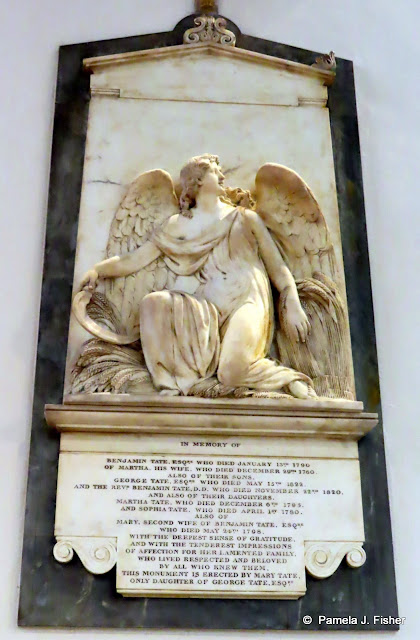
Wall-mounted memorial depicting a kneeling angel with outstretched wings, with inscription below
Memorial to members of the Tate family by Sir Richard Westmacott RA in the chancel of All Saints’ church

The inscription remembers ‘with the deepest sense of gratitude and with the tenderest impressions’, her grandfather Benjamin Tate (died 13 January 1790), his wife Martha (died 29 December 1760), their four children who reached adulthood, George (Mary’s father, died 15 May 1822), the Rev. Dr Benjamin (died 22 November 1820), Martha (died 6 December 1793) and Sophia (died 1 April 1780), and also Mary, Benjamin’s second wife, who had inherited Burleigh from her parents (died 24 May 1798).

A series of letters written by ‘our’ Mary Tate survives from 1844–5, when she was dividing her time between three properties, Burleigh Hall, Grosvenor Place in London and Langdown House in Hampshire. Her time in Leicestershire had been sufficient for her to become well acquainted with William Herrick of Beaumanor Hall and his family, and she turned to him for advice in the 1840s. She was then managing a large estate, and appears to have been doing so very capably, but as a woman she probably faced discrimination in some of her dealings, and he may have provided support on business and legal matters.

Mary extended the Burleigh estate a little by purchasing a neighbouring piece of land, and also improved her estate in Fawley, Hampshire by exchanging with Southampton Corporation parcels of land in other parts of Hampshire for land in Fawley. The latter suggests astute land management and confidence in her business dealings.

Mary was a devout Anglican, and spent large sums in charitable works and the establishment of new churches. In Mitcham, she demolished the property she had inherited from her uncle and built almshouses for 12 poor women on the site, which opened in 1829. In Dibden, near her Hampshire home, she gave money to a school for poor children. Her closest affections seem to have been for Loughborough and the neighbourhood of Burleigh, where the majority of her philanthropy was directed, and especially from the 1830s in Emmanuel parish, Loughborough and Thorpe Acre.

She began an infant school In Loughborough in a building in the yard of the Boot Inn, Fishpool Head (later known as Cattle Market) and by 1836 had rented two other buildings from John Paget, also for use as infant schools, which in that year were teaching 180 boys and 100 girls. These would have been a huge boon to the town, helping married women to obtain work, for example in the local hosiery industry. After Loughborough’s rector, the Rev. William Holme, built a boys’ school at Wards End attached to the new church of Emmanuel, Mary Tate built a girls’ school for Emmanuel on Bedford Square (the building survives as part of the retailer Bed City), endowed it with income of £54 annually towards the payment of salaries and other expenses, and gave a further endowment worth £30 annually to Emmanuel boys’ school. 

A bed shop in an old building
The former Emmanuel Girls’ school on Bedford Square

She gave £500 towards the building of Emmanuel church, alongside £1,000 from the Rev. William Holme and £1,000 from Emmanuel College, Cambridge (patron of All Saints’ church and soon-to-be patron of Emmanuel church). These donations were sufficient to leverage £2,143 from the Commissioners for the Building of New Churches and £500 from the Incorporated Society for Promoting the Enlargement, Building and Repairing of Churches and Chapels, which together enabled Thomas Rickman to be commissioned to design the church, and Rickman’s favoured contractor, John Bennett of Birmingham, to be employed in building it. Emmanuel Church opened in 1837. 

A church on a roadside
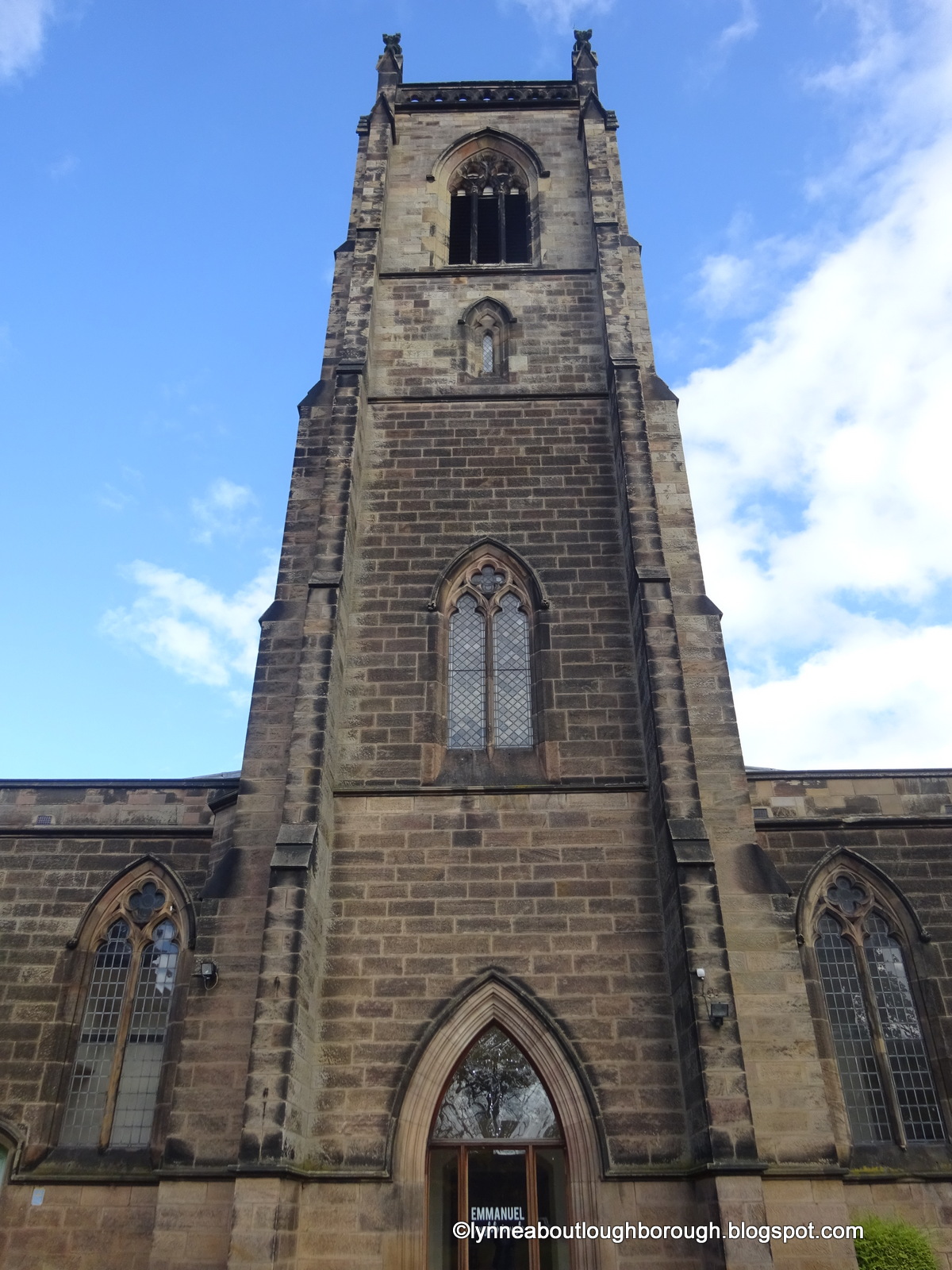
Emmanuel Church on Forest Road, built 1835–7

The comment that opened this post, by the Bishop of Peterborough in 1849 (Leicestershire was then within Peterborough diocese), relates to the building and endowment of Thorpe Acre church and its ministry. Thorpe Acre was then a small rural village with a population of 298 in 1841 (it is close to 20,000 today). There was no church in the village, but there was a weekly Sunday service in the medieval chapel at Dishley, a much smaller village c.¾ mile away. Dishley chapel was a donative – a church that was owned by an individual. In this case it had originally belonged to Garendon abbey and had passed into lay hands at the dissolution of the monasteries. Donative churches lay outside ecclesiastical jurisdiction: the family of the owner could choose and pay a minster, and refuse entry to anyone. Dishley chapel was the property of Charles March Phillipps of Garendon, and weekly Sunday services there were conducted by his brother, the Rev. Edward Thomas March Phillipps, vicar of Hathern. A copy of a printed circular now held in Lambeth Palace library shows that there were concerns in the early 1840s for the continuation of Anglican worship in Dishley chapel over the long term as Ambrose March Phillipps, the eldest son and heir of its owner, had converted to Roman Catholicism and was ‘full of zeal for the faith’ (he was employing a priest who was trying to convert local people). The ‘solution’ suggested, and supported by the Rev. E.T.M. Phillipps, was to build an Anglican church in Thorpe Acre, with its own minister.

An appeal was launched for funds to buy land, build a church and parsonage house in Thorpe Acre and provide an income for an incumbent. One account says Miss Tate was the principal donor towards the building of the church, but the amount she gave is not recorded. She donated £1,000 to the Ecclesiastical Commissioners towards an endowment to provide a minister’s salary, gave £500 for the parsonage house and established a fund for church repairs. Her £1,000 gift was the statutory sum that would enable Mary and her heirs to nominate the vicar at each vacancy, but she realised that this sum was insufficient to provide a decent clerical living, and that it could be bolstered by funds from the Ecclesiastical Commissioners at no extra cost to herself if she agreed that the incumbents would always be chosen by some ‘public body’. She therefore specified that the advowson (the right to nominate the minister) was to rest with the bishop of the diocese, but at the same time made a private agreement with the Bishop of Peterborough that she could choose the first appointee. It seems that her first, and possibly second, choice declined the appointment, but the Rev. John Bridges Ottley, a Fellow of Oriel College, Oxford accepted the position. Mary had met him 20 years before, when he was a curate at Dibden (Hampshire).

With a minister in place, Mary consulted him on the location of the parsonage, agreed an alternative site when he rejected the land already purchased for this purpose, and arranged for him to brief the church architect, William Railton, on the specification of the house he wanted. Ottley had a wife and daughter, servants and a private pupil who was boarding with the family, and a large house with three reception rooms and seven bedrooms was built. (This house has since been demolished and replaced by a smaller vicarage on a new site.) Mary Tate also told the bishop in confidence that she would ensure Mr Ottley received a stipend of £150 p.a., although she would not provide an endowment to pay that sum until the Ecclesiastical Commissioners (who then had no funds for augmenting livings) had added to the £1,000 she had already provided. To this end she set up a separate trust, endowing it with bank stock that would provide £120 annually above the sum that her endowment to the Ecclesiastical Commissioners would provide.

Thorpe Acre church was consecrated and opened on 30 September 1845. 
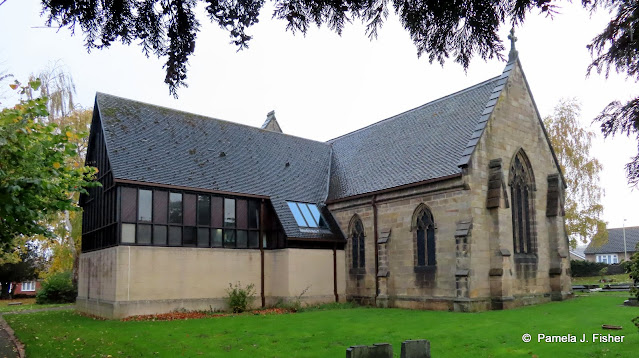
A church built in 1845 showing both the original part and the 1986 extension
All Saints’ church, Thorpe Acre. The original nave/chancel to the right of this image was extended to the south (and also to the west and north) in 1986, trebling the number of seats. The tip of the original western bellcote is just visible.

Other less prominent acts of philanthropy, of no less importance to the beneficiaries, included weekly gifts of meat to 200 poor families each winter and setting up ‘an establishment in which young women were taught washing’, helping them to earn money to lift them out of poverty.

Mary Tate died at Burleigh Hall on 15 March 1849, aged 73, the last of this Tate lineage. In accordance with her wishes, her body was taken to Mitcham, where she was buried on 22 March. Her charitable wishes continued to the end, with bequests in her will of £500 to each of four medical establishments, including Loughborough Dispensary and Leicester Infirmary. She also left £200 to the Rev. Ottley, the first incumbent of All Saints’ church, Thorpe Acre. Burleigh House passed under the terms of George Tate’s will to a cousin, Louisa Pinfold, who took the surname Tate, as George had desired. Louisa Pinfold Tate gave stained glass for the east window of Emmanuel church in 1851 in memory of Mary.

Before her death, Mary had settled her properties in Surrey on her half-brother Richard Moore (her mother’s son by Bridget’s first marriage to Blunsden Moore). By her will she left Langdown House to one of Richard’s children, Charlotte Selina Hobart (née Moore) and £30,000 to be divided equally between three other children of Richard, Mary Bridget, Mary Jane and Edmund. She does not appear to have been close to her cousin Louisa, as to raise the cash to settle her many personal bequests she instructed her executors to sell the land she had purchased on the edge of the Burleigh Estate, after giving Louisa the option of buying it before it went on the market.

Mary Tate has largely been forgotten today, yet she was a remarkable woman, especially for her time, and one of Loughborough’s and Thorpe Acre’s major benefactors.

Pamela J Fisher

____________________________________

Sources

Primary Sources

The National Archives, letter of wishes for Benjamin Tate (PROB 11/1190/8); wills for Edward Butler (father of Mary Herbert, PROB/ 11/742/486); the Rev. Dr Benjamin Tate (PROB 11/1637/245); George Tate (PROB 11/1658/44); Henry Tate (PROB 11/588/390); Lucy widow of Henry Tate (PROB 11/591/485); Mary wife of Benjamin Tate (PROB 11/1309/3); Mary Tate (PROB 11/2093/364); and others from this family, of less direct relevance to this article; 1851 census HO 107/2085/373.

Lambeth Palace Library, Emmanuel Church: CBC/7/1/4; ICBS 1701; ICBS MB7.

Lambeth Palace Library, Thorpe Acre Church: CC/OF/NB19/54; ECE/7/1/6676/1; ICBS 3319; ICBS MB12; QAB/7/3/F1442.

The Record Office for Leicestershire, Leicester and Rutland: DE884 (deeds Burleigh); DG9/2249 (Letters re Burleigh and Thorpe Acre); DG9/2556/1–39 (letters re Thorpe Acre church).

Parish registers (through FindMyPast), St George, Hanover Square; Mitcham, and others.

Commissioners for Building New Churches, Annual Reports, 1836, 1837

J.H. Chapman, The Register Book of Marriages belonging to the parish of St George Hanover Square in the County of Middlesex (Harleian Society, London, 1886).


Newspapers (through British Newspaper Archive)

Hampshire Advertiser, 29 Nov. 1834.

Leic. Jnl. 17 Oct. 1845; 16 Jan. 1852.

Leics Merc., 24 Mar. 1849.

Northampton Merc., 4 Oct. 1845.

Nottingham Review, 4 Mar. 1836; 3 Oct. 1845.


Secondary Sources

N. Pevsner (rev. E. Williamson), Buildings of England: Leics and Rutl.

M.H. Port, Six Hundred New Churches: The Church Building Commission, 1818–1856 (Reading, 2006)

VCH Hants. IV, Dibden

VCH Leics. III, Table of population

White, Hist., Gaz. and Dir. of Leics. and Rutl. (Sheffield, 1863)

Websites (all accessed 17 July 2023)

http://research.hgt.org.uk/item/langdown-house/

https://collections.hampshireculture.org.uk/object/painting-watercolour-langdown-house-and-garden-langdown-hythe-and-dibden-hampshire-louise-c;

http://www.speel.me.uk/chlondon/mitchamch.htm

http://www.croydonalmshouses.org.uk/our-history.html

____________________________________

About Pamela Fisher

Dr Pamela Fisher works with Leicestershire Victoria County History Trust and is currently researching a social and cultural history of Loughborough since 1750. This will include a history of the schools, churches and other places of worship in Loughborough (including Thorpe Acre and Nanpantan) and will be published as a paperback book as part of the national Victoria County History series of books. Other topics and periods will follow, to eventually become a full history of Loughborough from the earliest settlement in the town to the 21st century. You can follow progress on Twitter and Facebook (@LeicsVCHT) or make contact through their website https://leicestershirehistory.co.uk/ to be added to their mailing list for Newsletters and updates. 

____________________________________

Posted by lynneaboutloughborough

With apologies for typos which are all mine!

_______________________________________________

Thank you for reading this blog.

Copyright:

The copyright © of all content on this blog rests with me, or in the case of guest blogposts, with the named Guest Blogger. However, you are welcome to quote passages from any of my posts, with appropriate credit. The correct citation for this looks as follows:

Fisher, Pamela J. (2023). Mary Tate. Available from: https://lynneaboutloughborough.blogspot.com/2023/08/mary-tate.html  [Accessed 31 August 2023]

Take down policy:

I post no pictures that are not my own, unless I have express permission so to do. All text is my own, and not copied from any other information sources, printed or electronic, unless identified and credited as such. If you find I have posted something in contravention of these statements, or if there are photographs of you which you would prefer not to be here, please contact me at the address listed on the About Me page, and I will remove these.

Blog archive and tags:

If you are viewing this blog in mobile format, you will not be able to easily access the blog archive, or the clickable links to various topics. These can be accessed if you scroll to the bottom of the page, and click 'View Web Version'. Alternatively, there is also a complete list of posts, which when clicked will take you to the page you are interested in.

Searching the blog:

You can search the blog using the dedicated search box that appears near the top of the blog when viewed in the web version. Alternatively, you can search using your usual search engine (e.g. Bing, Google, DuckDuckGo etc.) by following this example:

site: https://lynneaboutloughborough.blogspot.com/ “Radmoor House”

NOTE – the words you’re actually looking for must be in “” and the first of these must be preceded by a space

Thank you for reading this blog.

Lynne

Sunday, 11 June 2023

Building Stone

Sadly, I missed a recent talk hosted by the Friends of Charnwood Museum, about stone, so, I had a look back over the blog to see what I’d already written. I must admit, I thought I’d done a piece on Coade stone, an artificial stone, but find I haven’t so I’ve only mentioned it in passing in some posts, like [quote blog posts]. So, let’s have a quick look at some real local stone, and where it’s been used.

Old Rectory, Rectory Place

The 13th-century building was once the home to the rectors of Loughborough, having been passed to the church around 1228 by the Cortlinstoke family. By the time it fell out of use, around 1959, it had been extended enormously, and would have been a substantial family home, however, once unoccupied the building fell into disrepair and was partially demolished, revealing its earlier core, which has been retained.

The building you now see is said to be made of Bromsgrove Sandstone; North Charnwood Diorite; Charnian (volcaniclastic breccia); Charnian (volcaniclastic sandstone); Swithland slate; and Charnian (banded tuff).


All Saints with Holy Trinity, Steeple Row

This church is a 14th century building, probably built on the site of an earlier church, and it is here that the rectors of Loughborough would have done most of their work. over the years the church has been subject to many alterations, most notably that by architect Sir George Gilbert Scott in the mid-19th century. 20th and 21st century renovations have included those to the pinnacles on the belltower, and various new stones in the fabric of the building. I've written more extensively on a very early blogpost.

Stone that has been used in the construction of the church includes Millstone Grit; Triassic Red Sandstone; North Charnwood Diorite; Upper Lincolnshire Limestone; Charnian (metasediments0; Swithland slate, and Mountsorrel Granodiorite.


Holy Trinity Church, Moor Lane 

This church is no longer a religious building, but was once a busy church serving the Leicester Road area of Loughborough, opened in 1878, to a design by William Arthur Blomfield. You can find out a bit more about its history on an earlier blogpost.

The range of natural stone used in the construction of the church is much less varied than the Old Rectory and Loughborough’s All Saints church, comprising only of Mountsorrel Granodiorite and Upper Lincolnshire Limestone.


Emmanuel Church, Forest Road

The church was created around 1838, and its first rector was William Holme, who was also Rector of All Saints. The first Rector dedicated solely to Emmanuel was Reverend Bunch, who lived at the Emmanuel Rectory, on Forest Road, close to Mountfields House.  

I’ve not written much about Emmanuel church, but have done a couple of posts about the associated rectory. Part 1 and Part 2 

It appears that Emmanuel Church is constructed solely of Millstone Grit, but has a much later extension using other stone.


St Mary’s Nanpantan

St Mary’s church in Nanpantan started life as a Mission Hall, created by the Warner family of Nanpantan Hall, in 1888. Since 2015, St Mary’s has been a parish in its own right, so no longer connected to Emmanuel.

Using Charnian (volcaniclastic sandstone), St Mary’s is another church which is constructed only from one stone, that is until the 1960s when a granite Chapter House, with a flat-roofed vestry was built.


All Saints Thorpe Acre

This particular church is more usually known as Thorpe Acre church, and was built in 1845 to a design by William Railton, who was the architect responsible for the design of Nelson’s Column in London, and a number of other local Leicestershire churches. I've written extensively about Railton - here's one example post. The church, which replaced All Saints at Dishley (see below), is proud to have an east window, created in 1892 by Charles Eamer Kempe, and in the 1980s, the church was extended and joined to the school house.

All Saints, Thorpe Acre, was constructed using only Millstone Grit, until the extension was built.


All Saints Dishley

Dishley church is now a ruin, having been deconsecrated when All Saints Thorpe Acre was created in 1845. The ruins, which contain plaques to the agriculturalist, Robert Bakewell, are close to Dishley Grange Farm, which was part of the Garendon Estate.

The stone used in the construction of All Saints at Dishley includes Charnian (volcaniclastic sandstone); Diseworth Sandstone; Charnian (igneous); Triassic Red Sandstone; Cobbles (Bunter), and Bromsgrove Sandstone.  


_______________________________________________

posted by lynneaboutloughborough

With apologies for typos which are all mine!

_______________________________________________

Thank you for reading this blog.

Copyright:

The copyright © of all content on this blog rests with me, however, you are welcome to quote passages from any of my posts, with appropriate credit. The correct citation for this looks as follows:

Dyer, Lynne (2023). Building Stone. Available from: https://lynneaboutloughborough.blogspot.com/2023/06/building-stone.html [Accessed 11 June 2023]

Take down policy:

I post no pictures that are not my own, unless I have express permission so to do. All text is my own, and not copied from any other information sources, printed or electronic, unless identified and credited as such. If you find I have posted something in contravention of these statements, or if there are photographs of you which you would prefer not to be here, please contact me at the address listed on the About Me page, and I will remove these.

Blog archive and tags:

If you are viewing this blog in mobile format, you will not be able to easily access the blog archive, or the clickable links to various topics. These can be accessed if you scroll to the bottom of the page, and click 'View Web Version'. Alternatively, there is also a complete list of posts, which when clicked will take you to the page you are interested in.

Searching the blog:

You can search the blog using the dedicated search box that appears near the top of the blog when viewed in the web version. Alternatively, you can search using your usual search engine (e.g. Bing, Google, DuckDuckGo etc.) by following this example:

site: https://lynneaboutloughborough.blogspot.com/ “Radmoor House”

NOTE – the words you’re actually looking for must be in “” and the first of these must be preceded by a space

Thank you for reading this blog.

Lynne


Thursday, 23 March 2023

Garendon Park Estate

Last week on the blog, we looked at letters that had been sent to and from Loughborough, which included mention of those sent by Ambrose Phillipps de Lisle of Garendon Park. As I understand it, Garendon Park was an ancient deer park which, before the dissolution of the monasteries, was also the site of a Cistercian Abbey. The estate then passed through the hands of various families before coming to Sir Ambrose Phillipps in the late 1600s, and staying with this family (through various branches) until quite recently.

Garendon Hall itself was re-designed around the late 1700s, and the grounds adorned with a variety of follies. In the mid-1850s, several lodge houses, and the Bavarian Gates - or Red arch - were designed by William Railton, who also designed Nelson's Column.   

During the Second World War, Garendon Hall itself, like many other homes of its type, was used as a base by the army. In the mid-1960s, the house was demolished, and the estate was separated by the M1. Today, the private parkland is being converted for a new housing estate.

A couple of weeks ago I was lucky enough to be part of a group guided around the estate by the housebuilders. We saw some of the listed structures, like the Temple of Venus and the Triumphal Arch, along with the White Lodge, the Bavarian Arch, and the small buildings once used as the operations HQ in WW2. We also saw the dovecote, the smithy, the listed railings and gateway, the huts from WW2 and a variety of other interesting buildings. Here's a snapshot of the visit ... photos by me, published with permission from the landowner:

Dovecote

WW2 buildings


Smithy

Swithland slate roof


_______________________________________________

posted by lynneaboutloughborough

With apologies for typos which are all mine!

_______________________________________________

Thank you for reading this blog. The copyright © of all content on this blog rests with me, however, you are welcome to quote passages from any of my posts, with appropriate credit. The correct citation for this looks as follows:

Dyer, Lynne (2023). Garendon Park Estate. Available from: https://lynneaboutloughborough.blogspot.com/2023/03/garendon-park-estate.html [Accessed: 26 March 2023]

Take down policy:

I post no pictures that are not my own, unless I have express permission so to do. All text is my own, and not copied from any other information sources, printed or electronic, unless identified and credited as such. If you find I have posted something in contravention of these statements, or if there are photographs of you which you would prefer not to be here, please contact me at the address listed on the About Me page, and I will remove these.

Blog archive and tags:

If you are viewing this blog in mobile format, you will not be able to easily access the blog archive, or the clickable links to various topics. These can be accessed if you scroll to the bottom of the page, and click 'View Web Version'. Alternatively, there is also a complete list of posts, which when clicked will take you to the page you are interested in.

Searching the blog:

You can search the blog using the dedicated search box that appears near the top of the blog when viewed in the web version. Alternatively, you can search using your usual search engine (e.g. Bing, Google, DuckDuckGo etc.) by following this example:

site: https://lynneaboutloughborough.blogspot.com/ “Radmoor House”

NOTE – the words you’re actually looking for must be in “” and the first of these must be preceded by a space

Thank you for reading this blog.

Lynne

Sunday, 27 March 2022

So who was Paul Pry?

Whilst there may well be someone actually named Paul Pry, for the purposes of this blogpost, the name might refer to a rather unsavoury publication, or a collection of stories in two volumes by Erle Stanley Gardner, called “The adventures of Paul Pry”, or a collection of stories by John Poole. Paul Pry was also a character in a play by John Poole, which was written in 1825, and it is this Paul Pry I am referring to. A bit of background info before we get to the Loughborough connection!!

John Poole (1786-1872) was a master of comedy-drama, known as farce, and seems to have been rather prolific. His play “Paul Pry: a comedy in three acts” was very popular at the time (1825), and toured the country. The leading part was played by the actor John Liston, who apparently expertly brought the character of Paul Pry to life. The Paul Pry of the play has been described as a meddling sort of fellow, of no occupation, who spends much of his time interfering with the lives of others, and can often be found frequenting inns. 

The catchphrases associated with him relate to his interference in everything, like 

“Hope I don’t intrude”, 

“I wouldn’t wish to intrude”, 

“Would not intrude for the world”, 

“I’m the last to intrude”,  

which all clearly indicate that he does in fact mean to, and knows he is!!

According to a review of the performance that took place in the Haymarket Theatre in London on Tuesday 13th September, a review that appeared in ‘Bell’s Weekly Messenger’ of 18th September, there was “nothing new in the plot”, the “incidents of this piece are whimsical and ludicrous, but without much of originality”

But, despite this, the article continues “Paul Pry is decidedly the best comedy which has been got up this season – there was no room for ennui – the audience were kept in a constant roar of laughter”, and they attributed much of this to the “excellent acting of Mr Liston, who, as Paul, had ample scope for his peculiar style of acting.” The verdict issued by the newspaper was that “Paul Pry, however troublesome to his neighbours, will become a great favourite with the public.”

During the course of the play, a couple of songs were performed, which were sung by Madame Vestris, an opera singer, although more known for her work as a theatre producer and manager. The music for one of these, “Cherry Ripe”, was composed by Charles Edward Horn, and the words were written in the 1600s by a poet who experienced a revival in the nineteenth century. This poet was one Robert Herrick. 

If the name sounds familiar, you’d be right, for Robert Herrick (1591-1674), poet, was the nephew of Robert Herrick (sometimes spelled Heyrick) (1540-1618). The elder Robert was the MP for Leicester, who at one time lived on the site of the dissolved Greyfriars monastery in Leicester. This lay opposite what is now the cathedral, the site later being used for the buildings near which a certain king was recently found buried. Robert the MP, also had a brother, William, who purchased a country estate – possibly that at Beaumanor, although the hall itself has since been replaced in the 1840s by the building we see today, which was designed by William Railton.

Of course, one connection between Paul Pry with our area is not enough!!!

Across the country there were a number of pubs and inns called the Paul Pry, for example at Sheffield, Peterborough, Alrewas, and Sneinton. Indeed there are a few establishments that bear the name today, notably that at Worcester, one in Rayleigh in Essex, and there is still one in Peterborough.

A report in the 'Leicester Evening Mail' of 5th March 1930, states that a property in Loughborough has applied for a licence to sell beer – to become an off-licence. Almost 100 years earlier, the 'Leicester Chronicle' had reported that George Moore of Loughborough had been charged by the overseers with not providing for his apprentice, and was ordered to take her back, provide for her, and pay the costs. Moore was said to be “of the Paul Pry”. Back to 1930, where we find the article reporting that the Paul Pry was situated on Leicester Road, at the extreme end of the town and “which afterwards became a private residence known as The White House, on the corner of Beeches Road”! It's certain from the article that the Paul Pry was still in existence in 1869, but unclear if it continued much beyond this date. 

You can read about The White House in a previous blogpost, and about Fairfield House, which is affectionately called The White House on the Fairfield School website

So, maybe the title of this blogpost should have been “What was Paul Pry”?!

The White House at the corner of Beeches Road and Leicester Road, once known as the Paul Pry


Beaumanor Hall, designed by William Railton and once home to the Herrick family

You are welcome to quote passages from any of my posts, with appropriate credit. The correct citation for this looks as follows:

Dyer, Lynne (2022). So who was Paul Pry? Available from: https://lynneaboutloughborough.blogspot.com/2022/03/so-who-was-paul-pry.html           [Accessed 27 March 2022]

Take down policy:
I post no pictures that are not my own, unless I have express permission so to do. All text is my own, and not copied from any other information sources, printed or electronic, unless identified and credited as such. If you find I have posted something in contravention of these statements, or if there are photographs of you which you would prefer not to be here, please contact me at the address listed on the About Me page, and I will remove these.
Thank you for reading this blog. 

Lynne