Showing posts with label Grudgings. Show all posts

Thursday, 5 January 2023

Changes in Loughborough in 2022

So, in my last post I rather rashly promised you I'd share pics of some of the changes that have happened over the past year. Well, that has turned out to be a mammoth task, as there has just been so much change, and I certainly haven't documented even one tenth of it. So, I am sharing a few select changes that have resonated with me. 

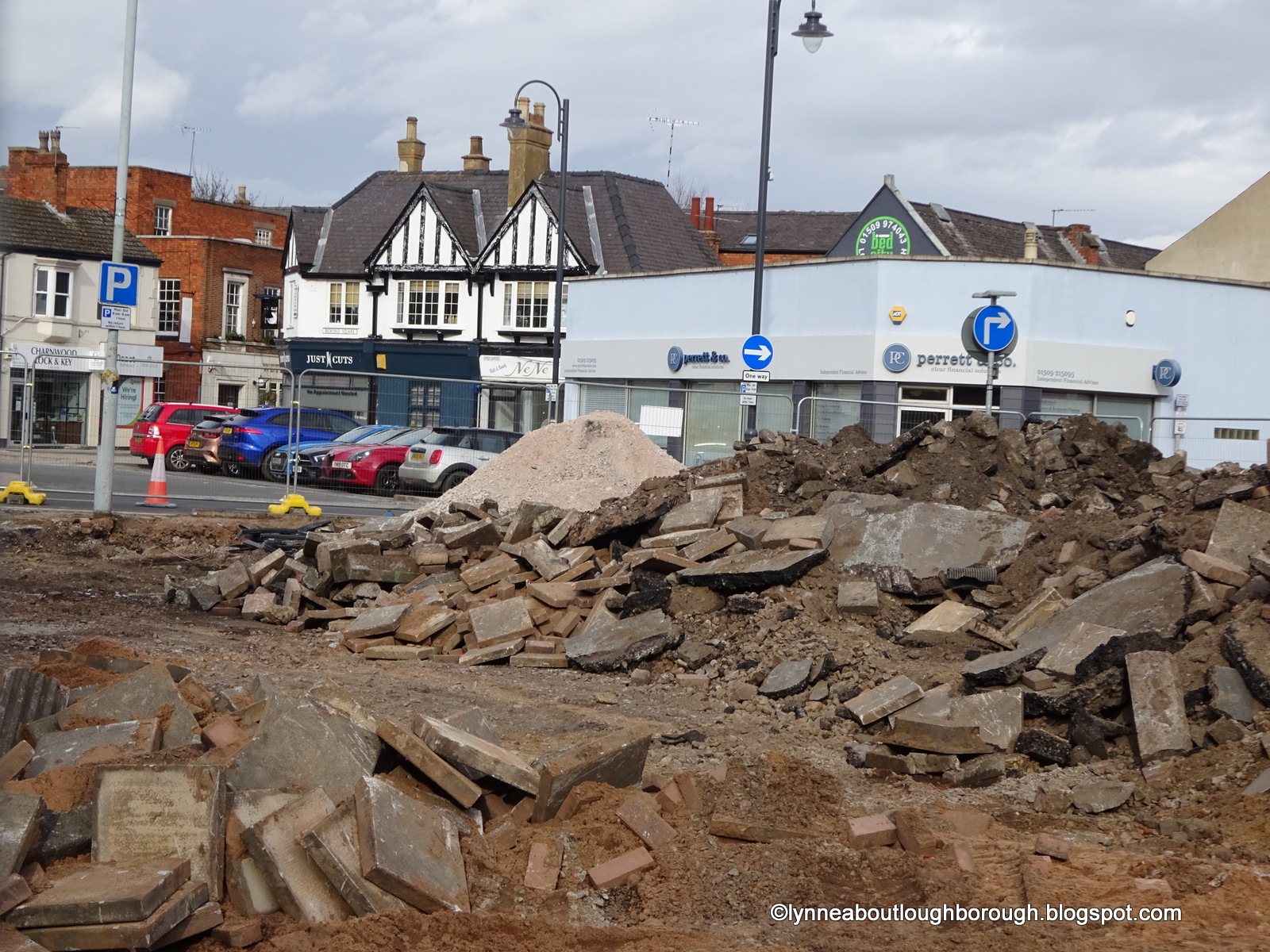
Firstly, the extensive works to improve the area around Bedford Square and Wards End have finally been finished - or have they?

February 2022


May 2022

June 2022


Meanwhile, down at the Bellfoundry, there's lots happening, as a new museum space is being developed. Let's have a quick peek at how this work began in March 2022:


Domestic properties have also been subjected to lots of work during the past year. Here's one Victorian property. I can't find my earlier photos, so here are two from December 2022:


As have some properties close by:


And a former farm being redeveloped in April 2022 (more pics in an earlier post):


The former Co-op on Derby Road has very recently featured in a blogpost. You can see pictures of it alongside other Art Deco buildings in a post from 2021. Here it is during its renovation in January 2022:


In August 2022


And in November 2022


Meanwhile, in the town centre, the Devonshire Square mural, which was suffering a little, has now been removed completely. This picture is from March 2022, and you can see more pictures of the whole mural in an earlier blogpost.


Over on Fennel Street, which is now the A6 inner relief road, things have been happening during 2022. The first shot is from February, the other two from November:


The 1930s labour exchange over on Cradock Street has now been demolished and a new building is currently being constructed. Here are pics from March and December 2022, and you can see more over on an earlier blogpost:


And the premises nearby that used to be Ellwoods Garage, and more recently a car wash, is no longer standing. Picture from December:


A former industrial building - GTG Engineering, previously one of the Grudgings, needlemakers, premises - over on Albert Street is also having an extensive makeover. You can read more about the Grudgings factories on an earlier blogpost and in 'Loughborough in 50 buildings'. The following three pics and the last one are from June and the fourth is from November:


And although it's slightly out of Loughborough itself, here are some pics from August and October of the work going on to build houses on the former Garendon estate:


Finally, the new cemetery off Watermead Lane is all ready to be used:


Apologies for not reporting on so many of the changes happening lately, but hopefully the above will show you a teeny bit of what has been going on during 2022!

____________________________________

posted by lynneaboutloughborough

With apologies for typos which are all mine!

_______________________________________________

Thank you for reading this blog. You are welcome to quote passages from any of my posts, with appropriate credit. The correct citation for this looks as follows:

Dyer, Lynne (2023). Changes in Loughborough in 2022. Available from: https://lynneaboutloughborough.blogspot.com/2023/01/changes-in-loughborough-in-2022.html [Accessed 5 January 2023]

Take down policy:
I post no pictures that are not my own, unless I have express permission so to do. All text is my own, and not copied from any other information sources, printed or electronic, unless identified and credited as such. If you find I have posted something in contravention of these statements, or if there are photographs of you which you would prefer not to be here, please contact me at the address listed on the About Me page, and I will remove these.

Blog archive and tags:
If you are viewing this blog in mobile format, you will not be able to easily access the blog archive, or the clickable links to various topics. These can be accessed if you scroll to the bottom of the page, and click 'View Web Version'. Alternatively, there is also a complete list of posts, which when clicked will take you to the page you are interested in.  
 
Thank you for reading this blog. 

Lynne

Sunday, 15 February 2015

Grudgings the Needle-makers

The needle-makers of Loughborough

A couple of weeks ago you may remember I posted a couple of articles on needle-making and promised you a blog post on one specific Loughborough company of needle-makers, but before I introduce you to that family, here's a quick update on other needle-making firms that appeared in the 1872 Loughborough street directory:

  • Thomas Armstrong in Pinfold Gate and at 11 Leicester Road
  • J T & C Grudgings at 7 Woodgate and on Packe Horse Lane
  • W Hammond Bearded Needles & Sons, one factory on Havelock Street (factory demolished in the 1960s was on the site of the current Goods Yard Close) and another on Bridge Street, on the corner of Limehurst Avenue opposite the former Fire Station (now ATS Euromaster) and Bridge Street, probably demolished in the 1980s, though left derelict for sometime
  • William Hubbard in Union Street (now the tiniest little cul-de-sac off Ashby Road, opposite the Old English Gentleman pub)
  • There is also another potential needle-making factory, as yet unidentified (by me, at least) along the jetty leading from Duke Street to Meadow Lane, which in 1925 could be W & W Hubbard  
There are, of course, other trades related to the hosiery industry and needle-making but let's get back to the Grudgings!

The Grudgings family had at least three needle-making factories in Loughborough:
  • on Woodgate/Packe Horse Lane (opened in 1850-1 and certainly around in 1872) 
  • School Street (J T & C Grudgings - being Josiah, Thomas and Charles Cross) 
  • and Albert Street (Daniel & Bros.).


Grudgings, now GTG Engineering, Albert Street


If you've read my previous posts you'll know that the Albert Street factory is still standing and is used by GTG Engineering, a company which was established as long ago as 1959, and provides "precision engineering, mechanical testing and metallurgical specimens and equipment to the aerospace and allied industries."


Grudgings, now The Needleworks, on School Street
The other two factories have disappeared, one on Woodgate - with an entrance also on Packe Horse Lane - at number 7 Woodgate, next door to the Marquis Of Granby pub, which was on the opposite corner of Packe Horse Lane from the Old Packe Horse Inn (now the Organ Grinder) - and the other being partially demolished and re-built as flats (28 School Street).


The Grudgings family who owned and worked in needle-making factories in Loughborough originated from Ratby, where Daniel Grudgings (let's call him senior) was in the needle-making trade (as was his father, also Daniel). His son, also Daniel (let's call him junior), moved to Desford and took needle-making there, and some of his sons brought the work to Loughborough, and created the Grudgings needle-making factories mentioned above. Years later, one of Daniel junior's grandsons took needle-making to Kegworth.

Between 1871 and 1881, members of the Grudgings family, either needle-masters, or needle-makers, were living in various dwellings in Loughborough, including numbers 1 & 2 Albert Street, number 4 Albert Place, number 8 Bedford Street (which appears to be on the end of the terraced houses, exactly where Browns Lane now cuts through), 2 Southfield Road, and 58 Woodgate (approximately where the Print House is). In later years, members of the family can be found living on Paget Street, Herrick Road (numbers 116 & 118), Beacon Road (numbers 14 and 20), 40 Moor Lane, 32a Cobden Street, 2 Corporation Road (no longer standing), 234 Forest Road (no longer standing), and more recently Charnwood Road.

Charnwood Road
116 & 118 Herrick Road


These days we probably struggle to conceive of the number of needles that would actually need to be made in order to support the hosiery industry: Needle-making was a skill and in high demand, as Loughborough and the surrounding area were major areas of hosiery production. Now, I'm no expert on the hosiery industry of the past, so I'm not sure whether they would have been producing latch needles or bearded needles, although, given that another firm, Hammonds, were publicised as bearded needle-makers I'm erring on the side of the bearded variety.

I do have it on good authority that if you were an engineer maintaining one of these hosiery making machines, you would be sure to wear a suitable boiler suit as, clambering under the machines you would come out covered in needles! And, if you worked on the milling machine, you needed to be careful not to get the beards caught in your fingers: They hurt and were very hard to get out!

In later years, the Grudgings family branched out from needle-making, so in the late-nineteenth century, early-twentieth century, we find school teachers (one at Cobden Street), in 1901 a trainee teacher was boarding on Uppingham Road, Leicester, also shoemakers, iron workers and I'm sure many of us will remember Grudgings tobacconist and confectioners who last traded on Swan Street.

Regarding the fortunes that were made in the Grudgings' needle-making enterprises, Daniel senior died in 1870 leaving under £100. Daniel junior died in 1876 and left effects under £450. Charles Cross Grudgings who died in 1918 left £5658 5s. 6d..

In 1871 there seems to have been some kind of industrial dispute, which may or may not have included the Grudgings needle-makers. on Tuesday October 17th, 1871, the Birmingham Daily Post reported:

"Strikes in the hosiery trade. The strike amongst the hosiery needle-makers of Nottinghamshire and Leicestershire still continues, with no prospect of a settlement at present. The master needle-makers will not acceded to the demands of the journeymen, which must cause great inconvenience to the hosiery manufacturers generally, if a speedy settlement does not take place. The men still remain firm in their demand, and it is stated do not intend to resume work until their demand is complied with."

I would like to end this post by mentioning that at least three members of the family were involved in WW1. Henry Archer Grudgings, son of Daniel (himself grandson of Daniel senior), born in 1892 died in battle on 13th May 1915, aged 23. William, also a great-grandson of Daniel senior, an elementary school teacher, joined the war in 1916, and survived. His story is currently being told on Twitter. Henry Ernest, also a great-grandson of Daniel senior via a different line, was a Gunner in the Royal Artillery and also survived the First World War.

I would like to thank a number of people for their help with my research including (but any factual inaccuracies, spelling and grammar mistakes are all down to me rushing as usual):

Stephen, Tony, Ray, Steve, Rob, Roy, Ernie, Margaret, Karen and the lovely folk at the Forge Mill Needle Museum in Redditch.


Sunday, 18 January 2015

Needle-making in Loughborough


Although last week's post included a little bit about needle-making, I've been meaning to write a longer post about needle-making in Loughborough for a very long time, prompted by a number of things, including spotting a photograph of a building I walk past every time I walk into town in a local history book, a postcard sent to someone in Loughborough with the same surname as the local needle-makers, a visit to the needle-making museum in Redditch, and a visit to Astley Book Farm!


At the Book Farm I discovered a book in the Shire Books series on needle-making, which was fascinating, and in the back was a list of places to visit, which included Redditch.


I had only ever been to Redditch once before, so put a trip there on my wish list, particularly to visit the Forge Mill Needle Museum. Here I discovered that not only was Redditch famous for sewing needles, but also for other, related sharp, pointy bits of metal, like darts, hooks for fishing rods, and medical syringes.


This got me to thinking about Loughborough, because I was sure on my travels through some of my local history books I knew I'd seen reference to needle-makers in Loughborough, and wondered why Redditch became the centre of needle-making in the country. Now, having tried to do a bit of research, I can only assume it was because the needles manufactured in Redditch were the sort used for hand-stitching, whereas those made in Loughborough were for framework knitting machines, initially bearded needles, then superseded by latch needles.


On a trip to Lichfield a long time ago I spotted some postcards that had been sent to someone in Loughborough, but it was only when I got home that I worked out the significance of the addressee, and I so wished I'd bought them. A little while before Christmas 2014, I visited Lichfield again, looking for some solace in the Cathedral and some Christmas presents in the shops. I suddenly remembered about the postcards I'd seen before and on the off-chance popped into the same shop I'd seen them in to look for some other presents. Imagine my surprise to find the postcards still there: This time I bought one - only when I got home I wished I'd bought them all!! The one I bought was a postcard from Leicester from an elementary school teacher to her slightly older elementary school teacher sister who was living in Loughborough. They were associated with one of the main needle-making families in the town.


As for that building, I admit I don't get into town as often as I used to, but when I do I always walk, and my journey takes me along Albert Street. I've often looked at the strange building on the end, but it wasn't until I acquired a copy of  Bygone Loughborough in Photographs, vol.2, that I discovered the building used to be a factory making needles.


Some of the needle-makers I've found listed are:

1841
  • Samuel Armstrong, Mill Street
  • Samuel Chester, Bridge Street
  • John Holland, North Street
  • William Priestley, Woodgate

1881
  • William Battison, Mill Street
  • Luke Cashmore & Sons, Mill Street
  • Charles, Thomas & Josiah Grudgings, Albert Street
  • William Hubbard, Regent Street

1912
  • Luke Cashmore & Sons, Mill Street
  • Charles, Thomas & Josiah Grudgins, Albert Street
  • William Hammond, 64 Leopold Street
  • Hartshorn & Hoult, 39 Pinfoldgate
  • Walter Hubbard, Meadow Lane

1925
  • Daniel Grudgings & Bros, Albert Street
  • J T & C Grudgings, School Street
  • William Hammond & Son, The Rushes *
  • William Hubbard, Meadow Lane

1928
  • Daniel Grudgings & Bros, Albert Street
  • J T & C Grudgings, School Street
  • William Hubbard, Meadow lane

1941
  • Daniel Grudgings & Bros, 1 Albert Street
  • J T & C Grudgings, 8 School Street

* I believe Hammonds might have been on Havelock Street at one time too.

Pop back next week or the week after to read a bit more about one of the needle-making families in Loughborough.

lynneaboutloughborough


Sunday, 11 January 2015

Needlemaking and other Loughborough connections

This week the Loughborough Archaeological and Historical Society held their members event which sees members of the society give presentations on things they've been researching that would be of interest to others. This year, I decided to give it a go, and presented a short talk on archaeology - my kind, not the trench-digging, field-walking kind - with examples of artefacts I've found on my travels that have informed my research.

If you would like to see the presentation, I've uploaded the slides , and I've included the transcript below.

Archaeology and the fundamental interconnectedness of all things (with thanks to DA)

In late 2012, when I responded to an advert for members of the public who were interested in the history of Loughborough to enrol on a 6-month course in Leicester on learning how to lead a guided walk, little did I know what was actually in store for me!

At the first session of the course I felt like a complete interloper! Almost everyone else there was attached to a museum  - The Old Rectory, The Abbey Pumping Station, The Space Centre, The GCR, Newarke Houses etc. – so I attached myself to the unattached chap next to me and we got on like a house on fire, which was great as he was a retired fire officer!

As a daughter of the grim industrial areas of South Wales, what exactly did I think I had to offer to people who might be interested in the history of our little market town – and probably knew more about it than I did anyway!

Well, to cut a very long story short, I may have known very little about Loughborough at the start of the course, but many years of researching significant (that’s significant to me) areas of Wales, and endless hours of pouring over census returns and bmd records in a quest to complete the family tree, all held me in good stead. And maybe, just maybe, being a librarian by day was also a bit of help!

So, I passed the tour guiding course, and have shared some of my knowledge on guided walks. But when I read on Twitter about 18 months ago that some people viewed Loughborough as a rubbish town, I decided to try and do something to raise the profile of the town. Thus, the blog, lynneaboutloughborough was born. Each Sunday evening I write a piece about, or related to, our wonderful town, and share this on the internet for anyone to read.

Articles are prompted by my own interests, by things people have said to me, by events happening in and around the town, and by chance finds.

I know the Loughborough Archaeological and Historical Society started life as the Loughborough and District Archaeological Society, and although I was daunted at the prospect of joining such a prestigious group, I paid my subs and showed up at meetings. Now, I know nothing about archaeology except what I’ve seen on television programmes like Time Team, and in truth, I have a bit of an aversion to getting dirty, but I bit the bullet and went on a fieldwalking event, and thoroughly enjoyed walking through a recently ploughed field looking for bits of debris that might be a flint arrowhead, or some kind of pottery. Problem was though, having been brought up in South Wales I could easily recognise slate, and had there been any granite I would have recognised that too, from regular holidays in Cornwall. But, I didn’t find anything significant, and was really rather more interested in the 19th century horseshoe I spotted!

So, if digging trenches and walking ploughed fields isn’t quite my kind of archaeology then what is?

Well, antique and junk shops are! Charity shops are! 2nd hand bookshops are! The internet is!

So, I dig around all of these, looking for clues, usually about something specific, but equally often just picking up things that might be of interest. Everything I see of buy helps me to build up a picture of what I’ve been researching into and helps me to understand more about social history.  

Take this postcard. A picture of Leicester, sent to someone in Loughborough and bought over 100 years later from Lichfield. To me, this is all hugely significant: My journey from home to town takes me along Albert Street, and I’ve always been fascinated by the engineering factory on the corner. Research revealed that it had once been a needlemaking factory, one of the ones run by the Grudgings family, at least one of whom died during WW1, and at least one other who survived (and whose WW1 diary is tweeted via the Carillon Museum). And here I am holding a postcard sent to Flo Grudgings, an elementary school teacher and a member of that needlemaking family. The card was posted in 1903.

And then, of course, there’s the Lichfield connection. Wasn’t Lichfield Cathedral once the cathedral associated with our town? And at least some of the current bells were cast by Taylor’s Bell Founders in 1947. It was Taylor’s, of course, who cast the bells for our beautiful war memorial, which can still be heard on Sundays when the carillon is played.

I did a spot of volunteering at the Carillon Museum this year, just before my grandmother died. How strange then to learn at her funeral that a long lost uncle who emigrated to the States in the ‘60s, regularly plays the carillon in his home town of Morristown, New Jersey.

But, back to archaeology! Earlier, I said I could recognise slate and granite, but perhaps I should also add alabaster to that list. I first met Ray State in the local studies library about a week after I’d written an article on spar ornament makers of Loughborough, so it was a real pleasure to come along and hear him talk, just before Christmas. Curiously, also a couple of weeks before Christmas, we had a sale of unwanted goods at work: We’re trying to raise money to train a guide dog, and for the huge sum of 50p I bought this alabaster egg. I got the feeling people thought I was a bit mad, but I’m now so glad I did buy it! Needless to say, I have been scouring the shops for other alabaster ornaments, but I don’t think I’ll ever find any! But, who knows, I might yet be surprised …

… as I was on another recent shopping trip looking for suitable Christmas presents!

Imagine my total astonishment and excitement when I stumbled across this trunk! Ok, so it’s a steamer trunk, but not just any old steamer trunk! Fortuitously, the last luggage label had been left on: This trunk belonged to Charles Knight Deeming, he, latterly of One Ash House, the former owner of the current Odeon (aka The Empire, The New Empire, The Curzon, The Reel), and the now demolished Victory Cinema, which stood in Biggin Street on the site now occupied by a card shop, Games Workshop and Bonkers.  

Ironically, I’m a little bit interested in cinema and theatre and had been researching the family tree of Charles Deeming. Unfortunately, at £165 the trunk was too expensive for me to buy – so no prop to show you!

Finally, it was a visit to a 2nd hand bookshop in Warwickshire that led me to this publication,  Needlemaking, and the list of places to visit in the back. This included Forge Mill Needlemaking Museum in Redditch. This, of course, takes us back to the Grudgings family where we started, unless we want to explore these connections further, for Bordesley Abbey was on the same site as the needlemaking museum and there is a strong connection to Garendon Abbey and has been the subject of a community dig.

So, our archaeologies are fundamentally interconnected, but I must stop here, otherwise I could carry on connecting for a very long time!

Thanks for listening!