Showing posts with label Woodthorpe. Show all posts

Saturday, 25 January 2025

Ones to watch

Time seems to be flying by, and we're already near the end of January!

Following the previous two posts about changes that happened in Loughborough during 2024, here's a very short post, focussing on changes and developments that are going to happen largely in 2025. I shan't cover the Garendon Estate here, as it's such a big project, and the properties aren't likely to be completed anytime soon. So, here are just two of the many developments I've seen recently.

Firstly, something finally seems to be happening to Atherstone House, the building which until October 2023 was home to the Moon and Bell, a Wetherspoons pub. Signs have appeared in the windows, work people have been spotted upstairs, and the signage suggests things will be progressing in the spring.


The other development I've been watching closely is the new housing that is starting to be built on the outskirts of Woodthorpe village. The entrance to the field being built on is where the road takes a ninety-degree turn to the village houses. If you walk along that road, there is a footpath to the left, which takes you to the GCR bridge (no. 339), and thence to the back of One Ash, and into Quorn. However, you can look back from the bridge towards the house building, which gives a sense of how big the field and the building area is. Hope that makes sense!!

The approach from Epinal Way Extension - Woodthorpe to the right 


The GCR bridge


Looking back towards the perimeter of the field showing the William Davis bridge


Looing back towards the field being developed

Exiting Woodthorpe - now a give way to the construction traffic

____________________________________

Posted by lynneaboutloughborough

With apologies for typos which are all mine!

_______________________________________________

Thank you for reading this blog.

Copyright:

The copyright © of all content on this blog rests with me, however, you are welcome to quote passages from any of my posts, with appropriate credit. The correct citation for this looks as follows:

Dyer, Lynne (2025). Ones to watch. Available from: https://lynneaboutloughborough.blogspot.com/2025/01/ones-to-watch.html  [Accessed 25 January 2025]

Take down policy:

I post no pictures that are not my own, unless I have express permission so to do. All text is my own, and not copied from any other information sources, printed or electronic, unless identified and credited as such. If you find I have posted something in contravention of these statements, or if there are photographs of you which you would prefer not to be here, please contact me at the address listed on the About Me page, and I will remove these.

External Links:

By including links to external sources I am not endorsing the websites, the authors, nor the information contained therein, and will not check back to update out-of-date links. Using these links to access external information is entirely the responsibility of the reader of the blog.

Blog archive and tags:

If you are viewing this blog in mobile format, you will not be able to easily access the blog archive, or the clickable links to various topics. These can be accessed if you scroll to the bottom of the page, and click 'View Web Version'. Alternatively, there is also a complete list of posts, which when clicked will take you to the page you are interested in.

Searching the blog:

You can search the blog using the dedicated search box that appears near the top of the blog when viewed in the web version. Alternatively, you can search using your usual search engine (e.g. Bing, Google, DuckDuckGo etc.) by following this example:

site: https://lynneaboutloughborough.blogspot.com/ “Radmoor House”

NOTE – the words you’re actually looking for must be in “” and the first of these must be preceded by a space

Thank you for reading this blog.

Lynne

Thursday, 27 July 2023

Ernest Edwin Coltman and Ernest Huram Marsh

What follows is the tying up of another loose end I promised in relation to Ernest Edwin Coltman, and it is indeed a relation we are considering! Ernest Edwin Coltman had a nephew, well, actually he had more than one nephew, and nieces too, but it is one specific nephew who is the subject of this post.

Possibly named after his uncle, and very likely to have been named after his grandfather, Ernest Huram Marsh was born on 18 July 1892 at TempĂ© House in Swepstone. Swepstone was a small parish in North-West Leicestershire, which had been in existence since before the Domesday Book of 1086. Ernest’s parents, who had married in 1882, were John William Marsh, a farmer who had been born at Woodthorpe around 1855, and Eliza Ann, Ernest Edwin Coltman’s older sister.

Woodthorpe in July 2023


Ernest Huram’s older sister Frances Ethel Marsh had been born in 1885, and Mabel Eliza Marsh in 1888. In 1891 the family were living at a farm in Swepstone, and had a nursery governess, Lucy Hill, a general domestic servant, Julia Cooper, and Edward Basford was the farm hand. In 1901 When Ernest Huram Marsh was aged 8, the family were still in Swepstone, but now only had one servant, Emily Wood. In 1902, another son was born – John Bernard Sidney Marsh, however, by 1911 the family had moved to Forest Road, Loughborough, next door to a house called Forest Hey. Father John was now a corncake merchant, living with his wife, Eliza, two daughters Frances and Mabel, and son John.

Forest Hey looking away from town


Forest Hey looking towards town

Ernest Huram attended the Loughborough Intermediate School, before going on to the Loughborough Grammar School, where he seemed to excel at sport, gaining the Kaye Cup for athletics in both 1908 and 1909. He was also Captain of the First XI football, a member of the First XI Cricket, and of the Tennis VI. Oh, and he also had the nickname of 'Emma', whilst at LGS, a name which he still rejoiced in, throughout his life.

Loughborough Grammar School in 2021

Ernest Huram, in 1911, was now nearly 17, and had been engaged in an apprenticeship for two years, since 1909. This apprenticeship had followed a period of general education at the Loughborough Intermediate School, which he attended from 1901-1906, before moving on to the Loughborough Grammar School from 1906-1909, where he had passed the Senior Oxford Examination. His younger brother, John Bernard Sidney Marsh (known I believe as Bernard) would also attend the LGS.

Ernest Huram undertook his technical education at the Grantham Technical Institute from 1909-1910, where he studied second stage Practical Maths; gained a second class in Machine Drawing, and in first stage Applied Mechanics. In each of his first stage Applied Mechanics, Construction, and Heat Engines studies he gained a first class. 

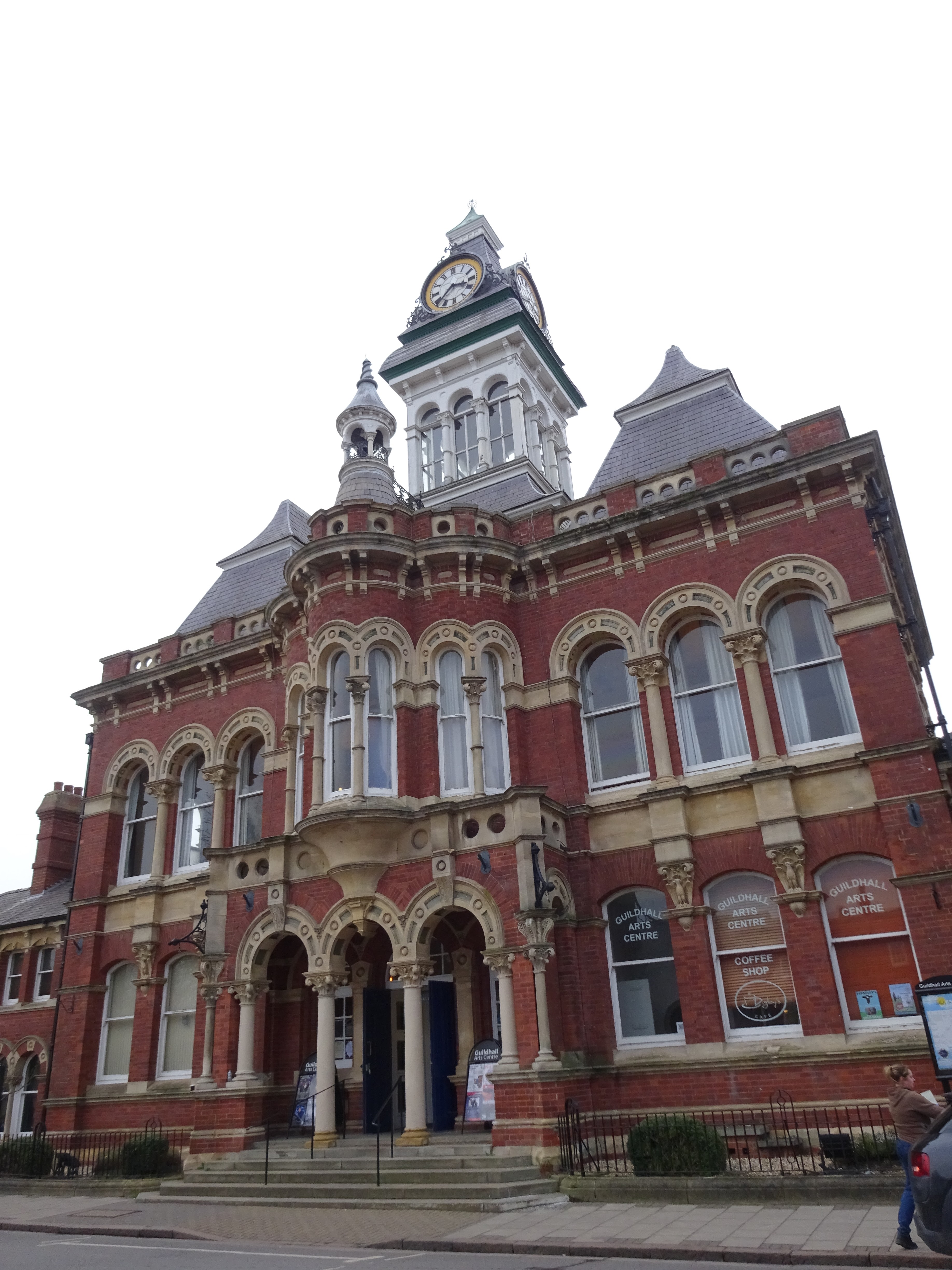
In 1897 the Grantham Technical Institute moved into this building, the former guildhall and jail. Whether or not it was still the Institute when Ernest arrived, I'm not sure.

At the age of 16 ½, Ernest Huram began an apprenticeship with Hornsby’s, in the gas-engine fitting and erecting workshops. In December 1910, at the age of 18, Ernest Huram March applied for membership of the Institute of Mechanical Engineers. He was an engineering pupil, working for Messrs. Richard Hornsby and Sons, Ltd, at Spittlegate Iron Works in Grantham, where he was an apprentice. The iron works were adjacent to the LNER as it passed through Grantham.

Richard Hornsby, snr., had taken over the well-established firm (makers of ploughs and seed drills) in 1828, and the company had thrived, winning a council medal at the Great Exhibition in 1851 at Crystal Palace for their products – a corn and seed drill, drop drill, two-row turnip drill on the ridge, oil-cake bruiser and steam engine – reminds me of Robert Bakewell! By 1861, the firm were employing 378 men, and when Richard Hornsby snr. died in 1864, the firm was carried on by his son, Richard, who led the company to more prize-winning products. After its becoming a limited company in 1879, more prizes followed, so by the time Ernest Huram joined, the firm it was thriving.

His application to the Institute of Mechanical Engineers was proposed by Charles H. Gadsby, a member of the Institution, who was based in London and was his uncle by marriage, having wed Florence Mary Coltman in 1886. The proposal was supported by another member of the Institution, this time, John Charles Coltman, another uncle, based in Loughborough. Further supporters of the proposal were members David Roberts, and Charles James. I believe the proposal was accepted and Ernest Huram Marsh joined the Institute as an associate.

So, while his family is living on Forest Road, in 1911, Ernest Huram is boarding with the Bowler family at 20 St Annes Street, Grantham, and his occupation is confirmed as a pupil engineer. Whatever Ernest had planned next was not to be as 1914 saw the outbreak of the First World War, and Ernest signed up with the Sherwood Foresters (Notts and Derby Regiment), by December 1914 being a temporary second lieutenant.


Is it possible that during this time, in July 1915, Ernest applied for a patent as the inventor of machine-gun mountings, as reported in the ‘Belfast News-Letter’?


As far as I know, the Royal Air Force was created on 1 April 1918, and by the time of his marriage, Ernest Huram had become a captain with the RAF. On 25 April 1918, Ernest married Margaret Althea Cook at the Wood Gate Baptist Chapel. Miss Cook was attended by her two sisters, Barbara Cook and Irene Cook, and Ernest’s sister Frances. At this time, Frances was serving with the VADs at Loughborough General Hospital, so was able to attend the wedding, unlike sister Mabel who was also in the VADs but who was stationed in Cairo, so would have been unable to attend. Their cousin, Phyllis Coltman, also served as a VAD, between 1916 and 1919.  

In 1921, Ernest, now aged 28, and his wife Margaret aged 24, were living with son David who had been born in 1920, at High Crest, Whaley Bridge, Derbyshire. Ernest was a Mechanical Engineer Representative with the firm, W. H. Allen, Sons and Co Ltd. Bedford.  

W. H. Allen, Sons and Co. Ltd. had been formed in 1880, originally in London, but had moved to Bedford. The business was involved in many things, including mechanical, hydraulic and electrical machinery, but specialised in the early 1900s in high-speed steam engines, centrifugal pumps and pumping engines for irrigation, and more. So, in many ways, very similar to the trade carried on by Ernest’s Coltman relatives in Loughborough.

In 1927, Ernest’s father, John William of Brooklands, Forest Road, Loughborough, died, and probate was granted to Ernest, a commercial traveller, and his brother John Bernard Sidney, a chartered accountant. Effects were £2,742 16s. 5d..

Ernest Huram Marsh applied for full membership of the Institution of Mechanical Engineers on 2 January 1939. On his application for membership, Ernest cited his occupation as “Representative Engineer in Yorkshire for Messrs. W. H. Allen, Sons & Co. Ltd.” Whoever it was who proposed his application had known Ernest for 20 years, and the seconder had known him for 16. The references that Ernest suggested were Lieutenant Colonel E. Kitson Clark MA, who was a past president of the Institution; F. C. Lea, Esq., OBE, DSC, a member of the council, and A. Roebuck, who was also a member of the council. Ernest states that although: “I have not passed the examination [the Associate Membership Examination], but was a Graduate of the Institution from about 1912 onwards.” Nonetheless, his application appears to have been successful.

By September 1939, Ernest, his wife Margaret, and their two boys, David J. (aged 19, and at college), Keith E. (aged 16 at school) and daughter Margaret R. aged 17, a social science student, were living at 4 West Park Place, Roundhay, Leeds. Ernest was still working for W. H. Allen Sons and Co. as a chartered mechanical engineer and representative.

On 30 December 1939, Ernest Huram Marsh’s mother, Eliza Ann, died, while living at Brooklands, Forest Road, Loughborough. Probate was granted on 20 April 1940 to Frances Ethel (who had married Arthur Thomas Walsh), Mabel Eliza Marsh, Ernest Huram Marsh, a commercial traveller, and John Bernard Sidney Marsh, chartered accountant. Effects were £7,427 18s. 

Of course, the 1939 register was taken at the outbreak of World War Two, and Ernest’s mother died shortly after this. By 1940 we find Ernest is a pilot officer with the RAF Volunteer Reserve (85181).

Ernest survived the war, and by 1958, we find him and wife Margaret living at Fosscote, Weeton Lane, near Barkston Ash, West Yorkshire. It might be that this is where Ernest and his wife retired to, since in November 1958, Ernest retired from W. H. Allen, a company he had been with for nearly 40 years. The trail here runs a bit dry. After 5 years of retirement, during which time Ernest had probably continued to play tennis and golf, there follows the death of Margaret Althea Marsh, Ernest’s wife, of Foscote, Weeton Lane near Leeds, on 23 August 1963. Probate was granted to Ernest on 16 September 1963. The effects were £1,945 11s. 4d..

Ernest Huram Marsh continued to live at Fosscote, on Weeton Lane, until his own death on 11 May 1971. Probate was granted on 13 August 1971, and effects were £13,072. 

It is interesting to note that Ernest Huram Marsh did not follow in the footsteps of his father John William Marsh, who early in life was a farmer, before becoming a cornfactor – a dealer in corn – nor of his grandfather, Joseph Marsh, who in 1861 was farming 230 acres in Woodthorpe, and employing 5 men. Rather, Ernest Huram Marsh followed in the trade of his namesakes, and maternal relatives – Ernest, his uncle, the boilermaker and engineer, and Huram, his grandfather, an enginesmith, boilermaker, and engineer.                

___________________________________

posted by lynneaboutloughborough

With apologies for typos which are all mine!

_______________________________________________

Thank you for reading this blog.

Copyright:

The copyright © of all content on this blog rests with me, however, you are welcome to quote passages from any of my posts, with appropriate credit. The correct citation for this looks as follows:

Dyer, Lynne (2023). Ernest Edwin Coltman and Ernest Huram Marsh. Available from: https://lynneaboutloughborough.blogspot.com/2023/06/ernest-edwin-coltman-and-ernest-huram.html [Accessed 16 July 2023]

Take down policy:

I post no pictures that are not my own, unless I have express permission so to do. All text is my own, and not copied from any other information sources, printed or electronic, unless identified and credited as such. If you find I have posted something in contravention of these statements, or if there are photographs of you which you would prefer not to be here, please contact me at the address listed on the About Me page, and I will remove these.

Blog archive and tags:

If you are viewing this blog in mobile format, you will not be able to easily access the blog archive, or the clickable links to various topics. These can be accessed if you scroll to the bottom of the page, and click 'View Web Version'. Alternatively, there is also a complete list of posts, which when clicked will take you to the page you are interested in.

Searching the blog:

You can search the blog using the dedicated search box that appears near the top of the blog when viewed in the web version. Alternatively, you can search using your usual search engine (e.g. Bing, Google, DuckDuckGo etc.) by following this example:

site: https://lynneaboutloughborough.blogspot.com/ “Radmoor House”

NOTE – the words you’re actually looking for must be in “” and the first of these must be preceded by a space

Thank you for reading this blog.

Lynne

Sunday, 30 October 2022

Loughborough's letterboxes Pt 5

Last time in this letterbox series, we looked at EIIR pillar boxes in Loughborough, and before that in Parts 1-3, we investigated our anonymous box, the Victorian pillar boxes, and the EVIIRs, GRs, and GVIRs. Today, let's have a look at other types of letterboxes, like lampboxes and wallboxes, from across the years.

Wallboxes

One of our best wallboxes is the one on the Midland Mainline railway station, but sadly, it's only in view if you happen to be on Platform 1. I wonder how much use it gets, given that it's so well hidden?! Anyway, it's a beautiful VR box, although I can't tell who made it, as the photo I took some time ago is a bit blurry, and the box has been repainted so many times, the maker's mark has lost its definition.

The VR wallbox at the railway station on Platform 1

As far as I know we only have another two wallboxes, both of which carry the GR cipher, so they were installed between 1910 and 1936. 

The box in the wall at the bottom of Beeches Road, at its junction with Leicester Road, is on the side of the Lifestyle Express minimarket, which many will remember as Maher's Off-Licence, and which many years ago used to be the home of the Clemerson family, and was once known as the Paul Pry. The box was made by Derby Castings, which was the name used by the Handyside company, from Derby who made some of the pillar boxes we've seen in earlier posts. Derby Castings was operating from 1931-1933, so this box can be dated quite closely:


The GR wallbox at the bottom of Beeches Road

The other GR wallbox is pretty spectacular, and always well-looked after, and sometimes the crown is highlighted in gold. This is another wallbox at a railway station, although this one is at the Great Central Railway on Great Central Road, and unlike the one at the mainline station, this one is actually outside the station. This one was made by W. T. Allen.


The GR wallbox outside the GCR station in 2014

Detail of the maker's mark on the GR box outside the GCR station

Lampboxes

As you might expect from the name, the lampbox was originally designed to be attached to a lamppost, but very few today are, and are mostly supported on their own stick. They were initially placed in more rural areas, or areas where the volume of mail didn't warrant having a larger, pillar box. All the lampboxes I've found so far date from 1952-2022, and bear the EIIR cipher - except one! Most have been made by Carron, and one by Carronade, but there are a few where I haven't been able to identify the maker, while there is one that was made by Machan.

The ones on Manor Road, Meadow Lane at its junction with Ratcliffe Road (outside a corner shop that used to be a post office), Montague Drive, Nanpantan Road, Toothill Road at its junction with Cambridge Street (outside the corner shop), and the one on Woodhouse Lane, Nanpantan outside the Longcliffe Care Home, are all very, very similar, if not the same. Here's the one on Toothill Road:

Lampbox on Toothill Road at its junction with Cambridge Street

The lampbox on Park Road, at its junction with Bowling Green Way, and almost opposite what used to be a post office, is slightly different as the marker's mark (Carron) is a separate piece of metal, screwed into the box, rather than being embossed. This is also the case with the box on Tuckers Road, although the maker here is Machan:

Carron lampbox on Park Road at its junction with Bowling Green Way

Machan lampbox on Tuckers Road


Meanwhile, over on Highland Drive, a new type of lampbox has been installed - it has no maker's mark, seems to be made from a material other than cast iron, has a metal plate screwed in that says 'Royal Mail', and the royal cipher - EIIR - is a silver-coloured plate, attached separately. 


Lampbox on Highland Drive


Close-up of the Highland Drive lampbox

And here's the one that is different and to my mind, is far and away the most beautiful of the lampboxes I've come across! The lampbox in Woodthorpe comes the closest to its original support as I've seen - it's attached to the side of a wooden stake, rather than being on its own post. It carries the GR cipher, and therefore probably dates from between 1910 and 1936, and whereas most of the EIIR ones are an upright oblong shape, that round down towards the back, the Woodthorpe box is an upright oblong, with a curved top. Here's some pics that'll make more sense than my words!!!

The EIIR lampbox on Montague Road from the side


Woodthorpe GR lampbox attached to a post


A close-up of the Woodthorpe GR lampbox

A view of the Woodthorpe GR lampbox from the side


That's just about covered wallboxes and lampboxes! Pop back to the blog later, to find out about some quirky postboxes, and maybe a story about a rather special pillar box!

If you want to look back over earlier posts about Loughborough's letterboxes, here are the links:

Part 1 - the anonymous pillar box

Part 2 - the Victorian pillar boxes

Part 3 - pillar boxes 1910-1952 

Part 4 - EIIR pillar boxes

____________________________________

posted by lynneaboutloughborough

With apologies for typos which are all mine!

_______________________________________________

Thank you for reading this blog. You are welcome to quote passages from any of my posts, with appropriate credit. The correct citation for this looks as follows:

Dyer, Lynne (2022). Loughborough's letterboxes Part 5. Available from: https://lynneaboutloughborough.blogspot.com/2022/10/loughboroughs-letterboxes-pt-5.html [Accessed 30 October 2022]

Take down policy:
I post no pictures that are not my own, unless I have express permission so to do. All text is my own, and not copied from any other information sources, printed or electronic, unless identified and credited as such. If you find I have posted something in contravention of these statements, or if there are photographs of you which you would prefer not to be here, please contact me at the address listed on the About Me page, and I will remove these.

Blog archive and tags:
If you are viewing this blog in mobile format, you will not be able to easily access the blog archive, or the clickable links to various topics. These can be accessed if you scroll to the bottom of the page, and click 'View Web Version'. Alternatively, there is also a complete list of posts, which when clicked will take you to the page you are interested in.  
 
Thank you for reading this blog. 

Lynne

Sunday, 19 September 2021

Bull-in-the-Hollow Part 3

Bull-in-the-Hollow Part 3 


As we saw in last week’s post, the area around the Bull-in-the-Hollow became a notorious accident blackspot. The grandson of one of the people involved in a fatal accident has been in touch, and what follows is the front-page newspaper report from the  ‘Leicester Evening Mail’, of Monday 1st June 1959. It is interesting that the location is given as ‘at Bull-in-the-Hollow’ not ‘at the Bull-in-the-Hollow’ which seems to imply that that part of the road itself was known as Bull-in-the-Hollow – but I might be reading too much into that!!! Anyway, here’s the report in full:

“In collision with 2 motor-bikes CYCLIST DIES IN ROAD TRAGEDY. 

Whist fan, Mr Reggie Hames (52), of 12, Babbington Road, Barrow-on-Soar, suffered fatal injuries when his cycle was in collision with motor-cycles ridden by two Leicester brothers, who both escaped without injury.

The accident occurred about 10pm on Saturday [30th May] at Bull-in-the-Hollow, the notorious black spot on the A6, near Loughborough.

It is believed that Mr Hames was cycling home after playing whist in Loughborough. “He would go anywhere for a game,” said Mrs Hames.

Mr Hames, a labourer at the Brush E.E. Co. Ltd., Loughborough, was first in collision with the machine ridden by 18-year-old Alan Jones, a soldier in the Royal Engineers, stationed at Devizes, whose home is at Swannington Road, Leicester.

Knocked from his machine, Mr Hames was then struck by a second motor-cycle, ridden by Graham Jones, also 18, of the same address. He is in the Royal Signals.

Pillion Injured.

Mr Hames was taken by ambulance to Leicester Infirmary, where he died.

Riding pillion passenger on the second motor-cycle was Miss Jacqueline Freestone of the Working Girls’ Home [i], Westcotes Drive, Leicester. She was admitted to the Infirmary with a broken collar bone, lacerations and concussion.

Passenger on the other machine was Miss Judith Owen, also resident at the hostel. She was uninjured.

Well-known in Barrow, Mr Hames leaves a widow, two married sons and a son of school age.”

The second motor-cyclist, Graham Jones, and his pillion passenger, Jacqueline [F.] Freestone went on to marry in January of 1960.

Let’s leave accidents now and move on to some different incidents. 

If you’re a fan of the television series ‘Only Fools and Horses’ then you might think that this headline – “No room at the inn for Trigger” – which appeared at the top of an article in the ‘Leicester Evening Mail’ of 17th October 1960, on page 8 - might refer to Colin Ball, aka Trigger, the character played by Roger Lloyd-Pack. But no! This story is about something much closer to home. The subtitle: 

“…SO HORSE AND RIDER BED DOWN IN A GARAGE.

is followed by an article:

… When a modern horseback traveller … arrived in Oadby on Saturday night he found the ‘stables’ at the inn – but they were not for horses. They had been converted into accommodation for ‘horseless carriages.’

That was the situation facing author William Holt, who is riding from London to York, selling on the way the book he has written. [ii]

He was misinformed on the way to Oadby that there were stables at the White Horse.

Rural breath

Yet the problem provoked by the advent of the motor-car turned in the end to his advantage.

A helpful Oadby resident moved his car out into the open for the night and Mr Holt and his grey gelding, Trigger, bedded down in the garage.

Yesterday morning, Mr Holt rode to Leicester to pick up a parcel of books from London Road station to replenish his stock.

And Trigger brought rural breath to the urban scene, lunching from his noseban on the pavement edge, under the watchful eye of a policeman.

Later Mr Holt moved on and after a night in an orchard at the Bull-in-the-Hollow, horse and rider arrived this morning at Loughborough, where there was a slight delay for ‘running repairs’.

Trigger had thrown half a shoe, and there was a visit to the blacksmith[iii] before Mr Holt could move on towards Nottingham. He expects to be in Nottingham tomorrow.”

The Cross Keys today

And finally, several people have confirmed that the road was definitely levelled off in the late 1960s-early 1970s, to make it a safer road to use.


[i] The Working Girls’ Home appears to be a hostel for working girls (!) with information found on a page entitled ‘Children’s Homes’, created and curated by Peter Higginbotham, where this particular home, at 136 Westcotes Drive, is the only one of its kind listed in Leicestershire: http://www.childrenshomes.org.uk/list/WG.shtml Latterly, it was called Bradgate House Residential Home, but has been vacated and vandalised. In November 2018, the artist referred to as Wormsy (well, a nod to the artwork, perhaps not the name of the artist), painted a pink worm on the back to the building which had been sold on and was destined to be converted to flats, although this still hasn’t happened yet.

136 Westcotes Drive, Leicester, 2021


[ii] I think the book in question is the novel, ‘The Wizard of Whirlaw’, because it was written in 1959 (the previous book, also a novel, was published in 1956, so less likely to be part of this promotional tour). Billy Holt, as he was known, seems to have been a polymath, being not only a writer and artist, but also a pioneer of the mobile library service, and the developer of a 'model' farm: Loughborough’s model farm is a topic covered in ‘A-Z of Loughborough’. Trigger, Holt’s horse, was a former rag and bone horse, who was rescued by Holt, and with whom he later travelled across Europe, documenting his travels in a book called ‘Trigger in Europe’ published in 1966, the last book that Holt authored before his death in 1977.

[iii] If Mr Holt was heading towards Nottingham from Loughborough, it’s possible that the blacksmith he visited was Bert Porter, and his son, Brian, who at the time were working out of premises very close to what is now the Phantom, pub, but what was at the time known as the Cross Keys. As well as working from here, the Porters would travel to visit their clients, to shoe their horses. Later, Brian Porter moved his business to Quorn, while his father retired to Wiltshire.        

Posted by lynneaboutloughborough 19 September 2021

You are welcome to quote passages from any of my posts, with appropriate credit. The correct citation for this looks as follow:

Dyer, Lynne (2021). Bull-in-the-Hollow Part 3. Available from: https://lynneaboutloughborough.blogspot.com/2021/09/bull-in-hollow-part-3.html [Accessed 19 September 2021]

Take down policy:
I post no pictures that are not my own, unless I have express permission so to do. All text is my own, and not copied from any other information sources, printed or electronic, unless identified and credited as such. If you find I have posted something in contravention of these statements, or if there are photographs of you which you would prefer not to be here, please contact me at the address listed on the About Me page, and I will remove these.

You can leave comments below, but do check back as my reply will appear here, below your comment.

Thank you for reading this blog. 

Lynne      
Sunday, 12 September 2021

Bull-in-the-Hollow Part 2

Bull-in-the-Hollow Part 2

Bull-in-the-Hollow April 2020


Last week we looked at the early history of the Needless Inn/Buffalo’s Head/Bull-in-the-Hollow up until the end of the nineteenth century. This week, let’s travel through the twentieth century – and take care not to have an accident!!

In 1905 a cyclist collided with horses attached to a brake[i] whilst cycling down the Bull-in-the-Hollow Hill between Loughborough and Quorn. She was pitched forward onto her head, and was taken to Loughborough hospital with severe injuries. She and her friends were returning home from visiting Costock.

In February 1908, severe gales hit the Loughborough area, and a large tree was uprooted near the Bull-in-the-Hollow and fell straight across the road. As it fell it broke the whole of the telegraph and telephone wires on the opposite side of the road and traffic was unable to pass, until the trunk had been sawn through and removed.

In the summer of 1910, a couple of accidents occurred, the first of which involved a horse that was being led near the Bull-in-the-Hollow by a Loughborough man. The horse reared and struck the man on his right shin. On being taken to Loughborough Hospital, he was found to have two broken bones in his leg. In the second incident, in July, a young man suffered serious injuries when he tried to cross the road near the Bull-in-the-Hollow, after following a van. As he ventured to cross the road, there was a car coming down the short slope in the direction of Loughborough, and the man was knocked down by the lamp on the front of the car. The occupants of the car took the man to Loughborough Hospital. As it happened, the driver, who was acting as chauffeur to the gentleman passenger, was driving without a licence, it having run out on 6th June and not been renewed.

Two accidents also occurred in 1914, the first in May when on a journey from Sileby to Loughborough to visit the market, people travelling on the brake suffered a serious fright when they reached the Bull-in-the-Hollow Hill, and the horse stumbled, falling, breaking one of the carriage’s shafts as it fell.  Later in the year, two motorcyclists attempted to pass a governess cart [ii] near the Bull-in-the-Hollow close to the lane leading to Woodthorpe, and in so doing one of them clipped the wheel of the cart, causing the motorcycle rider to be thrown to the ground. He was taken to Loughborough Hospital in a passing car, where he was treated for severe head injuries.

In 1915, a driver was fined for accidentally killing a dog, while driving near the Bull-in-the-Hollow, although there was a conflict in evidence presented between the two parties involved. In the winter of 1916, a local policeman was found unconscious on the road at the Bull-in-the-Hollow near Woodthorpe Lane. It appears that some part of the bicycle he was riding had broken whilst he was riding it, and that caused him to fall to the ground. He was taken to Loughborough (presumably to the hospital), where he regained consciousness, and his condition improved.

In the summer of 1919, it was alleged that a horse had been cruelly treated, but the case was dismissed once the evidence had been presented. Apparently, the horse stumbled at the Bull-in-the-Hollow, and on being pulled up sharply, went lame, but because the person leading the horse took it to be looked at immediately, this was not deemed to be cruelty.

So, the majority of the accidents that have happened so far have involved either horse-drawn carriages of some sort, horses themselves, cyclists or pedestrians. In subsequent years, the motorcycle becomes more popular and accidents involving these, more frequent.

A couple travelling in a motorcycle and sidecar tried to overtake a char-a-banc [iii] at the Bull-in-the-Hollow near Woodthorpe, in September 1920. As they sped down the hill, a car approached coming the other way, and the couple were dragged for some distance as their cycle and sidecar overturned. They were driven to Loughborough Hospital, and returned home later that day in the borough ambulance.

Pedestrians and cyclists were, however, still vulnerable, as is seen in December 1921 when a lady from Stanford-on-Hill [is this Stanford on Soar??] collided with a pedestrian at the Bull-in-the-Hollow, while she was out cycling with her husband, and sustained head injuries. In May 1923, a car collided with a motorcycle and sidecar at the Bull-in-the-Hollow. All vehicles were badly damaged, and the sidecar passenger sustained a broken ankle, abrasions to the arm, and possible internal injuries. Several lorries were held up on their journey between Loughborough and Leicester.

By 1925, the Bull-in-the-Hollow had ceased to be an inn, and was now a gardeners and craftsmans place. Ted Symes ran the nurseries at the property, and was still doing so into the 1970s. It seems to be around this time that the name of the former Bull-in-the-Hollow Inn seems to have been transposed and applied to the area in which the Inn, and now the nursery, stood.

In August 1926, a man sustained a broken collar bone when his motorcycle hit a large log and he was thrown to the ground, at the Bull-in-the-Hollow, and the next month, a car approached the top of the Bull-in-the-Hollow and swerved to miss a parked lorry. In the process the car driver hit a cyclist, who was thrown to the ground. The car driver was fined £2. And in November 1926, a lady was taken to Loughborough Hospital for treatment when she cycled into a ditch near the Bull-in-the-Hollow and broke her thigh bone, during a dense spell of fog. In June 1928 there was yet another cycling accident when a young boy was thrown from his bike at the Bull-in-the-Hollow, and sustained serious head injuries.

By now, the area was beginning to get a reputation, and the ‘Leicester Evening Mail’ of 25th October 1929, carried the following report:

“ “Bull in Hollow” mystery. Drivers of motor vehicles coming into Loughborough from Leicester are continually beset in wet or frosty weather by a notorious bugbear known as the Bull-in-the-Hollow. It is a deceptive dip in the road, where numerous skidding mishaps have occurred but the cause seem to be something of a mystery. One theory advanced by a motorist is that an accumulation of oil dropped by passing motors, particularly buses, is carried down the dip on every rainfall. That may be so, but what about frosty weather mishaps?”  

Knowing this was a bit of a dangerous area did nothing to curtail the accidents though. In 1932, a verdict of accidental death was reached when a van knocked down and killed a little boy from Woodthorpe Avenue, Loughborough. A number of accidents were reported in 1935. It is not clear if a lorry laden with bricks skidded near the Bull-in-the-Hollow, and plunged into the garden of a farmhouse, plunged into the Bull-in-the-Hollow farmhouse, or if it were the farm on the opposite side, known as Quorn Lodge. That was in July, a month that also saw a lorry from a Leicester firm [Pridmore] pulled across the road to pass a stationary bus, and in so doing collided with a car that was coming the other way, ripping off its door. The lorry driver was fined for dangerous driving.

In August 1935 the Loughborough Fire Brigade were called out to attend two grass fires in the vicinity of the Bull-in-the-Hollow, and later that same month, two students who were attending the Loughborough College summer school for teachers were in a car that collided with a lorry near the Bull-in-the-Hollow. Both students were treated at Loughborough Hospital for head injuries, having been thrown from the car, which was wrecked.

Thus, by September of 1935, this particular area of the road from Loughborough to Leicester had its reputation cemented as the “Main Leicester Road danger spot known as the Bull-in-the-Hollow” in a report which appeared in the ‘Leicester Evening Mail’ concerning a Loughborough motorist who had a ‘remarkable’ escape when his two-seater touring car skidded, and hit a telegraph pole, before landing overturned in a ditch.

Throughout the mid-late 1930s, accidents continued to happen near the Bull-in-the-Hollow. In both January 1936 and January 1937, snowy weather may have contributed to these incidents, the first when a driver was absolved on the payment of costs, when charged with driving a lorry without due care and attention. It was snowing and while the driver saw the car coming in the opposite lane, he didn’t notice the cyclist until he was very close to it, and thus drove into the back of the cycle, knocking its rider off, when descending the slope near the Bull-in-the-Hollow. In the second accident, a lady cycling to work at Quorn, from Loughborough, fell off her bike near the Bull-in-the-Hollow and broke her arm.  

In June 1937, a three-month-old passenger escaped unhurt, but the other passengers in the motor car were treated for cuts and abrasions at Loughborough hospital when their vehicle collided with a lorry at the Bull-in-the-Hollow. By November 1937, the area was not just a danger spot, but now a 'notorious' one, according to a report of a crash involving a car and a lorry in the ‘Leicester Evening Mail’.

In 1938, William Dakin was the farmer at the Bull-in-the-Hollow farm: I doubt he’d have been surprised that in August of that year there was a crash when a cyclist from Woodhouse Eaves collided with a bus at the Bull-in-the-Hollow, “a notorious Loughborough danger spot.” He suffered concussion and was treated at Loughborough Hospital. I’m pretty sure though, that Mr Dakin would not have expected there to have been an aeroplane crash in the area! A half-buried plane fuselage in a ditch near the Bull-in-the-Hollow caused a delay to hundreds of motorists as they were stopped by a traffic policeman. Luckily, this was not a real accident, but a staged event for the Loughborough College Rag Week, and motorists who were stopped dug deep into their pockets to make a contribution to the rag fund which was in aid of the Loughborough Hospital.

More real accidents, did, however, follow in 1939, when in April a motorcyclist died when he fell from his bike near the Bull-in-the-Hollow whilst travelling back to Derby, and the bike fell on top of him, and in the same month when a lorry driver, dazzled by the headlights of an oncoming car, crashed into a cyclist. Later, in August, a lorry skidded and left the road, plunging into a ditch near the Bull-in-the-Hollow. One occupant of the lorry escaped unharmed, but the other sustained a cut to the forehead and was treated at Loughborough Hospital.

In May 1941 a car crashed into a stationary lorry near the Great Central Railway Bridge, close to the Bull-in-the-Hollow, but in March 1946 an accident happened at the Bull-in-the-Hollow, which was described in a report in the ‘Leicester Evening Mail’ of 2 March: “four cars were piled up last night, rendered temporarily useless by the snow and weather conditions. A mantle of snow covered the whole of Charnwood Forest area, and trees and hedges presented a Christmas card appearance as a result of a ‘silver thaw’ – that is, a temporary thaw followed by a severe frost. Snow was from two to three inches deep in many places.” And in the same month, a motorcyclist from Sileby was killed at the Bull-in-the-Hollow when his machine skidded. His passenger escaped unhurt.

1947 and 1948 also saw a variety of accidents at the Bull-in-the-Hollow. In January 1947 a motorcycle collided with a lorry at the Bull-in-the-Hollow, and both rider and passenger were taken to hospital with injuries, and in August a car collided with a lorry at the Bull-in-the-Hollow. The car driver was taken to Loughborough hospital for treatment. In August 1948, a motorcycle ridden by a student of Loughborough College collided with a lorry at the Bull-in-the-Hollow; the rider sustained multiple injuries.

The toll of accidents just goes on and on …

In April 1955, a pig strayed into the road near the Bull-in-the-Hollow. A motorcyclist fell from his machine, and sustained head injuries as the pig was hit. The rider was taken to Loughborough Hospital for treatment, but the pig died in the collision. In April 1959, an accident at the Bull-in-the-Hollow saw a car smash through an iron rail, and uproot three concrete posts, before overturning into a ditch. Luckily, the occupants were unhurt. In June 1959, a cyclist died when his cycle was in collision with two motorcycles. A passenger on the motorbike sustained a broken collar bone, various lacerations and concussion.

In July 1963, opening batsman, Harold Bird, missed playing in the match between Leicestershire and Hampshire at the Brush sports ground, because on his journey to the match, he swerved to avoid a dog at the Bull-in-the-Hollow and crashed his car in the ditch, and suffered with concussion.

With all these accidents taking place at or near that notorious ‘Loughborough danger spot’ the Bull-in-the-Hollow, it was surely about time the road was made safer, somehow. Now, I’ve read somewhere that the dip in the road was actually levelled out a bit, sometime in the 1960s, but I can’t remember where I read that and I can’t find the reference again, so, forgive me, this is just dredged up from my memory. If you can shed any light on the truth, or otherwise of this, I’d be pleased to hear from you!

Bull-in-the-Hollow in pictures:

December 2020


May 2021


July 2021


August 2021

September 2021


[i] A brake is a type of four-wheel, horse-drawn carriage, sometimes with a hood. The seats face to the front and to the back, so that passengers face each other. There are a variety of brake types, like the shooting break, and the waggonette break.

[ii] A governess car can be seen at Calke Abbey. Basically, it is a small two-wheeled horse-drawn cart, with a tub-shaped body, which led to them being nicknamed ‘tub carts’. It could carry two people, who would sit facing each other. If one of these people was the driver, they would sit sideways on, so they could see where they were going and direct the single horse. 

[iii] A char-a-banc was pulled by four horses, and initially was used to carry shooting parties, before becoming a mode of public transport. It was open to the elements, and passengers sat on side-facing benches, with luggage stored underneath the seats, which were removable.