Showing posts with label Bull's Head. Show all posts

Sunday, 24 November 2024

Loughborough Pub Licence Transfers

Over the past couple of weeks I’ve been so busy on the blog, sharing the story of the Barkers the Builders, and Remembrance 2024, that I had forgotten that the first anniversary of the publication of my book ‘Loughborough Pubs’ – inspired by and dedicated to my friend Bill Wells, who was one of a few people who encouraged me in the early days of my local history journey – was mid-November 2024!

Around this time last year, I shared some relevant legislation around pubs, and the use of pubs as meeting spaces. This time, let’s have a look at a few selected licence transfers …

Half Moon to Hunters Moon 1959 / 1961

Half Moon (previously the Half Moon Inn) on Pinfold Street, closed in 1959 and the licence was transferred to the Hunter’s Moon which opened on Monday 11th September 1961, on the junction of Walnut Road and Poplar Road in Shelthorpe. It was opened as an Ind Coope house, and that brewery had just joined a group of other brewers – Ansells (Birmingham) and Tetley (Leeds) – to become Allied Breweries. Hunter’s Moon closed and was re-opened first as a Nisa then as a Spar mid-2015, but the pub name remains on the side of the building.


Bull’s Head to Bull’s Head 1927 / 1928

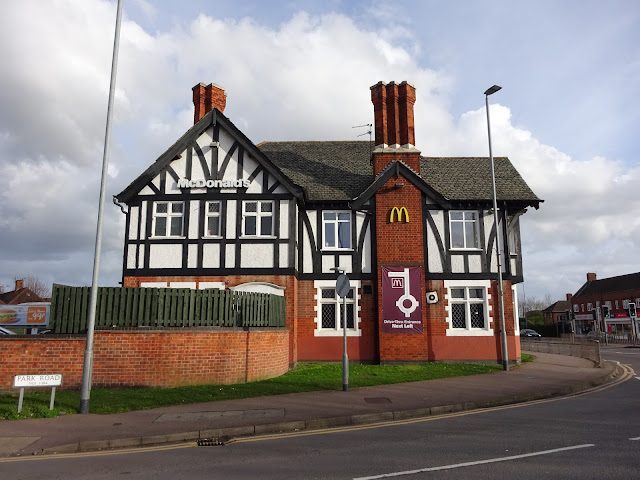
The Bull’s Head on High Street had originally been a coaching inn. It closed in 1927, and the licence was transferred to the new Bull’s Head in Shelthorpe in 1928. The Shelthorpe pub itself closed in X and is now a fast-food burger restaurant.


Nelson to Maxwells 1986 / 1987

The Nelson closed in 1986, and since that time has been home to various retail shops, and is currently a mobile phone shop. The licence was transferred in 1987 to Maxwells on Maxwell Drive, which was built to serve the residents of the new housing estate in that area.


Stag and Pheasant to The Beacon 1962 / 1963

As reported in the 'Loughborough Echo' of 6th December 1963, when the Stag and Pheasant on Nottingham Road closed in 1962, the licence was transferred in 1963 to The Beacon on Beacon Road, which served the growing population of that area. In recent years, The Beacon has had a major refurbishment, a side extension, and marquees erected in the grounds. However, both The Beacon and the Stag and Pheasant are listed in the 4th edition of a CAMRA listing - 'Real Ale in Leicestershire and Rutland' - which was published in November 1981 by the Leicester and Loughborough branch of CAMRA. Was the Stag and Pheasant still operating beyond 1962? Was a licence transferred from another pub to keep the S&P going for a while? Conversations with friends leads us to believe the licence really was transferred from the one to the other, and they were not open at the same time!


Nag's Head, Swan Street to the Ring O' Bells, Derby Road 1956 / 1956

Along with the Half Moon, the Nag’s Head is the only other pub mentioned here which no longer stands. It was situated where the former Wilkinsons building is now. Of course, the Wilkinsons building was only built around 2000, and replaced a Co-operative food store which had only been built around 1960, after the demolition of the Nag’s Head. The licence was transferred to the Ring O’ Bells on Derby Road when the Nag’s Head closed in 1956.


____________________________________

‘Loughborough Pubs’ is available from W H Smith in Loughborough, through various online retailers, and - for Loughborough residents - from the author upon request. 

____________________________________

Posted by lynneaboutloughborough

With apologies for typos which are all mine!

_______________________________________________

Thank you for reading this blog.

Copyright:

The copyright © of all content on this blog rests with me, however, you are welcome to quote passages from any of my posts, with appropriate credit. The correct citation for this looks as follows:

Dyer, Lynne (2024). Loughborough Pub Licence Transfers. Available from: https://lynneaboutloughborough.blogspot.com/2024/11/loughborough-pub-licence-transfers.html [Accessed 24 November 2024]

Take down policy:

I post no pictures that are not my own, unless I have express permission so to do. All text is my own, and not copied from any other information sources, printed or electronic, unless identified and credited as such. If you find I have posted something in contravention of these statements, or if there are photographs of you which you would prefer not to be here, please contact me at the address listed on the About Me page, and I will remove these.

External Links:

By including links to external sources I am not endorsing the websites, the authors, nor the information contained therein, and will not check back to update out-of-date links. Using these links to access external information is entirely the responsibility of the reader of the blog.

Blog archive and tags:

If you are viewing this blog in mobile format, you will not be able to easily access the blog archive, or the clickable links to various topics. These can be accessed if you scroll to the bottom of the page, and click 'View Web Version'. Alternatively, there is also a complete list of posts, which when clicked will take you to the page you are interested in.

Searching the blog:

You can search the blog using the dedicated search box that appears near the top of the blog when viewed in the web version. Alternatively, you can search using your usual search engine (e.g. Bing, Google, DuckDuckGo etc.) by following this example:

site: https://lynneaboutloughborough.blogspot.com/ “Radmoor House”

NOTE – the words you’re actually looking for must be in “” and the first of these must be preceded by a space

Thank you for reading this blog.

Lynne

Sunday, 13 March 2022

Rising cost of food, 1940s

This week a topic of conversation has been the rising cost of food – what’s affordable, what’s not, and how to make sure we eat a balanced diet. Which reminded me of last week’s post about Gertrude Mary Hutton, who worked at Unity House, and later uses of that building.

I seem to remember from one of the episodes of “A House Through Time” that during the Second World War, the Ministry of Food set up what it initially called communal or community ‘feeding stations’. These establishments were variously referred to as community meal centres, community kitchens, or civic or municipal restaurants, but became better known as “British Restaurants”, allegedly at the suggestion of Churchill.   

The Minister of Food at the time was Lord Woolton, and he was concerned enough about British health during the War, especially considering rationing and the lack of availability of foodstuffs, that he was instrumental in the setting up of the British Restaurant in 1940, where the aim was to improve the health and strength of Britons during a period of war. These restaurants ran from 1940 to about 1949, although there are cases where some lasted much longer.  

If a place didn’t have a suitable venue, like a working men’s club, or a church hall, a town hall, or even a school, or if any venue wasn’t able to be easily and cheaply converted, then a prefabricated building, made from mostly concrete, and called a Naschcrete, could be erected.  Some villages where no suitable building or space for one was available, were served by a British Restaurant on wheels, as were places that had been bombed.

If a building had a suitable kitchen, or if it could be equipped with cooking utensils provided by the Ministry of Food, meals would be prepared on-site, and cooked and served by volunteers, but some places received ready-prepared meals provided by either the local authority, or the Ministry of Food itself.  

Many of the restaurants were self-service, rather than waitress service, so more like a canteen than a restaurant, and at some, you could buy food to take away and eat at home. Some were staffed by volunteers, like those from the WVS (as it was then known), or had staff who were paid a minimum wage. The interiors of the restaurants were often quite different from each other, depending upon the space and furniture available, but they weren’t depressing places, and were often decorated with brightly painted furniture, bunting, tablecloths and posies of flowers, and in some cases, suitable paintings decorated the walls. Payment for meals was made by buying a special British Restaurant token, a different colour depending on how much one could afford to spend, so didn’t use coupons out of the ration book.

The restaurant generally served starters, main courses, and puddings, and some areas grew their own vegetables, although whether this happened before the coming of Woolton Pie or not, I don’t know!! However, one of the staple foods during the shortages brought on by the Second World War was the Woolton Pie, which was usually made of cooked, diced vegetables – a mixture of cauliflower, swede, carrots, and potatoes – along with spring onions if available, and vegetable extract and oatmeal. All these vegetables would be placed in a pie dish, and then baked, covered with either potatoes or pastry. Gravy was a welcome addition, to serve over the top, and one of the companies that made this – trademarked as Vita-Gravy - was William Symington’s of Market Harborough, not to be confused with the company founded by his brother James Symington!

But what has all this to do with Loughborough?? Well, Loughborough actually had two of these British restaurants, one in the Medical Aid Centre on Fennel Street, and one in the dance hall of the Bull’s Head in Shelthorpe.

Bull's Head, Shelthorpe, from Ling Road

The ‘Leicester Evening Mail’ of 4th July 1941 carried an advert from the Town Clerk, A. Gwynne Davies, as the British Restaurants were looking for 2 capable chefs, at £5 per week, and 3 women helpers, at 37/6d per week, plus a free midday meal. The closing date for applications was 15th July 1941, so it looks as though these will be open in the summer of 1941.

In a report in the ‘Leicester Chronicle’ of Saturday 12th July, it seems Loughborough’s ‘communal feeding centres’ were the talk of the county!!! Plans for the two centres were complete, and they were expected to be officially opened in September, and would provide one, three-course midday meal at a cost of 10d per head. It was planned that they would be open six days a week, and were primarily intended for use by factory workers, and their families. However, plans were already in place “to set up separate feeding centres for Loughborough school children.” The same newspaper confirmed in a later edition (26th July) that the Education Board of Loughborough were endeavouring to secure the Emmanuel Parochial Hall for the feeding and accommodation of children.

I don’t know when the Medical Aid Centre opened as a British Restaurant, but the 42nd one to open in the North Midlands area, was opened in Shelthorpe at the beginning of September, 1941. The Mayoress, Mrs George Hill, whose husband, George was the Mayor, attended the opening ceremony, as did the Deputy Regional Commissioner, Professor Wortley, and Alderman George Bowler. The adult dinner cost 11d, while the children ate soup, meat and vegetables, sweets and a cup of tea or coffee, at a cost of 7d..

Mayor George Hill, although he had been quite ill during his mayoral year, accepted the invitation of the Town Council to remain as mayor into a second year, and the mayor-making ceremony took place in November 1941, after which lunch was taken a the British Restaurant in Shelthorpe.

Bull's Head, Shelthorpe, from Park Road

In December 1941, a group of people from Kettering visited the British Restaurants at Loughborough and Leicester. The Ministry of Food had suggested to Kettering Town Council that meals for their proposed British Restaurant should be cooked at one of the cooking depots in a nearby town, and delivered to the Kettering premises, but the Town Council really wanted to have the cooking done in their actual restaurant, so they came to Leicestershire to see how this could work. They reported that apparently, the meals cost 7d. for an adult portion of meat and vegetables, while children under 14 could pay 4d., pudding was 2d., soup, 1d., and tea also 1d.. The chef was paid £5 weekly, women helpers £1 17s. 6., and the ticket office attendant £1 5s.. The outcome of their visit is not known.

In May 1942, the Loughborough MP, the Conservative, Major Lawrence Kimball, dined at a British Restaurant in Loughborough, and is reported to have said he had a better and bigger lunch for one shilling here than he could usually get in the House of Commons for four shillings!!

Finally, the ‘Leicester Evening Mail’ of 18th February 1943 reported that Loughborough’s total war savings, in the two and a half years to date, amounted to £1,725,063, which was about 8s. 6d. per head of population. The British Restaurant in Fennel Street served more than 37,000 meals, and brought in a surplus of £202, but there was a loss at the Shelthorpe venue of £144. By 1943, there were about 2,160 British Restaurants in the country, and about 600,000 meals were served each day, at a cost of around 9d.. Although the scheme was designed not to be profit-making, Fennel Street was not alone in making a profit – venues in about 546 local authorities also did; equally, around 203 made losses.

Medical Aid Centre on Fennel Street

British Restaurants largely ceased operation a few years after the end of the war. 

_______________

You are welcome to quote passages from any of my posts, with appropriate credit. The correct citation for this looks as follows:

Dyer, Lynne (2022). Rising cost of food, 1940s. Available from: https://lynneaboutloughborough.blogspot.com/2022/03/rising-cost-of-food-1940s.html     [Accessed 13 March 2022]

Take down policy:
I post no pictures that are not my own, unless I have express permission so to do. All text is my own, and not copied from any other information sources, printed or electronic, unless identified and credited as such. If you find I have posted something in contravention of these statements, or if there are photographs of you which you would prefer not to be here, please contact me at the address listed on the About Me page, and I will remove these.
Thank you for reading this blog. 

Lynne         

Sunday, 15 December 2019

Mr Yates completes his journey 200 years ago


Having read last week's blogpost about Mr Yates who was traveling to Nottingham each day from Loughborough as part of a bet, you might be interested to read about this progress over the week.


"Mr Yates, the Loughborough pedestrian, (of whose engagement, mention was made last week) completed his task, in grand style, on Saturday evening. The concourse of people who met him a short distance from the town, and attended him to the Bull's Head [on High Street], his "winning post" was so great, that it was with the utmost difficulty an avenue could be preserved for him to hobble along with his two sticks! The enlivening sounds of band music - the magnitude of the light shed upon the company by the large flambeau, and lanterns, carried before him - the ringing of bells, and the welcome shouts of his friends, rendered hist entry altogether, a truly exhilarating scene. Paradoxically speaking, the worst leg, about which such apprehensions had been entertained, ultimately "weathered the storm" the best; this however was accounted for by his having walked a good deal with one stick, and pressed considerably on the well let, with a view of saving the other, in the early part of his toil; but both of the were ar last, nevertheless much inflammed. He did not eat an ounce of animal food during the whole six days, subsisting chiefly on gingerbread, biscuits, brandy, gin and tea, with now and then a little soup, and small portions of bread and butter.
Underneath is a tabular view of the time occupied in each day's performance.
Monday, December 6th, 10 hours 25 minutes 
Tuesday, December 7th, 11 hours 7 minutes 
Wednesday, December 8th, 11 hours 39 minutes 
Thursday, December 9th, 11 hours 18 minutes 
Friday, December 10th, 11 hours 24 minutes 
Saturday, December 11th 10 hours 26 minutes"
So, in total Mr Yates walked 183 miles over 6 days, and for a total of 66 hours and 19 minutes! 

All for a bet, and with poorly legs!!  

From: Nottingham Review and General Advertiser for the Midland Counties, 17th December 1819, pg 3


You are welcome to quote passages from any of my posts, with appropriate credit. The correct citation for this looks as follow:

Dyer, Lynne (2019). Mr Yates complete his journey 200 years ago in Loughborough. Available from:https://lynneaboutloughborough.blogspot.com/2019/12/mr-yates-completes-his-journey-200.html    [Accessed 15 December 2019]

Take down policy:
I post no pictures that are not my own, unless I have express permission so to do. All text is my own, and not copied from any other information sources, printed or electronic, unless identified and credited as such. If you find I have posted something in contravention of these statements, or if there are photographs of you which you would prefer not to be here, please contact me at the address listed on the About Me page, and I will remove these.
Thank you for reading this blog. 

Lynne       
Sunday, 8 December 2019

Two hundred years ago in Loughborough

Again, this week I've been busy attending events, like the Loughborough Archaeological and Historical Society talk delivered by James Wright, FSA, on Mediaeval fireplaces, a trip to Nottingham Royal Concert Hall, a visit to Market Bosworth and attendance at an election hustings. I feel the need to go back in time a bit and see what was going on in Loughborough in December 1819 ...

The hustings were focussed particularly on the future of the NHS, and one of the things mentioned was health promotion and prevention of illness. Set me thinking about walking, as this is what I do to keep myself relatively fit, which suits me as I have no interest nor ability in sport. I'm not sure though that I could even begin to contemplate what Mr Samuel Yates of Loughborough did in December 1819:

"Mr Samuel Yates, of Loughborough, has undertaken for a wager, to walk from the Bull's Head Inn, in that town [High Street, most recently Browns beauty salon], to the Black's Head [1] in Nottingham, and back again each day for six successive days between the hours of eight in the morning and eight in the evening. He commenced his task on Monday morning last [Monday 7 December 1819], and there is now (Thursday morning) every probability of his succeeding, unless the leg, which he accidentally broke in going down Bunny Hill, about eighteen months ago, and from which misfortune he is but imperfectively recovered, should be incapable of sustaining the exertion till the end of the appointed term. Mr Yates sometimes walks with one, and sometimes with two sticks, is in his 53rd year, and his diurnal trip thirty miles and a half. The bets are two to one in his favour: indeed, he himself, so confident of winning, sacrificed the like odds in making the wager." 

From:
Nottingham Review and General Advertiser for the Midland Counties, 10 December, 1819, pg 3

Mr Joseph Barnsdall, was a builder and timber surveyor, based at Loughborough Dock, and
it was from him that further details of an amazing private contract sale could be obtained: 

"An entire new packet boat, partly decked over and fitted up for the convenience of passengers, and is well calculated for the conveyance of goods and merchandize [sic] on the River Trent and adjoining canals, to all parts of the kingdom. A good opportunity is now offered to persons who may be desirous of embarking in the conveying of goods etc. on the River Trent, the above packet being remarkably well built, and calculated to be worked by steam, and will be sold at half the original cost of steam packets in general."

From:
Nottingham Review and General Advertiser for the Midland Counties, 10 December, 1819, pg 1


[1] The only Black's Head in Nottingham that I have so far managed to find is one that is on Burton Road, Carlton, which via today's roads is just about 17 miles.

You are welcome to quote passages from any of my posts, with appropriate credit. The correct citation for this looks as follow:

Dyer, Lynne (2019). Two hundred years ago in Loughborough. Available from: https://lynneaboutloughborough.blogspot.com/2019/12/two-hundred-years-ago-in-loughborough.html [Accessed 8 December 2019]

Take down policy:
I post no pictures that are not my own, unless I have express permission so to do. All text is my own, and not copied from any other information sources, printed or electronic, unless identified and credited as such. If you find I have posted something in contravention of these statements, or if there are photographs of you which you would prefer not to be here, please contact me at the address listed on the About Me page, and I will remove these.
Thank you for reading this blog. 

Lynne