Showing posts with label Holy Trinity Church. Show all posts

Sunday, 18 May 2025

Bell Sunday

Well, today I learned that there is such a thing as Bell Sunday, which, according to the Central Council of Church Bell Ringers falls on the Sunday closest to St Dunstan’s Day, the latter, this year being 19th May. St Dunstan was a 10th century Archbishop of Canterbury, is the patron saint of bellringers, and as a skilled metalworker, was an early experimenter with bell casting. The celebration on Bell Sunday serves to recognise that bellringers add to the national soundscape, and contribute to the life of the church – summoning people to church for regular services, or for christenings, weddings, and funerals, or simply reminding people by their regular bellringing practice, of what day it is! Oh, and taking part in ringing contests!

A bellringer's essential

The ringing chamber at All Saints

At one time more or less in the centre of Loughborough, there were four Anglican churches, the Church of All Saints; Emmanuel; Holy Trinity, and St Peter’s. The bells of All Saints are well-documented, and there can be few who don’t know that the very reason we have the country’s last remaining dedicated bellfoundry is because the Taylor family came to Loughborough specifically to refurbish the bells of All Saints, in 1839. Indeed, it was actually part of the contract between the bellfounder and the church that the bells be cast in Loughborough, hence the Taylors setting up their bellfoundry initially on Pack Horse Lane, on land leased for 20 years. Things must have worked well for the bellfounders, because when that lease was up they set up a permanent factory on Chapman Street/Freehold Street, and have remained there ever since, making new bells, and repairing old ones.


I haven’t done too much digging around looking for information about our churches, so I have only found scant details about the bells in some of our town’s other Anglican churches. The statutory listing for Emmanuel church simply says: “[The] Tower has 3 light bell openings …”


A report of the consecration of the Holy Trinity church mentions everything from the Minton floor tiles to the ceilings of pitch pine; from the varnished pitch pine seating, to the Devonshire marble altar, but says nothing of the bells other than “A pretty turret contains three bells.” Ironically, the first incumbent at Holy Trinity was the former curate of All Saints, the Rev. E. Bell!


The bellcote at St Mary's Nanpantan

The description in the statutory listing for the church of St Peter’s, on Storer Road and Fearon Street is extensive! However, no mention of the actual bells, other than the sentence “Organ chamber to south has 2-light window and ashlar gabled bell-cote to side over vestry which has flat arched windows and curving parapet.”

Slightly further afield, is the church of All Saints at Thorpe Acre with Dishley, a church which was built in 1849 to replace the mediaeval church at Dishley. Sadly, on my brief search I’ve only found scant information, again in the statutory listing, which simply mentions the “Western bellcote.”


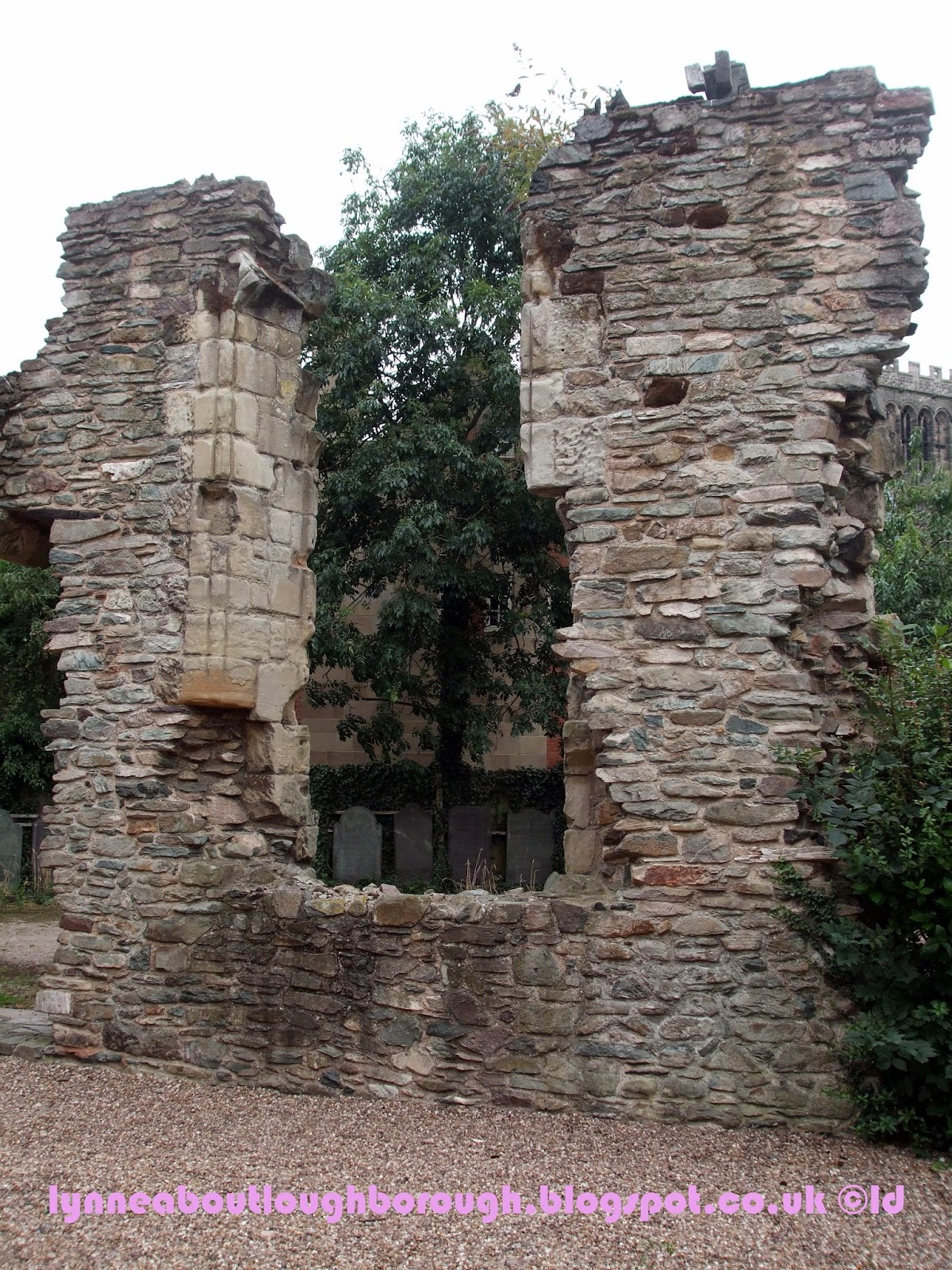
I’ve mentioned the mediaeval church at Dishley, but the summary one would expect to find in the statutory listing for this as an ancient monument says, “Not currently available for this entry.” Which is a little odd … It would appear, however, that while Dishley church might once have been a scheduled ancient monument, it appears it is now a Grade II listed building, which was listed on Monday 15th March 1965. The description associated with the entry makes for interesting reading, particularly the final sentence:

“East, north and south walls of ruined aisle less church, C12/C13; rubble stone with ashlar dressings. Triple lancet east window. North wall: round headed doorway with semi circular hoodmould, plank door. South wall (from east to west) lancet, blocked round headed doorway, ogee-headed lancet, base of porch. Interior has remains of piscina, sedilia, aumbry. Slate grave slabs including those to the Bakewell family C20 slate slab commemorating Robert Bakewell on north wall. Scheduled ancient monument.”


Today as I was walking through Queen’s Park, I was lucky enough to hear a different kind of bellringing – the sonorous sounds of our spectacular carillon played so beautifully by our wonderful carilloneure!! 


I also walked close to another bell that will hopefully soon be ringing (or will it be chiming?) – where there’s a bell, there’s hope!!

Hope Bell in Queen's Park


In the meantime, I mentioned Robert Bakewell above, which has prompted me to commemorate his life and work – but that’s a blogpost for another day!!   

____________________________________

Posted by lynneaboutloughborough

With apologies for typos which are all mine!

_______________________________________________

Thank you for reading this blog.

Copyright:

The copyright © of all content on this blog rests with me, however, you are welcome to quote passages from any of my posts, with appropriate credit. The correct citation for this looks as follows:

Dyer, Lynne (2025). Bell Sunday. Available from: https://lynneaboutloughborough.blogspot.com/2025/05/bell-sunday.html  [Accessed 18 May 2025]

Take down policy:

I post no pictures that are not my own, unless I have express permission so to do. All text is my own, and not copied from any other information sources, printed or electronic, unless identified and credited as such. If you find I have posted something in contravention of these statements, or if there are photographs of you which you would prefer not to be here, please contact me at the address listed on the About Me page, and I will remove these.

External Links:

By including links to external sources I am not endorsing the websites, the authors, nor the information contained therein, and will not check back to update out-of-date links. Using these links to access external information is entirely the responsibility of the reader of the blog.

Blog archive and tags:

If you are viewing this blog in mobile format, you will not be able to easily access the blog archive, or the clickable links to various topics. These can be accessed if you scroll to the bottom of the page, and click 'View Web Version'. Alternatively, there is also a complete list of posts, which when clicked will take you to the page you are interested in.

Searching the blog:

You can search the blog using the dedicated search box that appears near the top of the blog when viewed in the web version. Alternatively, you can search using your usual search engine (e.g. Bing, Google, DuckDuckGo etc.) by following this example:

site: https://lynneaboutloughborough.blogspot.com/ “Radmoor House”

NOTE – the words you’re actually looking for must be in “” and the first of these must be preceded by a space

Thank you for reading this blog.

Lynne

Sunday, 14 February 2021

Spotlight on Holy Trinity Church

Holy Trinity Church

In March 1868, a letter appeared in the Leicester Mail commenting upon how the church of All Saints was never full to capacity during either the morning or evening services, and that Emmanuel church was not full during the only time when it was open, which was during the morning. The letter-writer was therefore questioning why a need had been identified for a new church to be built in Loughborough.

This need had been articulated in a report in the Leicester Chronicle in 1865, which suggested that the Church Extension Society was contemplating building a new church in Loughborough, at an outlay of £6,000 and with an endowment of £300 per annum. Apparently, a site had not yet been determined upon.

The date of that newspaper article was 1st April 1865, but this was certainly no April Fool’s Day joke. The laying of the foundation stone for what was to become the Holy Trinity Church, on Moor Lane took place 12 years later, on Tuesday 20th November 1877. Lord John Manners laid the stone, and the service on the site was conducted by the Lord Bishop of Peterborough, William Connor Magee – a busy week for the Bishops who also consecrated St Lawrence church in Northampton. The procession to the new Holy Trinity church left from the nearby Warner School on Pinfold Gate at 12.30pm and luncheon was served at the Bull’s Head Hotel on High Street – to those who had paid in advance.

Holy Trinity Church


The new church was designed by William Arthur Blomfield who, as we know from last week’s blogpost about the Reverend Eddowes at Jackfield, was responsible for designing the new church at Jackfield, and also for the renovations at St Mary’s church in Sileby. The cost of building the Holy Trinity church was expected to be just over £4,500, and would be constructed by Mr Clipsham, the builder from Newark, the fabric of the building being made from Mountsorrel stone with Bath stone dressings. The internal height would be 24 feet, and from the eaves to the roof would be another 24 feet. There would also be a turret of 84 feet, the west side of the church would be 186 feet and the north and south sides 60 feet.

The church was to be positioned on land given by Mr Edward Warner and the committee responsible for organising the contributions to the endowment included Dr John Henry Eddowes, grandfather to Arthur Eddowes, who had just been born, and who would later become vicar of Jackfield.

The consecration of the church took place on Tuesday 8th October 1878, the event taking place at 11.30 in the morning and being delivered by the Lord Bishop of Peterborough. The procession again started from Warner School, at 11am, and lunch was provided in the Victoria Rooms in the Town Hall – to those who had paid in advance. The evening service took place at 7pm, and the sermon was preached by the Reverend Leonard Leader Cooper, MA, the Vicar of Raunds, who had recently left his position as Chaplain to the Board of Guardians in Loughborough, and who would shortly move to become the vicar of St John The Divine church, in Leicester.  

Once the new church building was consecrated and completed, in December 1878 the incumbency of Holy Trinity church was confirmed as being conferred upon the Reverend Edward Bell, who had been born 30 years earlier in Ireland, son of Daniel, a clerk in holy orders. On August 12th 1879, Reverend Edward Bell married Sarah Elizabeth Noble. Sarah had been born in Loughborough, also in 1848, and was the daughter of Frederic Collins Noble, a surgeon of the town. The marriage ceremony took place at St John’s church in Ealing, the Right Reverend the Bishop of Travancore and Cochin presiding.

Holy Trinity Church


By the time of the 1881 census, Edward and Sarah were living at 17 Leicester Road, which is the rectory associated with the Holy Trinity church, now an exclusive, boutique guest house, although now numbered 68a. [On re-reading this in 2025, it is very unlikely that No.17 Leicester Road became No.68A!. No.17 is likely to have been situated on the corner of Leicester Road and Southfield Road, as the architectural practice of Allcock and Grieves is at No.11. Furthermore, 68A wasn't built until 1883, but did become the vicarage to Holy Trinity. It is now a beautifully restored B&B and winner of Channel 4's Four in a Bed.] 

Edward and Sarah's daughter, Mary Winifred Bell had been born 3 months before the census was taken, and the family were supported by three servants, Elizabeth Ann Marston (?) the 29-year old domestic cook born in Thrussington, Martha Sharratt the 18-year old nurse, and Eliza Alice Barman (?) the 16-year old housemaid, both born in Manchester. A further daughter for Edward and Sarah, Kathleen Margaret, arrived in 1885.

The former Rectory to Holy Trinity Church


The 1891 census records the family still living and working in Loughborough, but in September 1892, Reverend Edward Bell moved to St Stephens in Saltash to become the vicar there, replacing the Reverend William Fraser who was moving from Saltash to - would you believe - Loughborough. When Reverend Fraser moved away from Loughborough’s Holy Trinity church, he was followed by Reverend Samuel Wathen Wigg, and the Reverend David Dewar.

There are many more stories to tell about the church of Holy Trinity in Loughborough, and of the resident vicars, but these must wait for another day. Suffice to say that the church ceased operation as a church in 1996, and the name passed to the All Saints church, now referred to as All Saints with Holy Trinity. The former church is now a school and the church hall home to Affixxus Films.

Posted by lynneaboutloughborough 14 February 2021

You are welcome to quote passages from any of my posts, with appropriate credit. The correct citation for this looks as follow:

Dyer, Lynne (2021). Spotlight on Holy Trinity Church. Available from: https://lynneaboutloughborough.blogspot.com/2021/02/spotlight-on-holy-trinity-church.html [Accessed 14 February 2021]

Take down policy:
I post no pictures that are not my own, unless I have express permission so to do. All text is my own, and not copied from any other information sources, printed or electronic, unless identified and credited as such. If you find I have posted something in contravention of these statements, or if there are photographs of you which you would prefer not to be here, please contact me at the address listed on the About Me page, and I will remove these.

You can leave comments below, but do check back as my reply will appear here, below your comment.

Thank you for reading this blog. 

Lynne                  

Sunday, 7 June 2020

Death and funeral of Reverend Henry Fearon


Reverend Henry Fearon: on the 135th anniversary of his death and funeral


On Friday 12 June, 1885 (1), at the age of 82 (2), and only 8 days off his 83rd birthday, the Reverend Henry Fearon, Rector of Loughborough, and Archdeacon of Leicester, passed away. Fearon had retired from the archdeaconry in early April, 1884, due to failing health, but had been granted permission by the Bishop of Peterborough to retain the title of archdeacon. Reverend Fearon had been in declining health for some time, and had refrained from taking part in the services of the church for several months. The final two months of his life were spent confined to his bed, under the care of Dr Eddowes (3) right up until the time of his death.


The living at Loughborough, which became vacant upon the death of Fearon, was variously described as being valued at anything from £800, through £988 to over £1,000 per year, a substantial amount, and probably one of the highest in the country at the time. It was not until the beginning of August 1885, that a successor to Fearon was appointed, when Reverend Thomas Pitts, MA and Fellow of Emmanuel College, Cambridge, accepted the living of Loughborough. Reverend Pitts had previously been a master of the Haileybury School, an independent school in Hertfordshire. By contrast, the Bishop of Peterborough was quick to confer the 8th Honorary Canonry on Reverend John Martyn Collyns, MA, and Rector of Daventry, and Reverend Collyns was installed at a service on the afternoon of Saturday 27 June 1885. Reverend Canon Assheton Pownell, MA, and graduate of Brasenose College Oxford, and Rector of South Kilworth, had been appointed to the archdeaconry of Leicester immediately upon Fearon’s resignation in April 1884.

Fearon’s death was reported widely in the press of the day (4). He was variously described as a most learned and courteous divine, and a moderate Liberal. Some newspapers reported on the admirable and kindly manner in which he performed his important duties, and how he gained the respect and esteem of the community of Loughborough. It was also said that one couldn’t over-estimate the value of his dedication to the cause of education, and his unfailing interest in the welfare of the working classes. During his time as rector, the church of All Saints had been improved, the ecclesiastical affairs of the parish had been developed, and all in a quiet and unostentatious manner. Fearon was reported to be earnest, making practical efforts to improve the condition of those around him, and a striking feature of his life was the charitable way in which he treated those of differing religious beliefs to his own.


Reverend Fearon’s funeral took place on Friday 19 June, the service being held at All Saints church, and the burial at the town cemetery on Leicester Road. The ceremony itself was simple, and the whole day was declared a day of mourning. Most of the shops in the town centre closed just before the time of the funeral, and even the blinds of private houses were drawn. All the town factories were closed for several hours so that the workers could pay their last respects to Reverend Fearon: as such thousands of townsfolk were able to attend the funeral or line the route of the funeral procession. The bells of All Saints, Holy Trinity church and Emmanuel church were tolled, and the flag on the tower of the Grammar School was mounted at half-mast.


The funeral procession was extensive, comprising both relatives and friends of Fearon; both clergy from the archdeaconry and non-conformist ministers from Loughborough; representatives from different public bodies and tenants of the reverend. In fact, so extensive was the procession that entry to the church service at All Saints was by ticket only. The cortege arrived at the church just before 2.30 on the afternoon of Friday 19 June, where, on entering through the west door, it was met by the sounds of a combined choir of over 80 voices from All Saints, Holy Trinity church and Emmanuel church, singing ‘When our heads are bowed with woe’.


Members of the congregation who were not part of the procession had been seated for over an hour before the procession entered the church. Once everyone was seated, the, which was taken by the Reverend James Mountain, the curate of All Saints, began. The lesson was read by Reverend L.L. Cooper of St John’s church in Leicester, and Dr Briggs, the organist at All Saints, brought the service to a close with a rendition of ‘Dead march’ from Handel’s Oratorio, ‘Saul’ (5).  


The funeral procession then made its way to the cemetery on Leicester Road, led by the sexton, Mr T. Grundy. Leaving the church at about 3pm, the procession went down Church Gate, passed the edge of Market Place, then along High Street and up Leicester Road to the cemetery, passing hundreds of mourners along its way. The whole journey of just under a mile-and-a half took about an hour to reach its destination. The massed choir sang ‘Jesus lives no longer now’ as the procession entered the cemetery gates, and did so also at the graveside. The service at the graveside was read first by the Reverend J. B. N. Woodroffe, followed by the Reverend Mountain, and the benediction was pronounced by the Venerable Archdeacon Lightfoot. The grave was layered with dark leaves, a cross of white flowers, and circles of daisies, and on the ledges were white blossoms fringed with ferns. The locally made oak coffin, with brass fittings and an inscribed brass plate, was covered in wreaths and crosses.

On the Sunday following Reverend Fearon’s funeral, a funeral service was held at All Saints, the sermon being preached by Reverend Lewis Clayton of St Margaret’s church in Leicester, assisted by Reverend Mountain and the Reverend R. H. Parsons. The chosen text read from the bible, was from the 9th verse of the 4th chapter of Phillippians, which was chosen for its appropriateness to the situation in Loughborough, and for its obvious application to the Reverend Fearon, a man who most certainly practised what he preached, and a man who was always ready to forgive. Later that same evening, the Reverend Martin preached to another large congregation, whilst the Reverend E. Bell held a special service at Holy Trinity church, and reference was made to the funeral of the Reverend Fearon at Emmanuel and other churches across the town.


Post-Script Further details of the life of the Reverend Henry Fearon can be found elsewhere on this blog, as can memories of happy times for the Reverend Fearon. 

Footnotes

(1) Newspaper reports of the time vary widely in their statements about the date of Reverend Fearon’s death: some quoted 7.50 on the evening of Thursday 11 June, others Friday 12 June and yet others Saturday 13 June. Friday 12 June is the date recorded in the probate record.

(2) Again, newspaper reports of the time claim the Reverend Fearon was 82, 83, 85 or even 89 at the time of his death. His birth is recorded as 20 June 1802, and he was baptised on 8 September 1802.

(3) I am unclear which Dr Eddowes was attending Reverend Fearon: this could have been John Henry (jun.) or his brother, Arthur Benjamin Jackson Eddowes. 

(4) The report of the funeral and burial of Fearon which appeared in the ‘Nottinghamshire Guardian’ of 26 June 1885, was ironically immediately followed by an article describing the opening of a new reservoir at Park Row, Nottingham, which cost around £12,000, the reservoir being capable of holding 2.25 gallons. In 1870 Fearon had been instrumental in providing Loughborough with a clean supply of fresh water from Nanpantan Reservoir, and presented the town with the Fearon Fountain, which, along with the more recent ‘Sockman’ is an iconic feature of Loughborough’s Market Place.

(5) The librettist who wrote 'Saul' was Charles Jennens, from Gopsall Hall, in Leicestershire, with whom Handel had a close friendship, and whom he visited often. 

You are welcome to quote passages from any of my posts, with appropriate credit. The correct citation for this looks as follow:

Dyer, Lynne (2020). Death and funeral of Reverend Henry Fearon. Available from:https://lynneaboutloughborough.blogspot.com/2020/06/death-and-funeral-of-reverend-henry.html  [Accessed: 7 June 2020]

Take down policy:
I post no pictures that are not my own, unless I have express permission so to do. All text is my own, and not copied from any other information sources, printed or electronic, unless identified and credited as such. If you find I have posted something in contravention of these statements, or if there are photographs of you which you would prefer not to be here, please contact me at the address listed on the About Me page, and I will remove these.

If you wish to leave a comment, please do so in the comments box that appears below this blogpost. Alternatively, you can contact me via lynneaboutloughborough[at]gmail[dot]com.

Thank you for reading this blog. 

Lynne     

Sunday, 26 February 2017

Cartwright and Warner

Oh dear, here I go again, promising you a further post on holiday connections, but finding myself eager to tell you about something else first!! This one's timely, as it follows immediately from my attending a book launch - a book about the Warner family, as associated with Cartwright and Warner (Hosiers), Nanpantan Hall, the churches of All Saints, Holy Trinity, St Peter's and St Mary in Charnwood at Nanpantan, and many other places!

Now, I don't want to spoil your reading of the book (by Derrick Hewitt) so what follows are a few snippets of information, not all of them gathered from the detailed talk that Derrick gave at the launch at the church of All Saints with Holy Trinity.

The Warner family is probably best known for its partnership with the Cartwrights in a hosiery business that seems to have been rather successful! There was enough money in the business for Edward Warner to buy Quorn Hall from the Farndon family, to build The Elms and Nanpantan Hall. 

According to Mr Hewitt, Aingarth (now retirement and sheltered housing) a Victorian building, was originally associated with The Elms, and the gatehouse to the Elms, now called the Lodge to Aingarth, fronts onto Leicester Road. This was recently for sale, and there are some pictures available. Both The Elms and The Lodge to Aingarth are listed buildings.
The Lodge to Aingarth

The Lodge to Aingarth

The Lodge to Aingarth

The Elms

The Elms

The Elms

Aingarth

Nanpantan Hall, was sold by the Warners to the Pagets (William Byerley Paget to be precise), and has latterly been part of the School of Economic Science. Not sure if this is still the case, as the Echo reported in July 2016 that Nanpantan Hall has recently become a wedding venue, ironic, since W B Paget's former house, Southfields House, is now the Loughborough Register Office!

The Warner family had connections with the Church of All Saints (now the Church of All Saints with Holy Trinity), and were instrumental in the building of Holy Trinity Church and St Peters Church, as well as a memorial to Archdeacon Fearon, in the form of Fearon Hall. 
Church of All Saints (today with Holy Trinity)

Fearon Hall

The company had various factories around Loughborough, including the one on Clarence Street (now a locally listed building) and those taken over by Towles.   

The Warner family were also benefactors of the Grammar School. 

In 1851 at the Great Exhibition, Cartwright and Warner* won a medal for their women's "union dresses" - a Victorian euphemism for women's combinations  

Apparently, one member of the Cartwright family, James, lived at 151 Ashby Road, in 1911.

There were a couple of Cartwright and Warner employees, Ernest Grimbley and Charles J Hunt, who died during the first world war and are listed on the Roll of Honour website.

In 1900 a row of almshouses were created on Mill Lane, as part of the Warner legacy. Sadly, the cartouche on the side of the building is beginning to wear away, but the properties are still, I believe, inhabited by former hosiery workers. These are administered by the Warner's Almshouse Charity in Melbourne, South Derbyshire. 
Mill Lane

One wonders if George Warner of Quorn, who went off to the United States, was part of the Warner hosiery family: Derrick may have said this, but I am a little hard of hearing and missed some of the talk.

An extract from White's Gazeteer of 1877 appears on the Genuki website, giving a brief description of Loughborough and naming various people associated with the hosiery trade. The complete White's Gazeteer is also available on the internet.

The Victoria County History of Leicestershire also includes some information on Cartwright and Warner, and is complemented by information on the British History Online website.

The Barrow Upon Soar Heritage Group include a report of evidence given by inhabitants of the village in regard to increasing mechanisation of framework knitting, some of whom worked for Cartwright and Warner in Loughborough.

If you're a member of the FaceBook Group Remember Loughborough, you've probably already seen this video of Cartwright and Warner employees leaving the factory in 1900 but here it is again!

Here are two of my favourite things - coincidences: whilst looking for mention of Cartwright and Warner on Grace's Guide, I happened upon a bell foundry called called J Warner who made the initial Big Ben, which was later recast by the Whitechapel foundry! And, would you believe it, John Henry Boyer Warner, one of Edward Warner's sons, moved to Kepwick Hall in Yorkshire, and on the top of one of the hills he built - you guessed it - an obelisk (see my previous post about obelisks)! The description I've found of this on various listed building websites seems to be incorrect, listing him as a Weaver not a Warner, but interestingly, the obelisk is constructed of Portland stone - just like the ground floor of our Carillon!

Portland stone bridge and Carillon base

We were lucky enough also to see some examples of original catalogues of products from Cartwright and Warner:


Finally, that institution, beloved of many Loughborough inhabitants, the Warner School, on what was the corner of Pinfold Gate and School Street, was funded by Edward Warner in 1870, as he provided both the land and the money for it. At the time it was most unusual as it had teacher's accommodation attached: ironically, today the teacher's accommodation is all that remains of the school which was demolished in 2015 to make way for the inner relief road. It is the only remaining stone building in Loughborough apart from the Old Rectory, and the former school on Nanpantan Road (which is classed as being in Nanpantan).
Warner School prior to partial demolition
The Warner School teacher's accommodation

The Warner School teacher's accommodation with a former framework knitters building adjacent
*Stanley, Chapman and Middleton-Smith, Jane (2015) John Smedley: the establishment of a tradition in fine knitwear, c. 1750-1874 In: Textile History, Vol. 46, No.1, pp.70-98 


You are welcome to quote passages from any of my posts, with appropriate credit. The correct citation for this looks as follow:

Dyer, Lynne (2017). Cartwright and Warner. [Online] Available from: http://lynneaboutloughborough.blogspot.com/2017/02/cartwright-and-warner.html [Accessed 26 February 2017]


Sunday, 17 August 2014

The Old Rectory Museum

A visit to the Old Rectory Museum

If you live in Loughborough, it's possible that you might have heard of the Old Rectory Museum: In fact, you might even have played in the grounds when you were a youngster! If, however, you're a student, or you're just visiting then it's possible you might have missed this treasure, tucked away in the old part of Loughborough, near All Saints with Holy Trinity Church, close to the former Manor House, the former Guildhall, and what is probably the oldest pub in town!!

The Old Rectory is, as its name suggests, the former rectory associated with what was at the time probably known as the church of St Peter and St Paul, later All Saints, and now combined with the Holy Trinity Church (which is situated on the corner of Moor Lane and Trinity Street and is now an independent school). 

It's quite possible that there was a rectory in this place from about the early 1100s, but in the late 19th century the building looked quite different, being a substantial family home. When a new vicar was installed, he deemed the rectory too big for his and his family's needs, so a new home was built, in about 1960. The Old Rectory was then scheduled for demolition, but in the process, the old stone building that you can see today was found inside the newer building. Such was the significance of this Old Rectory, that demolition was halted, and the stone building retained and turned into a museum.

I believe that the Old Rectory and the Warner Street School are the only stone buildings to remain in the town centre, although the school has now been demolished, leaving only the former headteacher's house. Some significant stonework from the school has been housed in the Old Rectory Museum.

The Old Rectory was at one time a scheduled Ancient Monument, but is now a Grade II* listed building. The museum contains a large variety of artefacts, including archaeological finds, tiles from Garendon Abbey, has a variety of displays, including several on locally important people, and has an area devoted to an exhibition which changes each year. This year the exhibition is based around the Big Meadow in Loughborough, the oldest meadow in the country, dating back to 1762. This meadow is one of the few remaining lammas meadows in the country, and was chosen by Prince Charles to be one of the 60 coronation meadows to celebrate the Queen's reign. 

Below is a selection of photos I've taken of the Old Rectory Museum. These are probably the worst photos I've ever taken, but at least they will give you an idea of what to expect when you visit the museum, which is run by volunteers from Loughborough Archaeological and Historical Society, and which is open every Saturday from April to September, 11-3.