Showing posts with label Midland Mainline. Show all posts

Saturday, 20 April 2024

Railway Accident

Following on with the train theme ... Please do not read on if you are likely to be upset by details of a local accident ... 

Transcribed from a report in the 'Leicester Journal' of Friday March 8th, 1878. Paragraph breaks added for ease of reading.

LOUGHBOROUGH

FATAL ACCIDENT NEAR LOUGHBOROUGH

On Monday afternoon an elderly man, named John Hyde, about 70 years of age, residing at Cherry Orchard, Loughborough, was crossing the line on a level crossing, about half a mile in the direction of Barrow, from Loughborough, when the Midland Express, which leaves Derby at 2.5 [not sure what time this is actually meant to be], and passes through Loughborough about half-past one, came up without him perceiving it. He was caught by the engine and killed instantaneously.

His grandson, who was with him, saw the train in time, and so escaped un-injured, but he was unable to warn his grandfather in time. At the place where the accident happened there is a clear stretch of railway of about a mile, so that there was plenty of time to get out of the way of the approaching train.

An inquest was held before H. Deane, Esq., coroner, a the Duke of York Inn, on the 5th instant [of this month]. The deceased was 73 years of age. On Monday, he and a grandson, James Rumsby, 10 years of age, went on a walk to the Station on some business, and returned by the Old Cricket Ground, on Nottingham Road, leading to Moor Lane. When they got to the Railway, deceased wished the boy to go across the line; he hesitated, seeing a train coming, and said, they perhaps might get run over.

The deceased wanted to go, so the boy made the best of his way, and got safe across, then turning round he saw the engine of the up express train “strike him up in the air.”. Willaim Brookes, being a short distance from the spot, the went to him crying, and told him the circumstance. On going to the spot he found the body 47 yards from the crossing, with one leg cut off, and the body knocked to pieces.

James Pegg, the driver of the engine in question, said being behind time, they were going at the rate of about 45 miles an hour. He saw the boy cross the line in front of him, and shook his head at him for so doing, but he never saw the deceased.

The body was frightfully mangled. A verdict of ‘Accidental death’ was recorded.

Note: This unfortunate event took place on the Midland Mainline, as although the Great central Railway is in the vicinity of Moor Lane, the line wasn't built until 1899. 


____________________________________

This is one in a series of posts for the ‘April A-Z Blogging Challenge’.


____________________________________

Posted by lynneaboutloughborough

With apologies for typos which are all mine!

_______________________________________________

Thank you for reading this blog.

Copyright:

The copyright © of all content on this blog rests with me, however, you are welcome to quote passages from any of my posts, with appropriate credit. The correct citation for this looks as follows:

Dyer, Lynne (2024). Railway accident. Available from: https://lynneaboutloughborough.blogspot.com/2024/04/railway-accident.html [Accessed 20 April 2024]

Take down policy:

I post no pictures that are not my own, unless I have express permission so to do. All text is my own, and not copied from any other information sources, printed or electronic, unless identified and credited as such. If you find I have posted something in contravention of these statements, or if there are photographs of you which you would prefer not to be here, please contact me at the address listed on the About Me page, and I will remove these.

External Links:

By including links to external sources I am not endorsing the websites, the authors, nor the information contained therein, and will not check back to update out-of-date links. Using these links to access external information is entirely the responsibility of the reader of the blog.

Blog archive and tags:

If you are viewing this blog in mobile format, you will not be able to easily access the blog archive, or the clickable links to various topics. These can be accessed if you scroll to the bottom of the page, and click 'View Web Version'. Alternatively, there is also a complete list of posts, which when clicked will take you to the page you are interested in.

Searching the blog:

You can search the blog using the dedicated search box that appears near the top of the blog when viewed in the web version. Alternatively, you can search using your usual search engine (e.g. Bing, Google, DuckDuckGo etc.) by following this example:

site: https://lynneaboutloughborough.blogspot.com/ “Radmoor House”

NOTE – the words you’re actually looking for must be in “” and the first of these must be preceded by a space

Thank you for reading this blog.

Lynne

Sunday, 25 February 2024

Loughborough's K6 telephone kiosk

Brief history of the telephone kiosk

There were several versions of the telephone kiosk created, ranging from the K1 released in 1912, through to the K8 created in 1968, to the KX100, the last to be designed in the 1980s.

The Grade II listed telephone kiosk at Loughborough railway station is of the K6 variety, and was made by the Carron Company of Stirlingshire, who were also responsible for many of the letter boxes that can still be found around the country [1].

Initially, telephone kiosks weren’t standardised, and early ones were sometimes made of wood, and looked like garden sheds! A company called the National Telephone Company (NTC) began the process of trying to standardise the kiosk design, and they created three models: the Birmingham, the Norwich, and the Wilson. Then, around 1912 the General Post Office (GPO) took over from the NTC and successfully standardised the kiosks, and began the numbering of the designs, starting with the K1, which started to appear around 1920. However, this K1 design, which had three concrete panels and a wooden door, a pyramid roof, sometimes thatched, is probably very unlike the ubiquitous red telephone kiosks like ours at Loughborough railway station.

For some reason, the K1 design wasn’t very popular and so in 1924, the GPO held a competition for a new design. The competition was won by Giles Gilbert Scott, grandson of Sir George Gilbert Scott who was responsible for Victorian renovations to many churches. The competition winner was knighted that same year after the consecration service at the new Liverpool Cathedral which he had designed, but which wasn’t completed until 1980. The new K2 kiosk was made of cast iron with a wooden door, had a domed roof and was painted red! However, the kiosk was large and expensive, and really only took off in London, so Giles Gilbert Scott then designed the K3, introduced in 1929.

The K3 was smaller than the K2 and was made from concrete. It was painted in cream, with the metal frames of the glass panels – of which there were 6 rows of three equal sized ones in each of the three glazed sides – highlighted in red. However, the K3 design only lasted for about six years, until about 1935, as the box tended to be rather brittle.

The K4 telephone kiosk, was designed by the Engineering Department of the General Post Office, and its production overlapped with that of the K3. Essentially, the kiosk followed the design of Gilbert Scott’s K2, but was constructed from cast iron, and had a stamp dispensing machine as its rear ‘wall’, so it was very large, and had to be placed so access could be gained from all four sides. The kiosk was painted entirely red, and had six rows of three panes of equal sized glass panes. However, the K4 was not hugely successful, partly due to the noise of the stamp machine which interfered with telephone conversations, the stamp machine not being waterproof, and the kiosk generally being overly large – and nicknamed the ‘Vermillion Giant’ – and only about 50 were ever produced.

The K5 can hardly be said to have been any more successful than the K4, and in fact, it never actually reached full-scale production. Had it gone into full production, the kiosk would probably be made from concrete, however, the design only ever reached the metal-faced plywood stage. In a design change from the earlier kiosks, the K5 was not fully glazed on the three normally glass sides, but had a window of two rows by two columns, rather like a house window.

Our K6 telephone kiosk

And so we come to the K6 kiosk, which is the design outside the Midland Mainline station at Loughborough. Although it looks perfectly normal, it does strike me as being a little odd because I would have expected the door to be on the front so when opened the dail and handset etc. are straight in front of you, but strangely, the door is actually on one of the sides, so you have to sidle up to the wall to get in! (see pic below). And I've just discovered why this is! In 1939, the K6 design was modified, resulting in a Mark 2 with several new versions:

Mk2 - K6A - the door is fitted opposite the back panel and is hinged, and therefore opens, to the left

Mk2 - K6B - the door is fitted opposite the back panel and is hinged, and therefore opens, to the right

Mk2 - K6C - the door is fitted as the lefthand side panel and is hinged, and therefore opens, to the left

Mk2 - K6D - the door is fitted as the righthand side panel and is hinged, and therefore opens, to the right

Interestingly, this kiosk is still in use as a telephone, but its original rotary handset and coin buttons (A for money in, B for returned coins) have been replaced. You can just about see the number punchpad through the glass on the first picture below:


What the inside would have originally looked like

There were originally detailed instructions on how to use the telephone, as well as a list of all the dialling codes, mounted inside the kiosk.

Instructions for use!

The K6 is really the one which came to be the iconic ‘red telephone box’ that we know today. It was designed in 1935, in celebration of the silver jubilee of King George V, who had come to the throne in 1911. The K6 was another box designed by Giles Gilbert Scott, who had designed the earlier boxes. The K6 was commissioned by the General Post Office, and 8,000 jubilee boxes came to our streets in jubilee year, 1936, sited in the towns and villages that actually had a Post Office.

These K6 boxes were mounted on a concrete base, and were rectangular in shape, being made of cast-iron sections (except for the door which is actually made from teak) that are bolted together. Each piece of the kiosk is numbered, perhaps to ensure that each piece was attached during construction to the right piece!


Three of the four sides of the box are glazed, with 8 rows of glass on each side, and each side having a larger glass panel sandwiched between two small panels. The box has a domed roof and a teak door, which has a metal cup-shaped handle.

A foundry plate, showing the name of the company that made the box – in our case, the Carron Company of Stirlingshire - can be found on the back of the box, towards the bottom.


The front pediment, above the door, bears a moulded St Edward’s crown. Since the K6 was produced until 1968, and as Queen Elizabeth favoured the use of the St Edward’s Crown over the Tudor Crown, kiosks produced since 1953 bear the St Edward’s Crown. This helps us to date the railway station K6 kiosk as having been produced between 1953 and 1968.


1937 was the 300th anniversary of the Post Office, and in celebration of this another 1,000 K6 boxes were installed over a period of 12 years, provided that the local authority paid a subscription of £4 over a 5-year period. Sadly, the original K6 was prone to being damaged, so a Mark II was developed and introduced in 1939, a design which was slightly more damage resistant.

Having said that the red K6 is iconic and familiar, in 1949, some rural boxes were painted in different colours, and some later ones in green and battleship grey. Over time, the K6 began to look dated, and production stopped, by which time - 1968 - around 60,000 boxes of the K6 design had been installed.

The moulded crown on the domed roof of the kiosk was originally painted in red, but since the early 1990s, in recognition of the heritage value of the iconic red telephone kiosk, British Telecom have highlighted the crown in gold paint. Ours is still red, however (see pic above).

In the late 1950s, the General Post Office began to consider a new design for the telephone kiosk, and initially chose a design for the new K7 by Nevill Conder, which was a square affair, intended to be constructed from aluminium and glass. However, the K7 never entered full-production, and only about a dozen prototypes were produced. This was mostly because aluminium became discoloured and stained in the British climate, making the K7 quite unsuitable.  Enter the K8 …

The K8 was designed by Bruce Martin, but rather than using aluminium as he suggested, the K8 was constructed of cast-iron sections which were bolted together, and mounted on a concrete base that was slightly narrower than the kiosk itself. The kiosk was three-quarter glazed on three sides, is rectangular in shape, and is painted red. In all, around 11,000 K8 kiosks were installed across the country.

When British Telecom took over the public telephone network from the General Post Office in 1985, a new kiosk, the KX100, was introduced. Its frame was made from aluminium, which was clad with stainless steel panels, the back panel which reached the ground, being made from stainless steel, and the other three sides, which didn’t quite reach the ground, and provided ventilation, were made of glass, and included a ‘modesty panel’.  Further variations of the KX100 – the KX100+ - having a domed roof, appeared between around 1996, which offered the customer the option of either paying for their call using cash or card, and also offering access to the internet. By 1999, there were just under 150,000 KX100 and its variants in existence.

Today, as people move to using mobile telephones, thus reducing the need to have a public telephone kiosk on every street, many of these public telephone kiosks have been, and are being converted. Popular conversions include use as a housing for defibrillator equipment, small libraries or book exchanges, tourist information kiosks, museums, or even small coffee vending machines!

A K6 in use as a tiny library near Carn Brea, Cornwall [2]

A K6 with a gold crown, in use as a defibrillator in Melton

News of a Leicester hero being celebrated in a tiny K6 museum in Hereford!

And here are some KX100s in Loughborough - the one on Cattle Market and those outside the Sparrow Hill post office.


More about the architect

Giles Gilbert Scott (1880-1960) grew up on a farm in Sussex, and attended a Jesuit school in Windsor.  Giles was the son of architect George Gilbert Scott (jnr.), and grandson of Sir George Gilbert Scott the Victorian architect mostly remembered for his renovation of churches. The latter was involved in the re-ordering and renovation of our own parish church, and along with W. Bonython Moffatt, also designed Loughborough’s Union Workhouse on Regent Street.

Giles’ mother was keen that he also followed the family tradition and encouraged him into the world of architecture. He was articled to the architectural firm of Temple Moore, and at the age of only 22 he won the competition to design the new cathedral at Liverpool. As Giles was a Roman Catholic, the competition committee assigned a joint architect, G. F. Bodley, but Bodley died 4 years into the build, and Giles was able to modify the original design. Liverpool Cathedral was not completed until 1980, so Giles didn’t get to see the completion of is design.

Giles was knighted in 1924, and was President of the Royal Institution of British Architecture (RIBA) for a time. Some of his other designs include religious buildings, like the Catholic Cathedral in Oban; the chapel at Charterhouse School in Godalming, Surrey, and the church for Ampleforth College. While his secular buildings include Chester House in Clarendon Place, London; Waterloo Bridge; the library for Clare College, Cambridge; the Bodleian Library at Oxford, and Battersea Power Station, which, rather like the red telephone box, is an iconic structure!

It is interesting to note that the website maintained by the Gilbert Scott family has as its logo, a red telephone box!

____________________________________

Notes

[1] I wrote a series of posts about those iconic letter boxes in October and November 2022. Here's the list:

Part 1

Part 2

Part 3

Part 4

Part 5

The case of the Burton Street box

Unusual and unreal letter boxes!

[2] Another connection with Loughborough is that the manufacturer, John Heathcoat, who took his lacemaking business to Tiverton in Devon after the Luddite riots, opened another factory in 1934, this time in Carn Brea - see picture below.

____________________________________

Posted by lynneaboutloughborough

With apologies for typos which are all mine!

_______________________________________________

Thank you for reading this blog.

Copyright:

The copyright © of all content on this blog rests with me, however, you are welcome to quote passages from any of my posts, with appropriate credit. The correct citation for this looks as follows:

Dyer, Lynne (2024). Loughborough's K6 telephone kiosk. Available from: https://lynneaboutloughborough.blogspot.com/2024/02/loughboroughs-k6-telephone-kiosk.html [Accessed 18 February 2024]

Take down policy:

I post no pictures that are not my own, unless I have express permission so to do. All text is my own, and not copied from any other information sources, printed or electronic, unless identified and credited as such. If you find I have posted something in contravention of these statements, or if there are photographs of you which you would prefer not to be here, please contact me at the address listed on the About Me page, and I will remove these.

External Links:

By including links to external sources I am not endorsing the websites, the authors, nor the information contained therein, and will not check back to update out-of-date links. Using these links to access external information is entirely the responsibility of the reader of the blog.

Blog archive and tags:

If you are viewing this blog in mobile format, you will not be able to easily access the blog archive, or the clickable links to various topics. These can be accessed if you scroll to the bottom of the page, and click 'View Web Version'. Alternatively, there is also a complete list of posts, which when clicked will take you to the page you are interested in.

Searching the blog:

You can search the blog using the dedicated search box that appears near the top of the blog when viewed in the web version. Alternatively, you can search using your usual search engine (e.g. Bing, Google, DuckDuckGo etc.) by following this example:

site: https://lynneaboutloughborough.blogspot.com/ “Radmoor House”

NOTE – the words you’re actually looking for must be in “” and the first of these must be preceded by a space

Thank you for reading this blog.

Lynne

Sunday, 19 May 2019

A week of local history

I have been very fortunate this week to have spent my spare time engaging in history and heritage-related activities, with quite a number of like-minded people, some of whom I already knew, and some of whom were new to me.

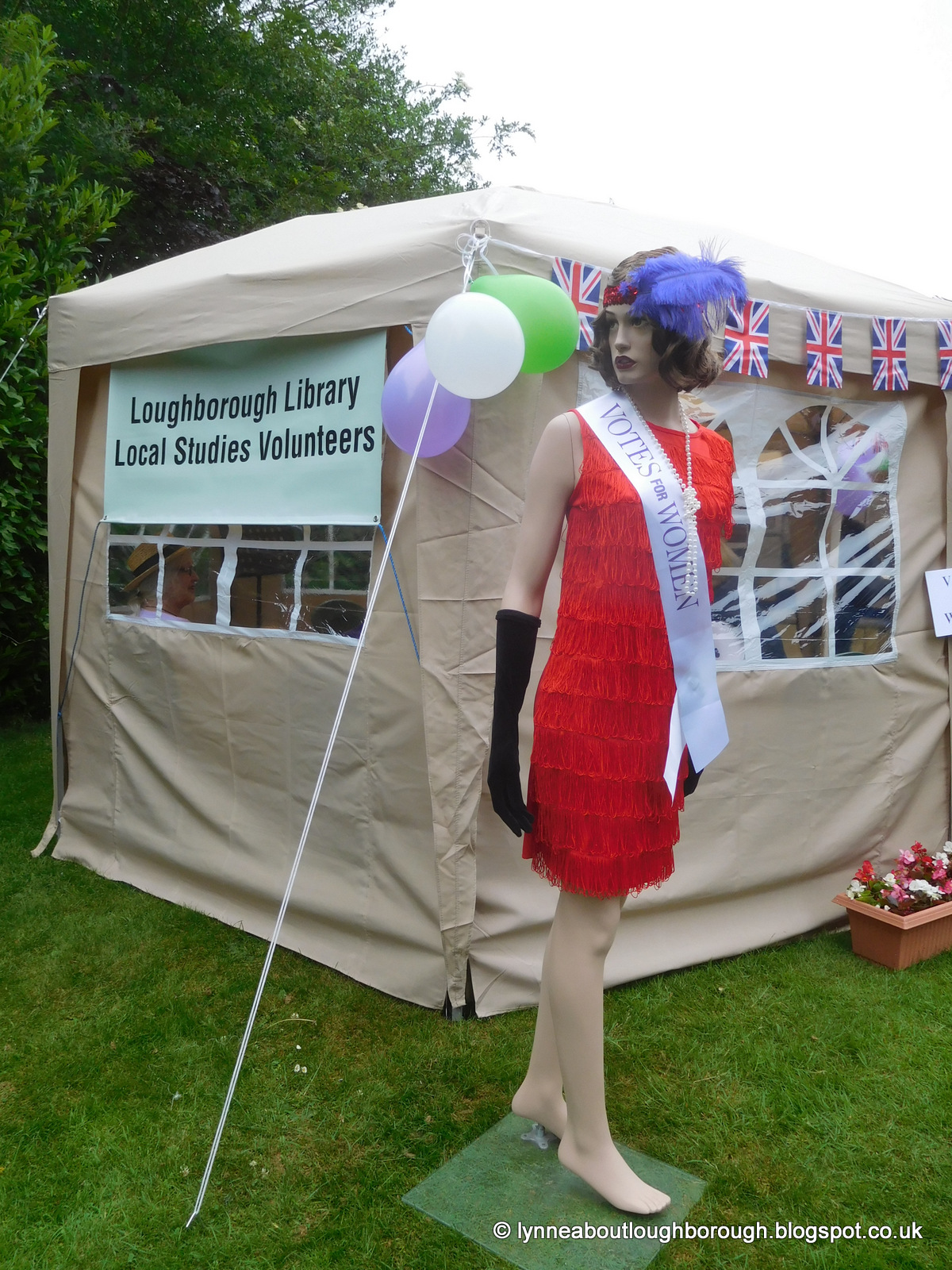
The week started with a meeting with a large group of folk, all engaged with activities and projects related to Loughborough. There seems to be a lot of big anniversaries coming up in the next couple of years and there are some exciting plans afoot. The next upcoming event to look out for is Picnic in the Park on June 8th, arranged by the folk at Charnwood Arts. Staff from the Local and Family History Centre, aka the Loughborough Library Local Studies Volunteers, will be hosting a stall celebrating the 200th birthday of both Queen Victoria and Prince Albert. Victoria and Albert will be in attendance - well, actors will be portraying them!

Picnic in the Park 2018

Talking of the Local and Family History Centre, the current display is a great one - the Midland Main Line then and now - and well worth a visit if you can.


I spent an evening talking with loads of people about what about Loughborough we'd like to see in the Victoria County History volume on the town. This is a national project that's been going since 1899, with the aim of writing a history of every single parish in the country. Progress was initially quite swift, but has since slowed down, and there are still many areas of the country to be written about. We had so many ideas Loughborough's history, it just reinforced to me how fantastic our little town is, and oh so interesting! We thought there was so much to include that we could fill lots of volumes!

I missed a trip to Nottingham with a dear friend due to illness. I was so looking forward to being shown around some of the more interesting parts, especially as I rarely venture off the beaten track that is the Broadmarsh Centre route through to the Victoria Centre, although I did once have a guided tour of the areas associated with D H Lawrence, which was fascinating, I have been to Green's windmill, and I recently had a look at the Alfreton Road area.


Green's windmill


Back in Loughborough, and at the Local and Family History Centre I did a bit of research and met some very interesting people, with whom I seemed to have much in common, not least an interest in milestones!!

After many years of not being available for training, I finally made it to the Old Rectory Museum for some training to be a guide during the open season! Wow! What an exciting opportunity to be able to show people around the building and explain its history, as well as learning something about the artefacts upstairs. There were three of us being trained, which should help towards keeping the ORM open, but there's always a warm welcome for anyone else to be trained up as a guide - just get in touch with the ORM if you're interested!


At the weekend I had a front row seat at a concert in the Trinity Methodist church on Royland Road, given by the Loughborough Male Voice Choir and Hathern Band. Sadly, the youngest wasn't playing due to revision for exams, but it was a great concert, with some lovely singing and some superb playing.

Well, better go now, books don't write themselves!

You are welcome to quote passages from any of my posts, with appropriate credit. The correct citation for this looks as follow:

Dyer, Lynne (2019). Garendon Estate water mill. Available from: https://lynneaboutloughborough.blogspot.com/2019/05/a-week-of-local-history.html [Accessed 19 May 2019]

Take down policy:
I post no pictures that are not my own, unless I have express permission so to do. All text is my own, and not copied from any other information sources, printed or electronic, unless identified and credited as such. If you find I have posted something in contravention of these statements, or if there are photographs of you which you would prefer not to be here, please contact me at the address listed on the About Me page, and I will remove these.
Thank you for reading this blog. 

Lynne 


Sunday, 24 February 2019

Thomas Cook or Maypole Dairy?

I recently caught sight of an interesting photograph of a Maypole Dairy which I want to tell you about, but first I feel I should explain about Thomas Cook!!

I was taken to task last week for suggesting that Loughborough was not a traditional tourist destination, because of the outing Thomas Cook made in 1841. Let me explain ...

When I suggested we weren't a touristy place, I was thinking around a number of things. When I first visited Loughborough I was an avid collector of souvenirs of places I'd visited, which usually took the form of a keyring with the name of the place on it. Sometimes these were beautiful with crests on, other times they were plastic fobs with a blurry picture of the place on, and other times they were a leather affair with the name of the town printed on. I looked all around the town, but the only one I could find was in Woolworths, and was one of the rather less-than-inspiring leather ones. I've still got it (and the rest of the collection) probably upstairs in the attic.

Ok, that's perhaps not the best reason to suggest Loughborough is not a tourist destination! The other thing that I was thinking was that I think people who would consider spending a week's holiday in Leicestershire are probably in the minority (something to do perhaps with a lack of coastline, and a dearth of charismatic, legendary heroes, like Robin Hood). I know I'm a bit on dodgy ground here, after all, Leicester now has Richard III, and it's true that visitors to the city have increased as a result of this, and not everyone wants to see the sea! 

As I said last week, when I first came to Loughborough there was a tourist information centre, but now there isn't. True, Leicester has a destination organisation in Leicestershire Promotions and they've done a good job of trying to connect tourist venues in the city and the county. And, as you know, I'm forever extolling the virtues of our 5 museums, our Local and Family History Centre, our wonderful buildings, our parks, our cinemas, our markets, our fair and everything else I can, when I chat with people, take people on guided walks, give talks, blog or write books. the one thing I keep forgetting to mention is that all our 'attractions' are within a very close area. If you start at the Market Place and walk the shortest route, these are the distances:

To Charnwood Museum in Queen's Park - 0.2 miles
To the Carillon in Queen's Park - 0.25 miles
To the Old Rectory Museum - 0.3 miles
To Taylors Bellfoundry - 0.5 miles
To the Great Central Railway - 0.8 miles 

So what of the Thomas Cook connection? Cook, living at Market Harborough, brought a party of about 500 people along to Loughborough from Leicester on a Temperance outing, on 5 July 1841. They each paid one shilling to travel by train, and arrived at the Midland Main Line station from where they walked to the meeting on Paget's Park, which I believe is now known as Southfields Park. This trip was successful, and Cook planned and executed excursions for Temperance supporters and school children over the next few summers. By 1854 Cook had given up his trade as a woodturner, and begun to make a living from arranging trips. So this is what makes Cook's trip from Leicester to Loughborough the first 'package tour', or more accurately, the first of Cook's package tours. 

Of course, Cook's trip in July 1841 was not the first trip to take place. An example of an earlier one happened when the Nottingham Mechanic's Institute brought a group of between 400 and 500 members by rail to Leicester to visit that town's * own Mechanic's Institute. This appears to have been a very successful visit despite there being few people around to welcome the visitors. However, by the time the group came to leave they were enthusiastically waved off by thousands of Leicester people.  

It does appear, however, that Leicester seems to play a role in those early trips. Sorry for the lack of photos and dense text!

Now, onto the Maypole Dairy. Ahhhh, sorry, I've run out of time today, so I'll be back next week with that story.

Thank you for reading. 

* Although Leicester was a city at the time of the Domesday Book, it lost that status in the 11th century, not regaining it until 1919, thus at the time of the visit of the Nottingham Mechanic's Institute, Leicester was a town. Nottingham gained its city status in the year of Queen Victoria's Diamond Jubilee in 1897.

You are welcome to quote passages from any of my posts, with appropriate credit. The correct citation for this looks as follow:

Dyer, Lynne (2019). Thomas Cook or Maypole Dairies? Available from: https://lynneaboutloughborough.blogspot.com/2019/02/thomas-cook-or-maypole-dairy.html   [Accessed 24 February 2019]

Take down policy:
I post no pictures that are not my own, unless I have express permission so to do. All text is my own, and not copied from any other information sources, printed or electronic, unless identified and credited as such. If you find I have posted something in contravention of these statements, or if there are photographs of you which you would prefer not to be here, please contact me at the address listed on the About Me page, and I will remove these.
Thank you for reading this blog. 

Lynne     
    

Sunday, 3 September 2017

Bridges, buses, trains, balloons and runners!

Well, this last week seems to have been all about transport of one sort or another!!

Last weekend a hot air balloon was spotted flying over Loughborough, and it came so close to my house I managed to take a couple of pictures, from the front bedroom window, and then from the back.


Hot air balloon over Loughborough

Hot air balloon over Loughborough

Hot air balloon over Loughborough

Hot air balloon over Loughborough

Hot air balloon over Loughborough

Hot air balloon over Loughborough

So, the Bridge to the Future is looking like the Bridge of Today - or last night!! Apparently, around 2am contractors working for the GCR put into place a couple of beams for the reinstating of the bridge over the Midland Mainline. The event is well-covered over on the GCR website, and there are some fabulous pictures of the overnight event. Below are some of my own photos from this morning.


Bridge to the Future GCR Loughborough

Bridge to the Future GCR Loughborough

Bridge to the Future GCR Loughborough

Bridge to the Future GCR Loughborough

Bridge to the Future GCR Loughborough

Bridge to the Future GCR Loughborough

On the way back from the 10K race at Abbey Park in Leicester this morning, we spotted a number of old buses pulling in and out of the Park and Ride at Birstall, so having spent some time this morning down at the Midland Mainline dropping a youngster off for a train, before popping over the road to look more closely at the GCR bridge, what better thing to do than walk to Quorn and Woodhouse Station and see those buses from the Leicester Transport Heritage Trust, a bit closer up! And how exciting that was too! Especially as we bumped into an expert friend who was able to tell us if the coach bodies were Brush, or shhhh, made in Lancashire! I must admit, although I wasn't familiar with the buses we saw, the little Midland Red, did remind me very much of the Western Welsh buses from Abergavenny. Of course, Q&W is a railway station, so we also saw trains!

Loughborough Midland Mainline Railway Station


Leicester 10K 3 September 2017

Bus stop at Quorn and Woodhouse Station, GCR

Midland Red single-decker bus

Midland Red single decker bus

Midland Red single decker bus

Midland Red single decker bus

Leicester 1964 Leyland PD3A/1 double decker bus

Leicester 1964 Leyland PD3A/1 double decker bus

Leicester 1964 Leyland PD3A/1 double decker bus

Eastern Belle blue coach

Double decker bus

Quorn and Woodhouse station


Steam locomotive at Quorn and Woodhouse station

Carriages at Quorn and Woodhouse station


I wonder what next week has in store for me?


You are welcome to quote passages from any of my posts, with appropriate credit. The correct citation for this looks as follow:

Dyer, Lynne (2017). Bridges, buses, trains, balloons and runners! Available from: https://lynneaboutloughborough.blogspot.com/2017/09/bridges-buses-trains-balloons-and.html [Accessed 3 September 2017]

Take down policy:
I post no pictures that are not my own, unless I have express permission so to do. All text is my own, and not copied from any other information sources, printed or electronic, unless identified and credited as such. If you find I have posted something in contravention of these statements, or if there are photographs of you which you would prefer not to be here, please contact me at the address listed on the About Me page, and I will remove these.
Thank you for reading this blog. 


Lynne