Local history of Loughborough: its people, its industry, its architecture and environment, past and current events, places to visit! Basically, anything that's interesting to me and I think might be of interest to you! Articles are usually posted at 8pm on Sundays. Shortlisted for the Alan Ball Award, 2023. No AI is used in the research or writing of this blog.
Pages
- Home
- About me
- Books & Bibliography
- Links to all the blog posts in lynneaboutloughborough
- Loughborough Art Deco Glossary
- Loughborough, Luddites and Lace Trail
- Loughborough Plaque Trail
- Loughborough Sculpture, Art & Architecture Trail
- Loughborough Zeppelin Trail
- 100 days about Loughborough
- Three Towers Trail
- Virtual Ten-Minute Town Trails
Sunday, 15 December 2013
Sunday, 8 December 2013
Loughborough Archaeological and Historical Society meeting
This week I have been to the monthly meeting of the LAHS. I
recently joined this society as a friend had recommended it to me, and their
programme of talks for this year looked interesting and informative.
So, I duly trotted off to the university campus and hunted
around for the James Mason building. This actually turned out to be quite easy
to find as there was a group of people loitering outside: For some reason or
other (possibly because this was not the regular meeting place) security had
not unlocked the doors, so we were unable to get in!
After a number of ’phone calls by a number of group members
to a number of university departments, a security van pulled up outside the
building and opened the doors for us. Quite glad really as although it has been
rather mild weather for the time of year, it was beginning to get a bit nippy,
standing around doing nothing!
I was quite intrigued by the topic of the talk: John Bley,
distiller and benefactor of East Leake, but thought for a minute we weren’t
going to be able to hear it, for there was a problem logging in to the
projector. Someone offered to go home and get their projector, but luckily one
of the members was able to activate the system and we were away!
Well, Keith Hodgkinson had us enthralled for about an
hour-and-a-half as he teased us with tantalising titbits about the life and
times of John Bley. Who was his father? Who paid for his apprenticeship to a
distillers in London? Why did he never marry? Who taught him to be so savvy
with his money and investments?
Some of these questions were answered by a consideration of
life as it was in the period of his life, spanning two centuries, from
1674-1731, and what was expected of people. Other questions remain unanswered,
queries for another day when more investigative work by the authors can be
done, but even then, there will remain some things that will be forever unknown
or at best, assumptions.
Keith was a joint author, along with Ian and Rachel Flynn,
of a book which showcased the story of John Bley through the masses of the
research that they did. Called: John Bley of East Leake and London 1671-1734: distiller
and benefactor, the book was published in 2012 by the East Leake and District
Local History Society, and is available to purchase from their website.
The ELDLHS also got a heritage lottery grant to renovate John Bley’s tomb which is in St Mary's churchyard, alongside a leaflet about the man. One of the church windows is also dedicated to John Bley and the house he built for his mother is still standing on the main street.
Looking forward to next meeting of the LAHS which is the one that focuses on presentations from members of the group!
Sunday, 1 December 2013
Christmas appears to have begun ...
Well today has been an exciting day in Loughborough – and I
missed it because I was listening to Hathern Band at the Melton Mowbray
Christmas tree service!! Looks like Loughborough was packed with lots of people, lots of rides and
lots of fun in the Market Place today, and the wonderful Christmas lights were
switched on by the Mayor of Charnwood! And for one day only – there was an ice
rink!
Although I missed all of this, I did, however, make it to the Continental market yesterday
with stalls ranging from selling soap to handbags, cheese to apricots, paella
to galettes! Tried really hard not to spend too much money, but, resistance was
futile, as they say! I did take some pictures, but for some unknown reason they are all blurred.
Still, I should be able to catch some of the events, as over the next couple of weeks, there’s plenty more festive fun
to be had in town. Pop over to the Love Loughborough website and look at their
calendar, where you can see what's happening. And, of course, the panto starts soon too, in the Town Hall!
On a more historical note, the December meeting of the Loughborough
Archaeological and Historical Society takes place on Saturday 7th ,
at the university.
The website of the Leicestershire Industrial History Society
has been updated, and there’s an interesting plea for people interested in being
interviewed in relation to working lives and wartime memories. I’d encourage
everyone to get involved with this: You may think your memories are just your
memories but to others they could be fascinating insights to a life in times
gone by.
And talking of Christmas trees, the parish church had a fine
display of trees decorated by various local organisations, schools and
charities etc., some of which are pictured in this week’s Loughborough Echo and will make it to the website soon, I’m sure.
Sunday, 24 November 2013
Loughborough, Lichfield, Lincoln and more!
This week has been extremely exciting for me as I’ve been
off gallivanting again!!
Thursday saw me in Lincoln, spending a leisurely day with
the other half who’d taken a couple of days off work prior to starting a new
job. We had a lovely inexpensive lunch at a great Italian restaurant and spent
a happy few hours wandering around the town. We left Lincoln during the rush
hour, but still managed to make it back to Loughborough in time for me to go to
an event run by the Friends of Charnwood Museum in the evening.
![]() |
| Elgar and friend, courtesy of R&R Hill |
Earlier this year, in July, the Elgar piece was played on the Loughborough carillon by the borough carilloneur, Caroline Sharpe, to celebrate 90 years since the opening of this stunning war memorial.
During the
talk we were shown how Elgar had really reached the pinnacle of his career just
prior to WW1, and that the works he created during WW1 were of a more patriotic
and straightforward nature – simple, but pleasant tunes.
In 1914 he wrote a piece called Carillon, which was composed
as a tribute to soldiers who had already lost their lives, and in celebration of Belgian carillons, many of which had been destroyed. You may
already be aware that our own Carillon is modelled on those in Belgium, where
there are many of them.
After the war, Elgar moved to the Sussex countryside and
here he began composing more traditional works, like the string quartet and the
cello concerto. He assigned opus numbers to the works he deemed important or
that he thought had the potential to leave a lasting legacy. Interestingly,
after these big works, his later output was mostly of smaller pieces, and
this included our very own Memorial Chimes for a Carillon, otherwise known as the
Loughborough Memorial Chimes, I mentioned earlier. Apparently, Elgar retained the rights to arrange this piece for other instruments, and as such it is more often heard as an organ piece, although I think most arrangements pre-date the finding of the original manuscript.
Elgar died in 1934, and although his popularity comes and goes, he left behind a body of work that is of
sufficient quality to ensure that he remains one of Britain’s great, if not
greatest, composer.
| Jacqueline Du Pre, with Daniel Barenboim |
| Sample of Elgar music |
As a result of listening to that talk and discussion I decided to join both the national and the East Midlands Elgar Societies. It was only when I got home that I realised that I had actually been to school with, and played in the same orchestra as Steven Halls, the Chairman of the Elgar Society!
The manuscript of Memorial Chimes for a Carillon, and some letters pertaining to its performance are currently on display in the Charnwood Museum: Do pop in and have a look the next time you are in town.
| Festival of Britten at Lichfield Cathedral |
Sticking with the musical theme - and a British musical theme to boot - Friday saw me watching a performance of Noye’s Fludde, by Benjamin Britten, in Lichfield Cathedral. I can’t think of a better way to celebrate the 100th anniversary since Britten’s birth and St Cecilia’s Day! I studied Noye’s Fludde for my music 'O' level, but hadn’t heard a live performance before. This was just under an hour of the wonderful, enthusiastic, energetic Cathy Lamb, joint Music Director of the cathedral, resplendent in a canary-yellow, made-for-the-occasion t-shirt! Fantastic, well-organised children from the three local church schools and some strong adult leads, all sang beautifully, telling the biblical story of Noah and his ark.
| Advert for Taylor’s Bellfoundry |
Before the performance began, I flipped through the programme, and imagine my surprise upon finding an advert for Taylor’s of Loughborough!! Thinking there must be some Taylor’s bells up there in the bell tower, I asked one of the lay chapters, Bryan Ramsell, about the bells: They had been re-cast in 1686 after being destroyed in the Civil War - a bit early for Taylor’s in Loughborough - but he introduced me to a gentleman in the orchestra who was able to tell me about the Taylor connection to Lichfield.
It was such a long time ago that I listened in earnest to Noye’s Fludde, that I had completely forgotten that some of the music was played on handbells! And this is what I discovered from talking to the gentleman handbell ringer! They had borrowed the handbells from Taylor’s for the event and were returning them on Wednesday! In fact, the gentleman told me that he enjoyed his trips to Loughborough, because, not only did he always visit the bellfoundry, but he also made regular visits to the Great Central Railway, and he often popped into the Carillon for an impromptu practice!!!
One disappointing piece of information, however, was his opinion that the Carillon was in dire need of some serious maintenance, before it becomes unplayable. His admiration for the tenacity of Caroline Sharpe was quite obvious, but he was clearly worried about the condition of the musical instrument in Queen’s Park. I do hope CBC read my blog!
So, one particular highlight of the musical event for me was being able to listen to the glorious sound of some Taylor’s handbells, expertly rung! Having returned home, I did a quick internet search, and discovered that the British Carillon Society has its headquarters in Lichfield!
So much excitement over the two days, but it wasn’t over yet!! Saturday morning I made my way to the Old John car park at Bradgate Park to take part in some fieldwalking for the Charnwood Roots project which I have mentioned to you before. With permission from the Bradgate Park Trust and the tenant farmers, we were allowed to walk one of the recently ploughed fields, looking for evidence of human habitation of the area. Each novice (that would be me, then) was paired up with a more experienced fieldwalker, and we spent three hours traversing the field, eyes down, scouring the field for exciting stones! As a novice, I don’t think I found anything interesting or helpful, but I was certainly pleased to find a complete horseshoe, a couple of bits of pottery, some large chunks of Victorian drains, and several bits of brick!!
Returning home a bit chilly and in need of some sleep, the afternoon passed really quickly, and Sunday morning saw me at Charnwood College for the Leicestershire Brass Band Association contest! Which actually is a bit of a fib, because as I write this, it’s still Saturday!! But I will be there tomorrow!
Hope you’ve enjoyed this week’s blogpost! See you next week!
Sunday, 17 November 2013
Spotlight on: Loughborough Fair
Introduction
The problem with researching the history of your locality is
where do you stop? It’s simply not possible to learn everything, so sometimes
it’s great to get something specific to concentrate on! Prompted by another of
those remarks on facebook, this time about the fair being hundreds of years
old, I set off on a voyage of discovery …
Fairs have always been important to me, especially since I
grew up in a village, where we lived on the side of the common [according to
wikipedia, this is the last remaining of 9 commons, but according to
Caerleon.net it is the last of 7], and it was here every May-time that the
travelling fair would set up for a week. To a young child the fair seemed huge,
and had all the attractions you’d expect of a 1960s fair. We were lucky enough
to have the dodgem rides right in front of our house – well, I though we were
lucky, but my parents’ bedroom was at the front of the house, so I would
imagine they would sometimes find the music and excited voices quite irritating
at bedtime!
| Sweet stall |
| Tombola |
Today, in the interests of research, I took myself off to
see what this year’s fair had to offer. Well, none of your hook-a-ducks, or
shooting galleries, and I didn’t see any hoop throwing stalls. I think there
was only the one set of dodgems, but they were so different – new cars and a
new stage, not surrounding by the usual little wooden fence!
I didn’t see any
penny arcades either, but there were a few grabber machines, and several large
tombola stalls, lots of people selling helium balloons and several stalls
selling hats and ears.
| The Princess tries to escape! |
| The pink waltzers! |
The pink waltzers were most attractive, as were some of the
other rides – jungle rides and ghost rides. A couple of attractions were very
odd, especially the big pink pillows filled with people, floating on a pond
outside the Echo offices!!
| An arm-like thing! |
There were a couple of tall arm-like things that
threw people up in the air and then rushed them back down again, there were a
couple of helter-skelters.
| The big wheel |
| The big wheel from Queen's Park |
And, of course, there was the big wheel, a
posh-looking version in white with bright white lights and modern-looking pods
– not like the old multi-coloured ones!
Some important dates in the history of Loughborough Fair
Of course, I’m so used to the fairgrounds of today, the
noise, the music, the crush, the expense, that it’s hard for me to imagine what
a fair may have been like all those years ago, when the fair was first granted
its charter. But, the origin and history of fairs goes way back, and is
considered by some to be associated with pagan customs, when people gathered
seasonally, for festivals and fairs. Such fairs were also popular in Roman
times, and later became part of the Christian festivals calendar; hence early
Charters specify occasions in terms of Saints days, and there was a deal of
confusion when the calendar we used changed from the Julian to the Gregorian in
1752.
There appear to be several specific important dates in the
history of Loughborough fair, starting with the granting of the Charter in
1221, which was apparently granted by Henry III, whilst still a boy. This
allowed for an annual event, held on 31st July and 1st
August, which were the vigil and day of St Peter ad Vincula, but because Henry
was a boy, the Charter was only temporary, so in 1227 he confirmed the Charter,
granting an extra day, on the day following St Peter’s Day. The following year,
1228, another Charter was granted, based around All Souls Day – the day after
All Saints’ Day – which falls on 2nd November. I believe there were about 5,000
other fairs that were granted Royal Charters around the same time as
Loughborough was given theirs, and the granting of the Charter meant that the
organisation and control of the fair stayed with the towns people (or their
representatives).
As I mentioned above, changing from one calendar to another
meant that about 11 days in the year were lost, so the November fair became 13th
November. In 1881, local officials, possibly the Board of Health, obtained an
order that stated that the opening day of the fair would always be the second
Thursday in November, as it still is today. Also, sometime in the period
1221-1228 a Charter was granted for holding a weekly market.
What's it all about?
The original Medieval fair was quite closely associated with
the town market, which had also been granted a Charter in 1221, and was held
once a week on a Thursday. Over time, Loughborough developed as a market town,
and by 14th century, was quite famous for trading in wool and cloth.
By the late 1700s, there were about 5 markets/fairs in the town, one of which
was the November 13th fair, which was associated with trading in
cows, sheep and horses. This lasted until the middle of the nineteenth century,
when cattle became the main focus of the first day of the November fair, and by
the end of the century other markets included a retail market, a corn fair, a
butter, egg and cheese fair a hiring, or statute fair and the funfair. With
developments in engineering and mechanisation, the cattle market eventually
moved to another location and amusements became the focus of the November fair.
| The Carillon, surrounded |
In the twentieth century, there have been times when there
has been no fair, for example, during the period of WW1. There was also a
period when the voice of the dissenters was quite loud and there was a risk
that the fair would be moved from the town streets. Luckily for us today, the
powers that be agreed to keep the location, thus helping to preserve the sense
of fun and excitement that accompanies a visit to the fair.
| View from the back! |
In the 1950s, according to a reporter for the “World’sFair”, the specialist newspaper for the Showmen’s Guild, suggested that for the
duration of the fair, the town lost its dignified character and adopted a
carnival-like atmosphere! In about 1955 the fair was described as being 5 fairs
in various of the town’s streets, linked with entertainment booths, until in
about 1965 when the whole of the Market Place was taken over by the fair. More
recently, in 1996, fairground rides and attractions were placed on the main A6
trunk road, at its junction with Market Place, and continue to this day.
| Pink pillows on the A6 trunk road! |
The Loughborough fair is traditionally the last fair of the
year and marks the end of the fairground season, although lately, some showmen
now take their attractions to the various newly-established town fairs that
have been created to boost trade, especially at Christmas-time.
History of the rides and entertainment
Today, when we think of the fair, we think of fairground
rides and entertainment stalls. The very early rides would have been made from
wood, and would have been operated (presumably meaning pulled, pushed or
turned!) by young boys. This all changed around 1860 following the invention of
steam power, when a chap called Frederick Savage mounted a steam engine in the
middle of the rides. This meant that rides could be bigger and more decorative,
as they were no longer relying on the strength of boys.
It is interesting to note that the annual November fair was
a place where the people of Loughborough could experience the latest in
entertainment. For example, during the 1880s, the annual visits of Wall’s
Phantoscope (one of the first film projection machines and was invented by Charles Francis Jenkins, around
the same time as Edison’s kinetoscope, or vitascope, but operating in a slightly different
way) were viewed with wonderment, and were followed by the introduction of the
bioscope. These machines and techniques were indeed precursors to the more
modern cinematography and to the cinema of today.
| Grabbing a Minion! |
Of course, today’s rides have benefited from advances in electrical engineering and hydraulics, and, no doubt, advances in programme logic controllers also have a part to play – in timings, control of synching music and safety.
All-in-all, a great time can be had at Loughborough fair! The noise, the crowds, the music, the excitement all make for the most wonderful experience - even if, like me, you never venture onto a ride!!
Roll on next year!
Sources:
Green, George H. Loughborough markets and fairs through 7 1/2 centuries. Loughborough: George Green, 1964.
Anon. (2007) National fairground archive [WWW] The University of Sheffield. Available from: http://www.nfa.dept.shef.ac.uk/history/charter/lough.html [Accessed 16 November 2013]
Sunday, 10 November 2013
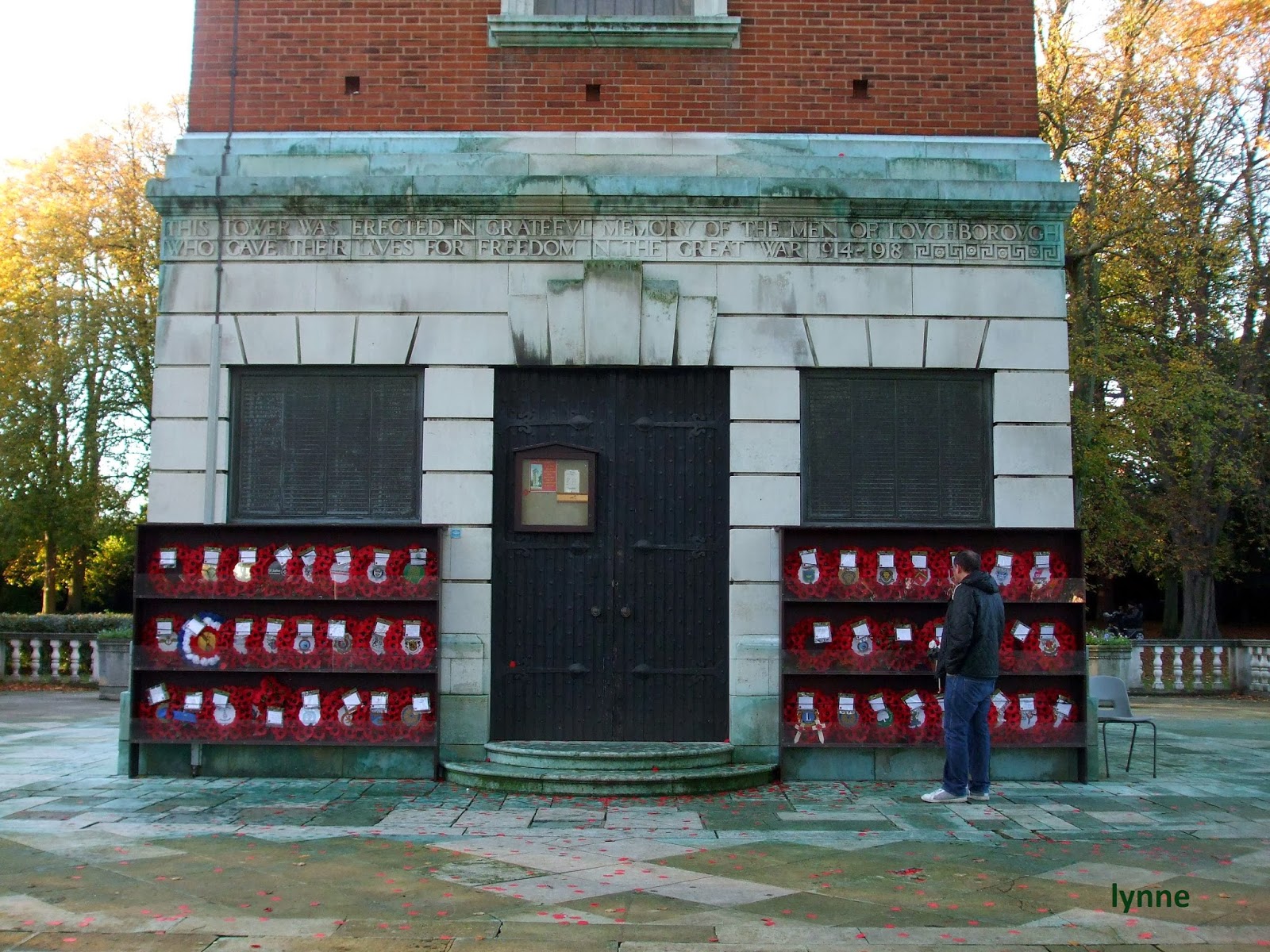
Remembrance: A picture paints a thousand words
Remembrance 2013
Remembrance 2007
Remembrance 2005
Please also look at the Loughborough Roll of Honour webpage.
Thank-you.
Remembrance 2007
Remembrance 2005
Please also look at the Loughborough Roll of Honour webpage.
Thank-you.
Labels:
Carillon,
conflict,
fallen,
heroes,
Loughborough,
Queen's Park,
Remembrance Day,
WW1,
WW2
Sunday, 3 November 2013
Loughborough Culture Walk
Culture, what culture?
So, for example, did you know that:
Loughborough has had four theatres, one of which is still standing – and that’s not including the Town Hall, nor any of the theatres on the university campus?
And, did you know that at one time Loughborough had three cinemas all operating at the same time?
And that the Odeon (formerly the Empire, The Essoldo, The New Empire, The Curzon, The Reel) which currently has six screens has applied for planning permission to add another four screens
And that Cineworld has put in a planning application to build a cinema complex on the site of the old Baxtergate Hospital?
And talking of alcohol, pubs have been the meeting places of numerous groups and societies, and places of musical entertainment, for many years. The Three Nuns still has live bands playing, the Organ Grinder still has folk music evenings, and the Swan in the Rushes also has bands and performances by Mikron the canal theatre group.
A library is not only about education, it is also about culture. The first library in Loughborough was a subscription library on Baxtergate, available only to those who could afford to pay for the service, and the first free public library was on Greenclose Lane, more or less where Sainsbury is now.
Today’s library provides much more than books, as befits a 21st century service: DVDs are available for loan, computers are available to use, and the library is home to a variety of other activities, including being hosts to public health checks, writing and craft classes.
And so to books! Loughborough, the home of Ladybird books! Originally based in Angel Yard, the publisher Wills, who produced trade and street directories, was joined, in 1915 by Mr Hepworth, and together they published the first Ladybird book. The rest, as they say, is history!
Loughborough is also rich in public sculpture, ranging from the Fearon Fountain in the Market Place, and elaborately carved reliefs on buildings in the town centre, to the Signaller in The Rushes.
The latest collection of sculptures which were erected in Queen’s Park as part of the In Bloom entry are on a music-related theme and includes the bell casing used to cast the Great Paul bell in St Paul's Cathedral.
If you were asked to join a Culture in Loughborough walk,
you’d probably say “That’ll be a short walk then!”. So, I’m sure you’d be
surprised to learn that 90 minutes to walk and talk about culture in Loughborough quite simply
isn’t enough: In fact, there’s more than enough culture in Loughborough to fill
at least two such walks! Had you come along to the recent culture walk, led by
Ernie Miller, you’d have discovered that, actually, Loughborough had, and still
has, it’s fair share of cultural activities!
| Theatre |
So, for example, did you know that:
Loughborough has had four theatres, one of which is still standing – and that’s not including the Town Hall, nor any of the theatres on the university campus?
| The Odeon as The Curzon in 2004 |
And, did you know that at one time Loughborough had three cinemas all operating at the same time?
And that the Odeon (formerly the Empire, The Essoldo, The New Empire, The Curzon, The Reel) which currently has six screens has applied for planning permission to add another four screens
| A new cinema? |
And that Cineworld has put in a planning application to build a cinema complex on the site of the old Baxtergate Hospital?
And, did you know that Loughborough’s modern coffee culture
has been going on for years, partly encouraged by the Temperance Society who
tried to persuade people not to drink alcohol, and who opened a coffee house on
the corner of Devonshire Square and Granby Street, now a locally listed
building?
| The Organ Grinder, aka The Old Pack Horse |
And talking of alcohol, pubs have been the meeting places of numerous groups and societies, and places of musical entertainment, for many years. The Three Nuns still has live bands playing, the Organ Grinder still has folk music evenings, and the Swan in the Rushes also has bands and performances by Mikron the canal theatre group.
| Carnegie Library |
A library is not only about education, it is also about culture. The first library in Loughborough was a subscription library on Baxtergate, available only to those who could afford to pay for the service, and the first free public library was on Greenclose Lane, more or less where Sainsbury is now.
Today’s library provides much more than books, as befits a 21st century service: DVDs are available for loan, computers are available to use, and the library is home to a variety of other activities, including being hosts to public health checks, writing and craft classes.
| An example of a Ladybird book |
And so to books! Loughborough, the home of Ladybird books! Originally based in Angel Yard, the publisher Wills, who produced trade and street directories, was joined, in 1915 by Mr Hepworth, and together they published the first Ladybird book. The rest, as they say, is history!
| Signaller in the sunshine |
| Re-dedication of the Fearon Fountain Apr 2013 |
Loughborough is also rich in public sculpture, ranging from the Fearon Fountain in the Market Place, and elaborately carved reliefs on buildings in the town centre, to the Signaller in The Rushes.
| St Paul bell casing in Queen’s Park |
The latest collection of sculptures which were erected in Queen’s Park as part of the In Bloom entry are on a music-related theme and includes the bell casing used to cast the Great Paul bell in St Paul's Cathedral.
Over the years the town has also been home to various music
shops: George Adcock’s on Baxtergate, George Hames on Baxtergate then Market
Place, Paltridge’s on Churchgate, Groops on The Rushes, and Just Music on
Leicester Road, to name but a few.
So, that’s the first culture walk done! Look out
for the next one soon!!
Subscribe to:
Posts (Atom)