Sunday, 14 September 2014

Loughborough to Canterbury!

Loughborough's old buildings


Last week I found myself in Canterbury, attending a conference at the university. As part of the final afternoon’s activities, some of us popped along to look at the cathedral library: Historic, atmospheric, and truly remarkable! After I’d finished there, I took the time to have a look around Canterbury, not a place I’d ever been to before, nor a place I’d ever considered visiting. As I wandered round, I came across a mill (no longer working) and was quite staggered by the timber-framed buildings and narrow streets which reminded me very much of York. This set me to thinking …

John Leland [sometimes spelled Leyland], a native of Leicester, travelled and wrote about his experiences. Now, I’ve not had time to go back to the original source, but several books in my collection quote (and possibly, misquote) Leland as saying (in relatively modern English):

“The whole town of Leicester at this time is builded of tymbre; and so is Loughborow after the same rate. The town of Loughborow is in largeness and good buildings next to Leicester of all the market towns in the shire and hath in it 4 main streets or more well paved …”

Canterbury made me wonder, where are all these timber buildings in Loughborough today? And York made me ask, did we have a Shambles?

To the first, I discovered that whilst some, like the fifteenth century Merchant’s House, that was on Church Gate, on it’s corner with Warner’s Place, where the Irish shop is now, is no longer there, being demolished in about 1975, others, remain, if you know where to look!

To the second, consulting my sources, I can comment in the affirmative: In about 1688, Loughborough did have a shambles. This was an open space where cattle and sheep were slaughtered, and above this, on huge wooden pillars, was the Chamber of the Court Leet. This building was on Cattle Market, on its corner with Market Street and Market Place, opposite the Town Hall, so where Clemerson’s and Gilesports used to be, and where there is now a ‘phone shop.

I haven't even mentioned the similarities between our two universities, from the 1960s buildings, to the popularity of the Sports courses ...

Anyway, pop back again next week, and I’ll tell you about Loughborough’s “tymbre” buildings, but, in the meantime, scroll on down for some pictures of Canterbury.

Detail on the cathedral

Part of the cathedral


Can't think of a better building to house a bookshop!

The mill

Part of the mill workings


Sunday, 7 September 2014

Spotlight on: 54 Baxter Gate

Former nurses' home


Number 54 in the distance

I'm a little short of time at the moment, so I am posting today about a brief conversation which I was involved with on the fbk Remember Loughborough page about a building on Baxter Gate. Coincidentally, I had been talking about this building earlier this week, and it has been one of my favourites since I first discovered it as part of my tour guiding course end 2012/beginning 2013.


Baxter Gate is an interesting street, with buildings from many different eras existing side-by-side. It's
1930s building on Baxter Gate
a one-way street: On the left-hand side as you go down, there are many fantastic examples of 1920/30s buildings, whilst on the other side are much older buildings, one such - Titania's - being thought to be 16th century. The reason for these different building styles is that in the late 1920s, early 1930s Baxter Gate, along with several other Loughborough streets, was widened from its original Tudor width. I do find it rather amusing that around 1985 (and I did say "around" because I can't quite remember the exact year!) the corner of Baxter Gate, where you turn left off the High Street, was made narrower again when the market Place was pedestrianized and the pedestrian lights changed. Not sure what's happening there at the moment, with the pedestrianization of the High Street.

Number 54 Baxter gate


Anyway, the building in question is a Grade II listed building, which at one time was next door to the hospital. Before the hospital was built, in 1862, there was a dispensary on Baxter Gate, which had been originally situated in 1819 on Mill Street (now Market Street), but moved to Baxter Gate in 1824. Looking at a map of 1837, I would suggest that the dispensary is on the plot now occupied by Beacon Bingo, and ceased to be used once the new hospital was built.


Messrs Garton the Mart


So, number 54 Baxter Gate was built around 1900, in brick, with terracotta - possibly from the Hathern Brick company - as an auction mart for Garton and Amatt, with a restaurant and rooms on the upper floors, and has a carriageway arch to the left. I'm not sure when Garton and Amatt vacated the building, but I know Garton moved to the Temperance cafĂ© on Cattle Market.


The hospital was originally a two-storey building, but in the early 1930s, when more space was needed, a couple of extra storeys were added, and some time later, the buildings adjacent to the hospital were demolished and an extension built on the side. This meant that number 54 Baxter Gate was now next to the hospital.


57 Park Road


The nurses' home at this time, was in a purpose-built building which had been built from about 1924 onwards, but at some point they moved to number 54 and stayed there until 1960 when they then moved to 57 Park Road. In 1963, number 54 became offices for the hospital, and was used in this way until at least 1984, becoming a medical information centre in the late 1980s, before closing the doors sometime in the 1990s.


Folks on fbk have said that they remember number 54 being used as a doctors' surgery: Certainly, a Dr McLeod lived at number 52 Baxter Gate in 1929. Mention was also made of Drs: Thompson, B[r]amber, Riley, Harris, Ryan, Acker, Jeffs, Earl, Shicks, and Janner. Perhaps the term "offices" really meant "doctors' consulting rooms"? Apparently, these doctors moved to Woodbrook Medical centre on Bridge Street: There is still a Dr Ryan listed as working there.

So, there is now a planning application out to re-develop the former hospital site, with number 54 included in this. The notices are currently pinned to the mural where the hospital used to be.  


See ya next week, hopefully!


Sunday, 24 August 2014

Magistrate's Court, Police Station and the Wheatsheaf Pub

Magistrates, police and spar ornaments

Yesterday morning I had an early start for a Saturday as I had to be at Heathrow Airport to pick up number one son, whose flight from Central America arrived at 9.40. Worried that the Bank Holiday traffic queues would be enormous, and that the world and his wife would be travelling to Heathrow, and the airport would be really busy, I set off at 7am, with some trepidation. Luckily, I arrived at about the same time as the flight and managed to find a space in the short stay car park reasonably easily. The airport was fairly quiet and I had no trouble finding said son in amongst the other disembarkees.

Number one son playing bowls


As a result of this speedy operation, we were on our way home by about 11am and finally arrived about 1.15. He had some lunch and then I whisked him off to the bowls club to take part in a doubles match, which left me with a free afternoon, having not scheduled anything because I hadn’t been sure what time I’d actually get home.

What's left of the police station


Hubby wanted to nip into town, and I also needed a few things, so we walked in together. Usually, we walk along Albert Street, but today we went via Southfields Park, where we passed the new police station. I’d forgotten they were demolishing the old one, but we had a good view of the pile of rubble that is now the former police station.

Which set me thinking …


The Magistrate's Court on Woodgate

Police cell on the right
Now, I know I should know the answer to this, and I have read it somewhere, but, I think the police station which is currently being demolished was built in the late 60s / early 70s. This new building replaced the former police station, which was situated within the Magistrate’s Court on Woodgate. If you walk down Town Hall Passage from Woodgate, you can see 3 windows at ground level on your right, but there is also a window at waist height, which is the old police cell, where prisoners were kept.


The police department left this building to move into dedicated premises, but the Magistrate’s Court continued in this capacity until about 2007 when the new Magistrate’s Court was built on a plot facing the NHS Walk-In Centre, being at right angles to Sparrow Hill. I must admit, the new Magistrate’s Court looks nice, and even won the Building of the Year Award in the Leicestershire and Rutland Society of Architects at the annual award ceremony. Strangely, when, rather belatedly, I settled down to read this week’s local paper, there was a letter in there about the court being underused, and a comment about it now being on the inner relief road, and therefore being seen as the architects intended. Ok, it’s great if the need to use the building is less than expected, but a shame that such a new building has already lost its sense of purpose.

The other thing that happened, because we chose to walk into town a different way, was that I met an old friend in a shop I wouldn’t normally go into because it’s not on my route into town, and how fortuitous that turned out to be! She had recently been clearing out her parents’ home and had come across loads of old photos of Loughborough: I love old photos, especially ones showing people and buildings together, which help to piece together the history of the town.

The Orange Tree (formerly The Wheatsheaf)


My friend also told me about the shop next to the Orange Tree (formerly the Wheatsheaf pub): Apparently, there were spirits in there, which explained why no-one would stand near the till, and also an elderly lady in the back room who didn’t like the constant comings and goings of people. She also told me that long ago that if you went down the passage at the side of the shop and the pub there were houses there, and that there had been a big fire, which burnt them down. This was of great interest to me as this is where Henry Moore was a spar ornament maker. I’d already worked out that the Wheatsheaf Yard contained lots of little houses around a central courtyard, but it was so great to have it confirmed!
The Town Hall


After this I visited the Town Hall to see the new exhibition of local art and paintings. This was fantastic and there was some wonderful stuff on display, which is well worth a look if you have time. 


The Hospital mural


Finally, I walked past the site of the former hospital on Baxtergate and noticed that planning notices had been pinned to the mural: Applications have been submitted by Pizza Express, Bella Italia and Centro, so it looks as though we will be getting another cinema, along with at least two new restaurants.  


That’s all for this week, folks! See ya next week!


Sunday, 17 August 2014

The Old Rectory Museum

A visit to the Old Rectory Museum

If you live in Loughborough, it's possible that you might have heard of the Old Rectory Museum: In fact, you might even have played in the grounds when you were a youngster! If, however, you're a student, or you're just visiting then it's possible you might have missed this treasure, tucked away in the old part of Loughborough, near All Saints with Holy Trinity Church, close to the former Manor House, the former Guildhall, and what is probably the oldest pub in town!!

The Old Rectory is, as its name suggests, the former rectory associated with what was at the time probably known as the church of St Peter and St Paul, later All Saints, and now combined with the Holy Trinity Church (which is situated on the corner of Moor Lane and Trinity Street and is now an independent school). 

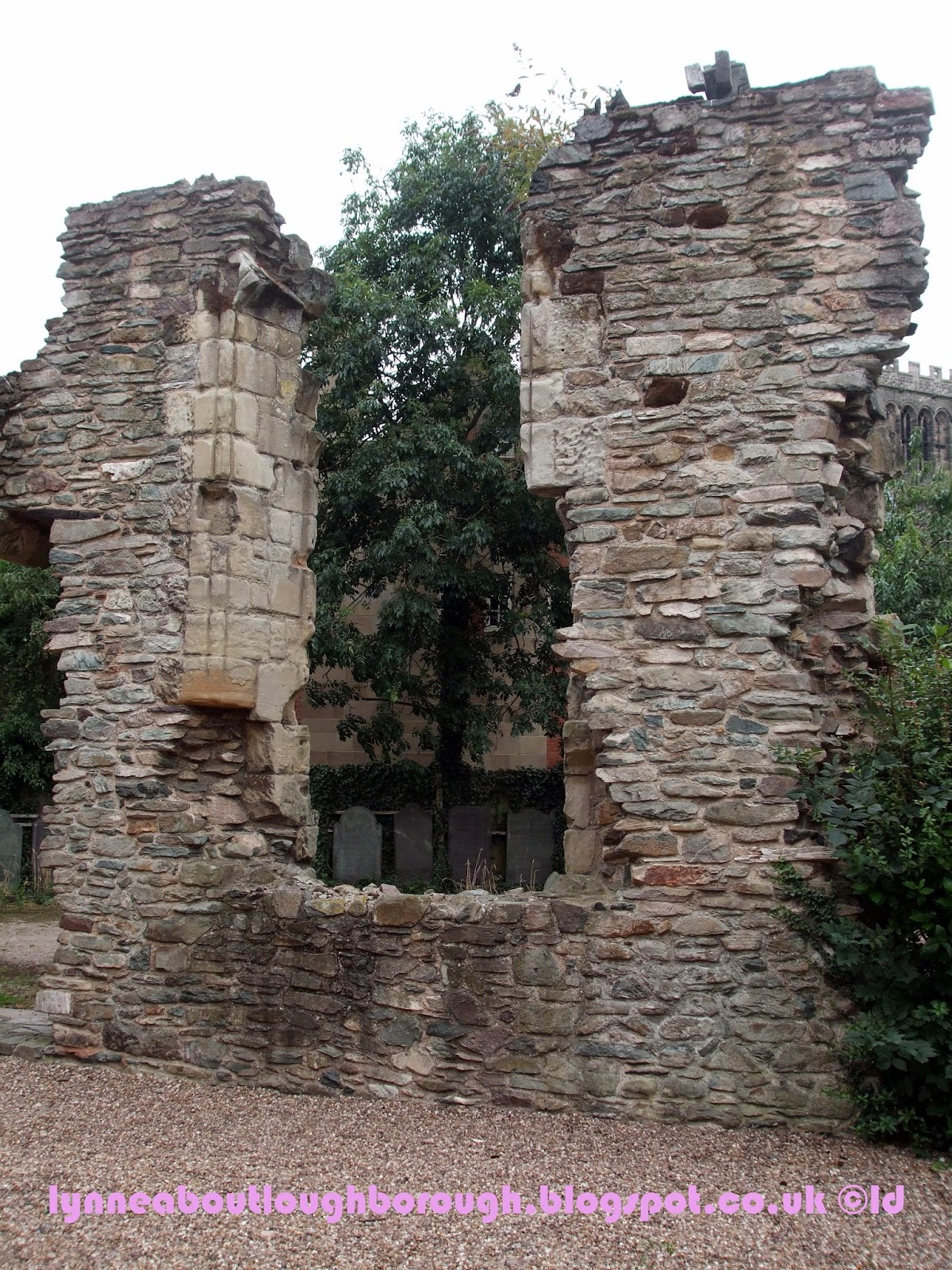
It's quite possible that there was a rectory in this place from about the early 1100s, but in the late 19th century the building looked quite different, being a substantial family home. When a new vicar was installed, he deemed the rectory too big for his and his family's needs, so a new home was built, in about 1960. The Old Rectory was then scheduled for demolition, but in the process, the old stone building that you can see today was found inside the newer building. Such was the significance of this Old Rectory, that demolition was halted, and the stone building retained and turned into a museum.

I believe that the Old Rectory and the Warner Street School are the only stone buildings to remain in the town centre, although the school has now been demolished, leaving only the former headteacher's house. Some significant stonework from the school has been housed in the Old Rectory Museum.

The Old Rectory was at one time a scheduled Ancient Monument, but is now a Grade II* listed building. The museum contains a large variety of artefacts, including archaeological finds, tiles from Garendon Abbey, has a variety of displays, including several on locally important people, and has an area devoted to an exhibition which changes each year. This year the exhibition is based around the Big Meadow in Loughborough, the oldest meadow in the country, dating back to 1762. This meadow is one of the few remaining lammas meadows in the country, and was chosen by Prince Charles to be one of the 60 coronation meadows to celebrate the Queen's reign. 

Below is a selection of photos I've taken of the Old Rectory Museum. These are probably the worst photos I've ever taken, but at least they will give you an idea of what to expect when you visit the museum, which is run by volunteers from Loughborough Archaeological and Historical Society, and which is open every Saturday from April to September, 11-3.