Sunday, 4 September 2016

From Loughborough to Melbourne and back again via ...

So, I'm not normally one for watching much television, but having recently done a course called "Investigating the Victorians" which started with an introduction to Queen Victoria, I was excited to learn that the life of this long-serving queen was being shown on television, and settled down to watch it last night, instead of writing my usual blog post!

The programme didn't disappoint, and reinforced much of what I'd learned on the course. Coincidentally, only three days before, the youngest child and I had visited nearby Melbourne Hall, in Southern Derbyshire, near Donington Park. Melbourne has been a haunt of ours for very many years, initially a place of tranquillity, then, when the children were young, a place for feeding the ducks, and now a place to start a 12-mile walk!! We've been around the hall a number of times, but this time we were taken around by the Curator, and told some wonderful stories about some of the owners and some of the artefacts. I had learned about William Lamb's role as Prime Minister in my course, so it was great to hear about Lord Melbourne from the Curator, who naturally has access to personal documents that reveal much about him. 

I must admit, I decided to change my t-shirt before we went, for fear of being a bit controversial:

And I'm glad I did for it was Lord Melbourne, when he was Home Secretary in about 1830, who was instrumental in the group of men known as the Tolpuddle Martyrs being transported to Sydney, Australia as punishment for their "crime". Later, in 1835, an area of New South Wales was named Melbourne, after William Lamb, and was declared a city by Queen Victoria in 1847, before becoming the capital of the newly founded colony of Victoria.

So, back in the Derbyshire home of Lord Melbourne, we could of course get back to Loughborough via Leicester, on what is popularly believed to be the first package tour - Leicester to Loughborough - on a train with Thomas Cook. This Thomas Cook (1808-1892) was born in Melbourne, and shouldn't be confused with Thomas Coke (1674-1727) who was the owner of Melbourne Hall, and responsible for the beautiful gardens and the re-modelling of the house. Thomas Coke was a politician and courtier, and sat in the House of Commons. 
Melbourne Hall, Derbyshire
Or, from Melbourne we could return to Loughborough via Dishley. As the crowning glory of the gardens, Thomas Coke commissioned Robert Bakewell (1682-1752) of Uttoxeter to make an arbour-like structure from wrought iron. Today this is known as the "birdcage" and has a direct and beautiful view towards the house. Bakewell went on to produce much ironwork of note, which can still be seen today (for example in Derby Cathedral and Staunton Harold church). Of course, Robert Bakewell, ironsmith, is not to be confused with Robert Bakewell (1725-1795), who was an agriculturist involved in the development of animal husbandry at Dishley!
View from the birdcage

Plaque commemorating the work of Robert Bakewell, ironsmith

Iron railings at Melbourne Hall, by Robert Bakewell 

A view of the birdcage from the Melbourne Hall
The home of Robert Bakewell, livestock breeder, Dishley

Commemorative plaque to Robert Bakewell, livestock breeder
But, let's not go that way, let's go via a slightly more circuitous route! Through William Lamb's wife, Caroline Ponsonby, to Lord Byron and Newstead. I hadn't been to Newstead Abbey for a few years, but last weekend I went along to the food festival. Newstead Abbey was the family seat of the poet, Lord Byron, although he didn't live there for very long, and as well as sampling some great food I also had a chance to look around the extensive house.   
Newstead Abbey
Lady Caroline Lamb (nee Ponsonby)

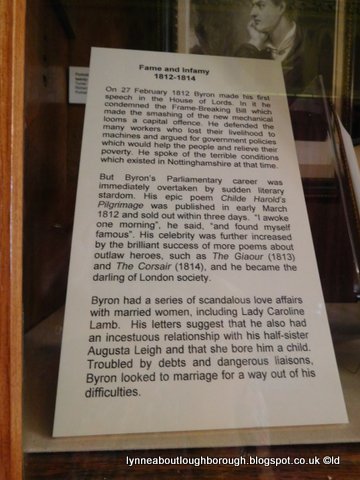
In one of the glass cabinets was a transcription of Byron's maiden speech in the House of Commons. This was in support of the Luddites, suggesting that actually they were right to revolt as they were simply trying to earn enough money to feed themselves and their family, but were being thwarted by the march of the factory system. 
Concerning Byron's maiden speech in the House of Lords
So, from Newstead we return to Loughborough where, in 1816, Luddites attacked the lacemaking factory of John Heathcoat and John Boden, which was in Market Street, where Iceland is now. Some say that this was no ordinary attack and that Heathcoat was expecting it, hence he wasn't in town at the time, and very quickly moved his factory to Tiverton, in Devon, taking many of his workforce with him (well, actually they followed him down).  

And so from Loughborough back to Victoria via Lady Flora Hastings ...
And on the programme, Victoria, there was Lady Flora Hastings, she being the daughter of Francis Rawdon-Hastings, 1st Marquess of Hastings, known as Lord Moira from 1793-1816, he of the famous sales of land around Loughborough and NW Leicestershire in the early 19th century.

So, let's settle down for another episode of Victoria tonight!  


Sunday, 21 August 2016

Loughborough to Tiverton Pt 3

A third post about connections between Loughborough and Tiverton, I hear you ask? Well, yes, there were so many that I spotted while I was there that I wanted to share them all with you, but I hadn't realised I'd be doing so many other things in between posts that I haven't had time to research much else! Anyway, checkout parts 1 and 2, just to remind yourself of connections I've already covered, then read on for yet more!

So, one of the connections between our two towns is that we were both part of the second round of Mary Portas towns, that saw lots of different initiatives taking place in our towns to improve footfall, to make the towns more attractive and to ensure the towns survived and even thrived in the economic downturn.

In the mid-19th century, both towns (as did practically the whole of the British Isles) experienced deaths from the various illnesses (cholera etc.) that abounded at that time. In Tiverton, Thomas Webster Rammell was appointed to investigate and in 1849 he suggested a supply of water should be piped to every house and hydrants placed in the streets to help combat the numerous fires there were. He made lots of other recommendations, but these were rejected in 1851 as costing too much, so it wasn't until 1875 that some recommendations were acted upon. Meanwhile, in Loughborough, in 1870, the Reverend Henry Fearon arranged for Loughborough's first clean water supply, which is commemorated by the Fearon Fountain in the market place. 
Information board on public health in Tiverton Museum
Our Fearon Fountain in Market Place
Tiverton Museum of Mid-Devon Life had a lovely information board about fingerposts and milestones. This reminded me of the tale of the milestone in Loughborough, on Wood Gate, just outside the Organ Grinder pub (formerly the Old Pack Horse).
Fingerposts and milestones in Tiverton Museum
Our misplaced milestone
One of the major exhibition areas in the Tiverton Museum was a specially created room housing a wonderful collection of railway memorabilia, including a steam engine! Tiverton was on the Great Western Railway, whilst Loughborough had (and still has) the Great Central Railway.
A water fountain installed at the Great Western station 
The re-created booking office at Tiverton GWR station

The station exhibition at Tiverton

The steam engine at Tiverton Museum

The steam engine at Tiverton museum
Our GCR
Both towns are lucky enough to have canals. The canal that ends in Tiverton is the Great Western Canal, which runs from Taunton, and although the Somerset part is now closed, the stretch at Tiverton is still navigable.
The information board at Tiverton Museum
Our lovely canal
Sticking with transport, I was really excited to read that the Morrison Electricar was used in Tiverton as a milkfloat, for, this electric vehicle was developed in Leicester by the grandfather of a very close friend of mine, and at one time, until 1935, the bodies were built by the Brush.
The Morrison Electricar
Tiverton Museum also had a small section on clubs and societies. I've already talked about the Temperance Society, but there was also a bowl from the United Order of Druids in a glass case. The connection here is that our Windmill inn was home to a meeting of this society way back in 1837!
The United Order of Druids bowl
Our own Windmill Inn
Of course, the biggest connection between our two towns is John Heathcoat, owner of a lacemaking factory which was attacked by Luddites in 1816, and who left Loughborough to set up a new factory in Tiverton. Sorry, that's a bit brief, isn't it? Pop over to my virtual walk to learn more.
The Heathcoat exhibition in Tiverton Museum
  
Other connections include pubs of the same name. So, for example, both towns had a Bishop Blaize pub, a pub called the Barley Mow, a White Hart, a Cross Keys, a Three Tuns (the name of the Loughborough one was changed to the Three Nuns), a Royal Oak, a Black Horse, a Red Lion, a Railway Inn, and a White Horse. Refer to Billy's book of Loughborough boozers if you want to know more about ours, or have a go at my easy pub quiz! 

There are also many similarities in shops. So, for example, both towns had a Home and Colonial Stores. In Tiverton the local jewellers is called GW Pack: Loughborough's is Denhams. The drapers in Tiverton was Thorne Brothers, whilst in Loughborough it was Pilsbury's. Today, Tiverton has a bakers called Number 33: Loughborough has a deli, selling artisan bread, called Number 58!
Denhams the Jewellers on the corner of High Street and Baxter Gate

Loughborough's Home and Colonial Store in Market Place
This has certainly been an interesting series of posts to write and do hope you've found them interesting!

You are welcome to quote passages from any of my posts, with appropriate credit. The correct citation for this looks as follow:


[Dyer, Lynne (2016). Loughborough Union Workhouse. [Online] Available from: 
http://lynneaboutloughborough.blogspot.co.uk/2016/08/loughborough-to-tiverton-pt-3.html [Accessed 21 August 2016]    


Sunday, 14 August 2016

Loughborough to Tiverton Pt 2

I recently posted about our stopover in Tiverton on the way to Cornwall this summer. There were so many connections between Tiverton and Loughborough, and so many things that reminded me of my home town that I wanted to share with you, but ran out of time last time! So, here's some of the things I didn't get a chance to tell you about. The order they come out might seem to be a bit random, but is actually the order in which I happened upon things that reminded me of Loughborough!

So, to horses!!

In one of the cabinets in the Tiverton Museum of mid-Devon Life there was a china Shire horse, which reminded me of the work of Robert Bakewell in relation to the heavy horse:

"Bakewell also improved the draught horse, the Black Carthorse, or Leicestershire Black, which was the forerunner of the Shire horse. These horses were bred for their strength, and it is widely reported that where other farmers needed between for and seven horses to pull their ploughs, Bakewell only needed to use two."
Shire horse
The next reference to horses was in relation to the Point-to-point and steeple chase which was held in Tiverton on 20 March 1909, at 2 o'clock in the afternoon. This reminded me of Sunloch, the Loughborough horse who won the Grand National in 1914, because at the age of 8, after being a hunting horse, he entered the steeple chase.
Point-to-point and Steeplechase poster
Temperance is a topic which has been covered quite extensively in this blog - Loughborough and the Temperance Movement, Loughborough and the Opening of the Temperance Hall, Nanpantan and Temperance, and Coffee Houses to Coffee Shops - so I was thrilled to see a poster in the Tiverton Museum relating to the Temperance Society (although I took a rubbish photo!).
Temperance Society poster bottom right
Now, in 1770 - Tuesday 31 July, to be precise - John Wesley, the Methodist preacher - passed through Loughborough, and in the Tiverton Museum they had a plate commemorating the life of said Wesley!
Plate commemorating John Wesley
Of course, in Victorian times, brickmaking and bricklaying were quite popular occupations due to the explosion in house-building, so it was great to see a poster referring to the Operative Society of Bricklayers
Operative Society of Bricklayers poster

In Tiverton there used to be a brick and tile company called Culm Davy Brick and Tile Company (not sure when it was founded, but it was wound up in 1881, although whether it that means wound up completely, I'm not sure), which reminded me so much of the Hathern Station Brick and Tile Company, which still exists today, albeit as part of another company! Concerning Culm Davy, curiously, the records on the National Archive website reads as follows:


Description:
Papers re formation of the Culm Davy Brick and Tile Company Limited, leasing of the brickworks and Chancery Case re non-execution of the lease by William Moss
Date:1880-1881

So now let's talk cinemas!! At one time Tiverton had two cinemas (that I know of), The Electric (converted from a drill hall in 1912, last show in 1976, converted to a snooker hall and then demolished between 2004 and 2009) and the Tivoli, threatened with demolition, but reprieved - well, it was still there, and in use when we visited this summer!
Clock from the Tivoli

Information board about the Tivoli

Chairs from the Tivoli
Loughborough, being a slightly bigger town, boasted three cinemas at one point, as well as other places that showed films. Now, we have one Odeon, which has been a cinema since about 1914, and one Cineworld, which was built earlier this year, which reminds me of nearby Swadlincote (which had an Empire Cinema, which closed and a new Odeon was built in about 2014), but that's a story for another day.   
Now the Odeon

Formerly the Odeon, now Beacon Bingo
And finally for today, how's about this? The workhouses at both Loughborough and Tiverton were designed by Scott and Moffat, Tiverton's in 1837-8 and Loughborough's in 1838. Loughborough's became Hastings House and then Regent Hospital, before being demolished, whilst Tiverton's became the Belmont Hospital, a Grade II listed building. This investigation came about because we passed an AA sign directing folk to a new area of house-building called Gilbert Scott Way. Further investigation once I got home revealed that according to the local newspaper the hospital was demolished in 2012, however, there are a number of websites that reveal that actually, some of the former workhouse has been renovated and some new houses built around it, so all is not lost!! Scroll through all the pictures to see what has actually happened to the buildings. So, a similar story to our own workhouse, and a similar story to our own hospital, which was sadly demolished around 2012.

Oh dear, it's now getting rather late and I still have so much to say! Perhaps I'll pick this up again next week, as I'd still like to share the story of John Heathcoat with you, as well as a few other things! Apologies for spelling and grammar mistakes - mine, all mine, I'm afraid!! It's been a long, tiring few weeks!!

You are welcome to quote passages from any of my posts, with appropriate credit. The correct citation for this looks as follow:

Dyer, Lynne (2016). Loughborough to Tiverton Pt 2. [Online] Available from: http://lynneaboutloughborough.blogspot.co.uk/2016/08/loughborough-to-tiverton-pt-2.html [Accessed 14 August 2016]

Sunday, 7 August 2016

Fairs and markets come to the library!

I mentioned in last week's post about Tiverton and its market charter on display in the Tiverton Museum of Mid-Devon Life, and compared this to Loughborough's own market charter. So, I popped down to our market on Saturday and took a couple of pictures. It was late in the day, and most stalls were packing up, if not already packed away:
Loughborough market, Saturday 6 August 2016
On the Friday I had popped into the local public library as I'd heard there was an exhibition about Loughborough's markets and fairs, put on by the Local Studies Volunteers, and I wasn't disappointed. There were some great displays, and some interesting information so, here's some pictures of what I saw:


And here's a bit more information about the exhibition - do pop along if you can:


If you're interested in Loughborough's markets and fairs, you may be interested in re-visiting a couple of my blogposts: