Sunday, 18 February 2018

Lighting up the Carillon and West Quay

This weekend I have been fortunate to spend some time in Southampton with some lovely people! Ok, I can hear you asking what on earth this has to do with Loughborough ...

Connections with Loughborough include my eldest who lives there: he used to play bowls for the Brush up at Nanpantan, but now plays for the Old Bowling Green in Southampton. The connection this weekend was the light show that was taking place in West Quay, which reminded me so much of the light show that we had on the Carillon about three years ago

Putting aside the argument about whether or not directing a light show onto the Carillon - a war memorial paid for by public subscription and built in 1923 - was appropriate or not, the event in Loughborough, which was the precursor to the Loogabarooga Festival, a now annual event celebrating children's literature and book illustration, projected images from children's books onto the building. The event in Southampton was similar, with characters from literature and legend, like St George and the dragon, the pied piper of Hamlyn, projected onto the town walls, but on a much grander scale!

There were a number of other light shows around West Quay like lit cubes and balls, a light maze, a musical instrument - an illumaphonium - and colour-changing water geysers. The latter looked great fun - children dressed head-to-toe in waterproofs and wellingtons were getting soaked as they played with the jets of water, whilst parents and grandparents watched with amazement!

Here's some photos, firstly two Loughborough bowls clubs, followed by some photos from the Loughborough event, and then some from the Southampton light show, and a surprise finale!

Men Bowling at Queen's Park Loughborough
Bowling at Queen's Park

The Brush bowls green Loughborough
The Brush bowls green

Light show on the Carillon Loughborough
Light show on the Carillon

Light show on the Carillon Loughborough
Light show on the Carillon

Light show on the Carillon Loughborough
Light show on the Carillon

Light show on the Carillon Loughborough
Light show on the Carillon

Light show on the Carillon Loughborough
Light show on the Carillon
   
Light show on Southampton walls

Light show on Southampton walls

Light show on Southampton walls

Light show on Southampton walls

Light show on Southampton walls

Light show on Southampton walls

Light show on Southampton walls

Light show on Southampton walls

Light show on Southampton walls

  The illumaphonium Southampton light show
The illumaphonium 

The Guildhall Southampton


Folded Spitfire at the Guildhall Southampton
Did I say we saw a folded up spitfire outside the Guildhall?

Spitfire outside Southampton Guildhall
Close-up of the spitfire

Inside The new John Hansard Gallery Southampton
The new John Hansard Gallery Southampton

Modern art in the new John Hansard Gallery Southampton

A Ford transformer in the new John Hansard Gallery Southampton
A Ford transformer!

You are welcome to quote passages from any of my posts, with appropriate credit. The correct citation for this looks as follow:

Dyer, Lynne (2018). Lighting up the Carillon and the West Quay. Available fromhttps://lynneaboutloughborough.blogspot.com/2018/02/lighting-up-carillon-and-west-quay.html [Accessed 18 February 2018]

Take down policy:
I post no pictures that are not my own, unless I have express permission so to do. All text is my own, and not copied from any other information sources, printed or electronic, unless identified and credited as such. If you find I have posted something in contravention of these statements, or if there are photographs of you which you would prefer not to be here, please contact me at the address listed on the About Me page, and I will remove these.
Thank you for reading this blog. 


Lynne  


Sunday, 11 February 2018

More on suffrage and the carillon

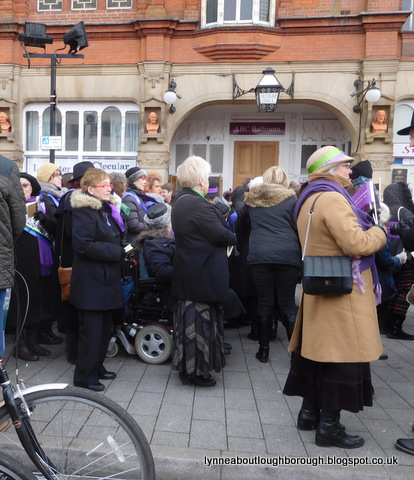
Following on from last week's mention of the unveiling of the statue of Alice Hawkins, suffragette from Leicester, this week I found myself at another unveiling, this time of the suffragette exhibition in the public library. 

This display was researched and arranged by the newly-formed Leicestershire Labour History Society, and the unveiling timed specifically to coincide with the passing of the Representation of the People Act, 1918. This Act decreed that all men over the age of 21 would be granted the vote, as would women over 30, provided they held property to the value of at least £5, or were married to a man who did. 

There were, of course, many things that lead up to the passing of this Act, including the First World War, during which whilst men were fighting in the trenches, women were working in munitions factories, as well as on the trains, trams and buses, and in other industries which were previously regarding as men's roles. Also, as part of the women's suffrage movement, women were campaigning to be allowed to vote. 

The exhibition in the public library starts with the early days suffrage, possibly around 1875, and follows the progress of the movement, form early meetings in the Town Hall, to later involvement of some Loughborough women. 

The opening of the exhibition began in the Charnwood Museum, in front of the model suffragette, and moved on to the public library. Many members of the Leicestershire Labour History Society were present, along with other interested people, and the exhibition was declared open by Lord Willy Bach, Police and Crime Commissioner for Leicester, Leicestershire and Rutland.

I've put a few photos from the event below, but do pop along to the exhibition if you can - it's well worth a read.

Last week I attended a fascinating talk given by Caroline Sharpe (King) about the Loughborough Carillon. After the initial discussions over the pronunciation of the word "carillon" Caroline told the meeting all about her tour of the carillons in the UK, which she undertook when she became our carilloneur in 2008. Apparently, there are 15 carillons in the UK, and Caroline, along with some of her relatives, visited and played quite number of these. 

She also explained how the instrument works, and how to interpret the music that is written for it. Unlike playing a piano or an organ, playing the carillon requires a good deal of strength and is a great workout!

There are regular carillon recitals during the year, given by Caroline, and special performances during the week surrounding 22 July, the anniversary of the opening of the Carillon, and on Remembrance Day. The sound of the bells rings out around the town, and can be heard from quite some way away.


Alice Hawkins the day after unveiling


You are welcome to quote passages from any of my posts, with appropriate credit. The correct citation for this looks as follow:

Dyer, Lynne (2018). More on suffrage and the carillon. Available fromhttps://lynneaboutloughborough.blogspot.com/2018/02/more-on-suffrage-and-carillon.html [Accessed 11 February 2018]

Take down policy:
I post no pictures that are not my own, unless I have express permission so to do. All text is my own, and not copied from any other information sources, printed or electronic, unless identified and credited as such. If you find I have posted something in contravention of these statements, or if there are photographs of you which you would prefer not to be here, please contact me at the address listed on the About Me page, and I will remove these.
Thank you for reading this blog. 


Lynne  


Sunday, 4 February 2018

What is Loughborough's story?

So, over the last couple of weeks, apart from sharing anniversaries with you, I've been out and about and doing  a lot of thinking about things I've encountered on the way.

In particular I've been trying to work out the story of Loughborough, but in all honesty, I'm having a bit of bother with this!

Imagine you go to a work meeting where there's lots of discussion about a variety of topics. After the meeting you chat with someone else who was there and they say something like "Gosh, that was a controversial meeting", and you think to yourself "Was it? What was controversial about it?". 

Or, imagine you go to a party, and have the time of your life! Afterwards, you talk to a friend who was a the same party, who says to you "Wasn't that such a boring party last night?" 

Or imagine you go into town on a Monday, while your 21st cousin 300 times removed goes in on a Saturday. You meet up one evening in the local pub, and you say to them "Loughborough is so quiet and boring, with lots of empty shops, lots of charity/betting/telephone/coffee shops". They look at you in amazement and share their thoughts "Good grief! Yes, there's some empty shops and quite a lot of charity/betting/telephone/coffee shops, but it's a really, really busy and buzzing little place."

So, you may be left wondering if you went to the same meeting/party/town centre?

But, of course, all these views are valid, none are right, none are wrong, and there are plenty of other views to be had as well! 

And so it is with history. Events are interpreted in different ways by different people. Events are recorded in different ways by different people. Some things are recorded to the nth degree, other things more sparsely, other things not at all. 

An additional problem with trying to piece together history is trying to find what's been recorded and where it is now kept. And then once you've found it, trying to read it, both from a handwriting point of view and from an etymological point of view. Then it's helpful to know where the person who recorded the information is coming from - so, why did they record this information? for their own use? for official use? and why did they only record this but not something else?  

So, it's helpful to know what has been recorded, and by whom, and where it can be accessed. Of course, other issues affecting historical records are geographic coverage, which can vary widely across the country, hence some areas have a rich story, others virtually none. And, whilst many events and happenings have been diligently recorded, some have since been lost, for example, the 1931 UK census was taken, but later destroyed during a fire in WWII.   

On top of all the above, add your own 21st century perspective, and you've got a story that represents one view of what might or might not have happened, which may be extremely far-removed from the general contemporaneous consensus, or the view of other people today.

2018 sees the centenary of the Representation of the People Act, which gave the right to vote to those men who didn't already have the right, and to a certain selection of women. The Suffragettes were instrumental in campaigning for votes for women, so it is not surprising that the women's suffrage movement is getting a bit of publicity. For me this has started with the unveiling of the statue of Alice Hawkins, the Leicester Suffragette, and will continue with the opening of an exhibition in the public library. 

The story of the Suffragettes is one which has been told many times, but it is also one of those where the whole story may not be available. If you're interested to learn more about this, and the story of Kitty Marion, pop over to this blog. And pop back to my blog next week and see what's been happening over the coming week. 

New Market Square Leicester Alice Hawkins, Suffragette, covered
Alice Hawkins under wraps

New Market Square Leicester Alice Hawkins, Suffragette, covered
Alice Hawkins under wraps

New Market Square Leicester Alice Hawkins, Suffragette, uncovered
Alice Hawkins unveiled

You are welcome to quote passages from any of my posts, with appropriate credit. The correct citation for this looks as follow:

Dyer, Lynne (2018). What is Loughborough's story? Available fromhttps://lynneaboutloughborough.blogspot.com/2018/02/what-is-loughboroughs-story.html [Accessed 4 February 2018]

Take down policy:
I post no pictures that are not my own, unless I have express permission so to do. All text is my own, and not copied from any other information sources, printed or electronic, unless identified and credited as such. If you find I have posted something in contravention of these statements, or if there are photographs of you which you would prefer not to be here, please contact me at the address listed on the About Me page, and I will remove these.
Thank you for reading this blog. 

Lynne  


Sunday, 28 January 2018

Anniversaries 1068 to 1578

Following on from last week’s blog post, in which we delved into the history of Loughborough in the years ending with an 8, we shall continue with our journey.

We got to 918 when Britain regained control of its country from the Danes. Here's a bit more!

The year is: 1068

William I (aka The Conqueror) was the King responsible for commissioning the Domesday Book, which was the survey that listed all landholdings in England, along with the name of their current holder. Loughborough has an entry in this book – total population at the time 39 households, which in relation to other settlements appearing in the Domesday survey was a very large population.

It was in 1068 (or maybe 1069, depending on which sources you consult) that William I marched northwards from Westminster, through Warwick, Leicestershire, Nottingham and into Yorkshire, building castles along the way. His mission was to put down rebellions and it is said the area surrounding Loughborough suffered greatly during his march.


The year is: 1228


The Old Rectory in Loughborough, tucked away on Rectory Place, next to the new development of houses on Steeple Row, may well have been in existence before 1228, but it is from 1228 that the first written evidence is found, when the Old Rectory was acquired from the Cortlinstoke family by the church. There’s a full history of the Old Rectory over on the Old Rectory and Loughborough Archaeological and Historical Society blog.


The year is: 1238

When Ranulf de Blondeville, 6th Earl of Chester, 1st Earl of Lincoln, and Lord of the Manor of Loughborough died in 1232, the lordship of Loughborough passed to the Despenser family. Sadly, the first title holder, Hugh, who appears to have been popular with his monarch, King Henry III, died, despite being under the care of one of Henry’s physicians. Hugh was succeeded by his son, also called Hugh.


Not entirely sure what happened in the intervening 300 years but –

The year is: 1538

This is the year that sees the beginning of the keeping of the Parish Records – a book in which all births, marriages and deaths are recorded, the book being kept in the Parish Chest.


The year is: 1558

Queen Mary I had made Sir Edward Hastings, 2nd Earl of Huntingdon, a Knight of the Garter, and in 1558 she granted him the title Baron Loughborough, as a reward for his bravery and loyalty. It is believed that Sir Edward was the first of the Lords of the Manor to live in the Manor House.

Later in 1558, Queen Elizabeth 1 acceded to the throne.

Tragically, also in 1558, there was a protracted outbreak of the plague, which lasted intermittently for 100 years, and killed nearly 300 people in the space of 18-months. There's a bit more about the later plagues on my blog.   


The year is: 1578

It was in 1578 that repairs were made to the whipping post, and the stocks. The whipping post was a wooden post to which the person to be punished was tied, in order to be whipped. The stocks were a wooden frame with holes cut out for the person being punished to put their hands and head through, where they stayed for a couple of hours whilst people threw all sorts of things at them.

Where exactly these instruments of punishment were in 1578, I don’t, know, but from 1688 both the whipping post and the stocks were near The Shambles, on the corner of Market Place and Market Street, where the phone shop is now, that was once Potters Toy Shop and Clemerson’s department store. The Shambles was the area beneath the court leet - a meeting place for local government – and was where butchers slaughtered animals.     

More information on medieval punishment can be found at:

  
and
  

You are welcome to quote passages from any of my posts, with appropriate credit. The correct citation for this looks as follow:

Dyer, Lynne (2018). Anniversaries 1068 to 1578. Available fromhttps://lynneaboutloughborough.blogspot.com/2018/01/anniversaries-1068-to-1578.html [Accessed 28 January 2018]

Take down policy:
I post no pictures that are not my own, unless I have express permission so to do. All text is my own, and not copied from any other information sources, printed or electronic, unless identified and credited as such. If you find I have posted something in contravention of these statements, or if there are photographs of you which you would prefer not to be here, please contact me at the address listed on the About Me page, and I will remove these.
Thank you for reading this blog. 

Lynne  


Sunday, 21 January 2018

Anniversaries and names

I was off on a hunt for some information the other day, when I happened upon some dates, which I thought I'd share with you. Not sure how many we'll get through today, but here goes!

The year is: 878
King Alfred (known as Alfred the Great, a name given him by writers from the 16th century), was King of Wessex from 871-899, and during his reign he defended against invasion from the Vikings. So, during the year 878, after winning the Battle of Edington, King Alfred apparently made a deal with the Vikings, and Danelaw (a set of legal terms and definitions) was created in the North of England. Interestingly, King Alfred ceded Loughborough and the area around it to the Danes as part of this Danelaw. Is this why people from the South like to think that we are in the North of the country?! How wrong they are: we're in the Midlands!! In reality, however, the part of the country ruled by Danelaw stretched from Windsor in the South, almost as far as Durham in the North, from half-way between Lichfield and Leicester in the West to the Norfolk coast in the East.

The Vikings brought their language with them, and many of these have been absorbed into English. There's a great list over at Babbel, and the BL website also indicates those place names ending in -by, a word of Viking origin, initially meaning a farmstead, some of which grew into larger villages and towns, but kept the name. There are many villages and towns ending in -by in our area, like Sileby, Ashby, Kirby Muxloe, Asfordby etc..

Then, there's also all those words ending in, or containing -thorpe, a word meaning a secondary settlement, or small hamlet. Places around Loughborough that come to mind are Thorpe Acre, Shelthorpe, Woodthorpe, but should I mention Barkby Thorpe here or under -by!

-toft, again, meaning a small farmstead, however, is not much used in Leicestershire: I can only think of Scraptoft and Knaptoft.

-wick may be Viking, meaning creek, or bay, but might also be an Anglo-Saxon word for port. The only one I can think of locally is Whitwick.

-kirk is a Viking word for church, and indeed, is most often found these days as church - so, Church Langton, Church Greasley. 

-gata, meaning way, or street, is found locally in the form -gate, usually as a suffix in street names, like Baxter Gate, Pinfold Gate etc.. So, Church Gate combines Kirk with Gata and was once known as Kirk Gate.

-borough, finally, King Alfred fortified some of the towns to become defence centres in case the Vikings attacked again. -borough means a fortified place, and is sometimes found as -burgh, -brough, -bury. However, the Anglo-Saxons also used the word -borough in relation to Iron Age and Roman forts they found in Britain when they invaded. There are many -boroughs in our area, not least our own town. Latest thinking is that Loughborough is the fortified place belonging to Lehedes.     

The year is: 918
In 918, Leicestershire, which included Loughborough, was recaptured by the British from the Danes.

I don't know about you, but I think that's enough dates for one day!

Thanks for reading!


Parish boundary marker at Woodthorpe


Church Gate during inner relief roadworks, May 2013


Informative street sign in Heanor, Derbyshire

You are welcome to quote passages from any of my posts, with appropriate credit. The correct citation for this looks as follow:

Dyer, Lynne (2018). Anniversaries and names. Available fromhttps://lynneaboutloughborough.blogspot.com/2018/01/anniversaries-and-names.html [Accessed 21 January 2018]

Take down policy:
I post no pictures that are not my own, unless I have express permission so to do. All text is my own, and not copied from any other information sources, printed or electronic, unless identified and credited as such. If you find I have posted something in contravention of these statements, or if there are photographs of you which you would prefer not to be here, please contact me at the address listed on the About Me page, and I will remove these.
Thank you for reading this blog. 

Lynne  
  

Sunday, 14 January 2018

A ramble around some Loughborough Connections

Today's post is one of those odd ones! A bit of half-finished research, prompted by some research I've been helping a friend with.

So, the architect William Railton built St Paul's Church at Woodhouse Eaves - amongst others - and was also responsible for the Bavarian Gates on the Garendon Estate, and Beaumanor Hall, the Herrick residence. I've posted about this before: 

http://lynneaboutloughborough.blogspot.co.uk/2016/03/william-railtons-bavarian-gates.html 

and

http://lynneaboutloughborough.blogspot.co.uk/2015/10/walk-from-loughborough-to-beaumanor.html

It appears that Railton, who lived in London, was brought to the county of Leicestershire by Ambrose Lisle March Phillipps de Lisle, who had great plans to bring Catholicism back to the county. Having designed and created a home for De Lisle at Grace Dieu (which was altered in 1837 and updated in 1847 by Augustus Welby Northmore Pugin), Railton was then commissioned to design the original Mount St Bernard's Abbey and this was followed by two lodges and a house on Garendon Park.

The folk engaged to build the abbey at Mount St Bernard were Irish Catholics, and because they settled in Whitwick, De Lisle paid for the building of a small chapel (Holy Cross Church, now demolished and rebuilt on the other side of the road) and later a presbytery (still standing and now a listed building), and engaged the services of Augustus Welby Northmore Pugin, architect. 

From about 1875 the presbytery was used by Rosminian nuns who eventually transferred to the Convent in Loughborough, which had been created around 1841 when Lady Mary Anne Arundel, born Mary Anne Nugent-Temple-Grenville, and widow of James Everard tenth Lord Arundel of Warder, opened a small girls' school in Loughborough on Paget land.

In 1844 Sisters Mary Parea and Mary Somonini took over the running of the school, and Lady Mary died the next year, following a two-day illness. She was buried in the cloisters of what is now Ratcliffe College, despite her long-standing home having been Prior Park in Bath, now a National Trust property. Further buildings at the Loughborough Convent were designed by Charles Hansom, brother to Joseph Aloysius (prominent architect, but possibly more popularly known for the design of the Hansom cab), who was highly influenced by the works of Augustus Pugin. 

Interestingly, Ratcliffe College was designed by Augustus Pugin, and the area known as The Square was designed by Charles Hansom. The Historic England listing for Ratcliffe College suggests that Augustus Pugin didn't finish the building, but that was done by Joseph Hansom, and that the chapel was created by Edward Welby Pugin, son of Augustus, in about 1875.

It doesn't appear that Edward Pugin created many buildings in Leicestershire, but he did create an 80 foot high tower, a monument to the son of Ambrose de Lisle, Everard Aloysius Lisle Phillipps VC, who was killed in the Indian Mutiny at Dehli in 1857. The tower was demolished in 1947 as it had become unstable. In 1865-6 Edward Pugin made various additions and changes to Garendon Hall.

As for the Hansoms, well, Joseph designed what is now New Walk Museum in Leicester, which was built in 1836 originally as a Nonconformist Proprietary School, and the Belvoir Street Baptist Chapel in Leicester, which is now home to the Vaughan College. At one time he lived in Hinckley, and was the architect for the Workhouse. I haven't been able to identify any further work by Joseph's brother, Charles in Leicestershire, although he has certainly designed some important buildings around the country, for example the Malvern College.

So, I think I'll end there, before I start rambling too far away from Loughborough.
    
Joseph Hansom's London House and blue plaque
Joseph Hansom's London House
Beaumanor Hall Woodhouse


You are welcome to quote passages from any of my posts, with appropriate credit. The correct citation for this looks as follow:

Dyer, Lynne (2018). A ramble around some Loughborough Connections. Available fromhttps://lynneaboutloughborough.blogspot.com/2018/01/a-ramble-around-some-loughborough.html [Accessed 14 January 2018]

Take down policy:
I post no pictures that are not my own, unless I have express permission so to do. All text is my own, and not copied from any other information sources, printed or electronic, unless identified and credited as such. If you find I have posted something in contravention of these statements, or if there are photographs of you which you would prefer not to be here, please contact me at the address listed on the About Me page, and I will remove these.
Thank you for reading this blog. 

Lynne