Friday, 22 January 2021

Loughborough market and fair

Loughborough market from above
Loughborough market


In this blog post I was going to write about the history of Loughborough market and fair, but during my research for information, I came across a lovely little book (1), a sort of guide to some of the market towns of England, that I just found so appealing I had to share with you before looking into the history of Loughborough market - and fair.


The book in question is basically an introduction to English market towns, and it’s rather like a guidebook. How wonderful to find our lovely town in a guidebook! The book is a Colourmaster Publication, printed in 1973, but the author does not reveal their identity, either within, or on the cover. However, in the acknowledgements, the author and publisher thank a number of people, which includes the then Market Manager for the Borough of Loughborough, M. W. Green.

Let’s take a look at what appeared in the text.

“Ancient Loughborough is the second largest town in Leicestershire and has been described as the town of bells. It owes this title to John Taylor of Oxford who came to the town to recast the bells of All Saints Church. He was so taken with the town that he stayed, setting up his famous foundry in Cherry Orchard.”

The tower of Loughborough parish church


The writer goes on to comment upon the world-wide reputation of the bells that have been cast in Loughborough, including the Great Paul bell for St Paul’s Cathedral. The church of All Saints is said to be of 14th-century structure, although much restored, with a bell tower that is 500 years old. There was at the time of the writing of the book, a small museum to the memory of Taylor, although it does not specify which Taylor.
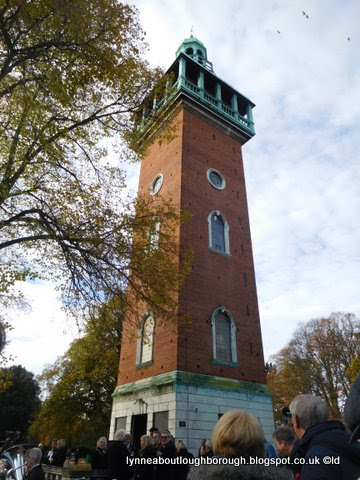


Loughborough's carillon


Of course, no book about ‘what to see’ in Loughborough would be complete without mention of the Carillon, the bells of which were of course made by Taylors:

“The 151 feet high war memorial in Queen’s Park also contains one of the finest carillons in the country. Forty-seven bells hang in there ranging in weight from over four tons to twenty pounds. It rang for the first time in 1923 and it was from here that the first broadcast of bell music was made.”


Without pausing for breath, the writer continues:

“Loughborough was also the home of John Cleveland, the so-called Cavalier Poet. His devotion to the Stuart cause was reflected in his work in which he heaped scorn on the Commonwealth and he was hounded by those he satirised. He died before the Restoration but his works were avidly read for many years although now they are little known, for his wit was topical and not enduring.”

We finally get to a section on Loughborough’s wonderful market and fair:

A fairground ride at Loughborough

“Loughborough is eminent as a market town and much of the history of the town is reflected in the story of its fairs and gatherings. The earliest known document relating to Loughborough fair is dated 1221 although the market has almost certainly existed before that time, probably from the right to hold the Thursday market granted by Hugh Despenser in 1206.

In 1227 the charter was a confirmation that the market was to be held on Thursdays and likewise the fair was to be a two-day event to commence on 31st July each year. The following year the right to hold an additional fair was granted, to be held in November and to this day the annual November pleasure fair is held on the second Thursday of that month.”

Some general history of the town follows:

“So the town, prosperous and growing, continued to expand and in the years 1400 to 1600 was an important centre for the wool trade. The Civil War left it unmarked, although Royalists on one occasion recruited a motley army after a fiery speech from the Market Cross. The town had passed to the Earls of Huntingdon and in 1677 there was granted the right to hold two additional fairs in the town, ‘on the Tuesday preceding Palm Sunday and on the second Tuesday after Easter Sunday’.

In 1742 the original cross was replaced by a new structure, known as the ‘butter and hen’ cross, which instantly evokes the picture of a bustling market place. It was described as having a ‘slated roof supported by eight round brick pillars set up in an octagon form’, and was topped with a sumptuous weather vane. Additional fairs flourished, including two described in contemporary accounts as ‘cheese meetings’. In 1829 the manorial rights in the markets and fairs were sold to the Loughborough Local Board. The Cattle Market continued to function in the Market Place until 1896 when it was moved to a new site. During recent years this has been much modernised and improved. The general market, after some years of uncertainty about its future, has been saved on its traditional site and made a pedestrian precinct with an added bonus of more space for open air trading. Its future as one of England’s oldest markets now seems assured.”

Background to Loughborough markets and fairs

So, here’s a bit of background to Loughborough’s markets and fairs. The charters for the market and fair were granted in the reign of Henry III, who ruled between 1207 and 1272, and who during this reign granted charters to over 1,000 towns and villages, of which Loughborough was one, and Ashby, Belton and Waltham-on-the-Wolds some of the others.

Henry III had become the monarch at the age of nine, thus the country was ruled by two regents, until Henry came of age. However, Henry signed up to the Great Charter of 1225, which was the definitive version of the Magna Carta created by King John in 1215, and which separated out rules pertaining to forests. This charter limited royal powers and protected some of the rights of the manorial barons.

Thus, in a royal letter (2), Henry III granted Hugh Despenser the right to hold a market, from 22nd January 1221 – 800 years ago! The market and fair was to be held at Despenser’s manor in Loughborough, and the permission granted in the royal letter was to be valid until Henry came of age. In 1227, on 12th February, once Henry had come of age, he granted a charter to Hugh Despenser to hold a market on a Thursday, and further confirmation was given in February 1229 and February 1233.

Loughborough’s market is therefore known as a Charter Market, and this status can only be changed by an Act of Parliament. The other type of market is a Statutory Market, one which has not been created as the result of a charter, rather being formed by an Act of Parliament.

The former manor house

Hugh Despenser’s manor house was in the area of Sparrow Hill, now occupied by an Italian restaurant, inside which, beams have been dated to 1477. This area is close to the church, and the churchyard would have been the original location for market stalls – barrows, carts, as well as static furniture. Because of the regularity of the market in such a well-known area, it would have been easy for people to remember when the market was, and for them to meet here to trade their goods. There would also have been plenty of witnesses, should anything go wrong!

It had been known for events to get a bit out of hand during these markets, and occasions when people set up stalls without permission, so in 1285, Edward I passed a law that stopped the holdings of markets and fairs in churchyards.

In August 2020, the inhabitants of Sileby set up a few market-type stalls in the car park at the Free Trade Inn. This sparked a whole debate about charter markets, the area around them that were protected by such a charter (in Loughborough’s case this was a radius of six and two-third miles) and competition, which reached the national news.

This wasn’t the first battle over the rights to hold a market, for in 1239, the town of Leicester claimed that its market trade was being damaged and put under threat by a Tuesday market that had been installed in nearby Narborough. Both markets had been in fact been going for quite some time. Narborough’s market day had changed in 1220 from a Thursday to a Tuesday, so perhaps this change of day was the concern in Leicester, although why this was raised as an issue nineteen years later, I cannot say.

Loughborough fair

Although today we think of fairs as being fun places, full of whizzy rides, bright lights, amusement, and food stalls, all to the cacophony of music, sirens and people screaming, fairs haven’t always been all about fun and games, but were once very important trading places.

Originally, the terms ‘market’ and ‘fair’ were used interchangeably, as charter fairs were essentially markets. The main differences between the market and the fair were that markets were held either daily or weekly, while fairs were usually an annual event associated with the feast day of a specific saint, and while markets traded in fresh produce and necessities, fairs traded in higher value, non-perishable goods, like homewares, pottery, furniture, and farm tools.  

The word fair comes from the Latin word ‘feria’, which means holiday, and as early fairs often began on the feast days of a saint, people would go to church in the morning, and then the fun of the holiday would begin after this. Amusements may have been provided by acrobats, fire-eaters, jugglers, and minstrels. Shops closed, but their proprietors were able to trade at the fairground.

Like markets, fairs could only operate if granted a charter, and there were close to 5,000 such charters granted in the thirteenth and fourteenth centuries. Of these, most villages, towns and cities that were granted permission could hold only one fair per year, which probably lasted for just a few days. Some of the more important fairs were held at Winchester, Stourbridge, Bartholomew in London, and St Ives in Cambridgeshire (although at the origination of the fair, there was no town of St Ives: the town grew up there because of the fair).

Also like markets, fairs could operate if allowed so to do by an Act of Parliament. These fairs were called hiring fairs, statute fairs, or mop fairs, and were conceived from about the mid-1300s, when there was a shortage of workers, probably in part due to the black death. Later, around the mid-1500s, it became the custom for rates of pay for workers to be fixed on a specific day each year, which would hold true for the coming year, and be re-set the next year. So, workers were employed for a year, and then had to seek employment at the end of that year. Because so many people congregated at the annual fair, this became a good opportunity for workers and employers to seek each other out. People looking for work would often carry with them some visual indication of their trade: perhaps a shepherd would carry a crook, a housemaid a mop, hence the term ‘mop’ fair.

So, what of Loughborough fair?   

The background to Loughborough fair is almost identical to that of its market. In a royal letter (3), Henry III granted Hugh Despenser the right to hold a fair, from 22nd January 1221 – 800 years ago! On 12th February 1227, once the king had come of age, he specified that the fair be held on the eve or day before the feast of St Peter. A further letter was sent to Despencer in April 1227, and again confirmed in February 1229 and February 1233.

Today, Loughborough fair has now expanded to cover many of the town centre’s streets – and the Granby Street car park, which used to be the site of the cattle market. 
One of the rides on the Granby Street car park

For many years, the event always began on the second Thursday in November, but a few years ago this was extended, and now begins on the second Wednesday of November. The fair is opened at an official ceremony, when the current mayor reads out the charter, and there are usually many dignitaries in attendance.

Dignitaries at the opening ceremony


When the fair closes for the final time the stalls are quickly dismantled, and the following day, a visit to the town centre reveals barely any remnants of the amazing show. In some years, there is an even greater urgency for the fairground rides and stalls to evacuate, as the annual Remembrance Day parade, which passes through the town into the market place, always takes place on the second Sunday in November (which is closest to Armistice Day, 11th November), which is often the morning following the last night of the fair.

Remembrance parade through town, 2007


The year 1978

In October 1978 I arrived in Loughborough, the place that was to be my home for the next three years, but which has turned out to still be my home 42 years later!! Some friends and I went down to the fair the next month, excited to see what was on offer. 

In truth, I'd grown up with fairs, because the small town in which I had been brought up held a fair each May on the common: my house was beside the common and the dodgems were right in front of my house! Not only that, the town where my parents had been brought up, and where my grandparents lived also had an annual fair in May, although this was on what was now a large car park, but it was somewhere we visited most years.

Although I was excited to visit Loughborough, I have to say this excitement was tempered a bit by an experience I'd had only a couple of months before at the fair on Harrogate Stray, when I'd been persuaded to go on the waltzers. Hanging on for dear life, and practically falling off with dizziness, I realised why I'd never been on them before, and that sealed my relationship with fairground rides: great to look at, but not ever to be ridden on!

Anyway, in November 1978, we trooped into the town centre from the Forest Road direction and ended up at the start of the fair in Bedford Square, where there was a stallholder just standing there, without a stall, offering to guess people's ages. Well, my friends thought it would be a sure-fire bet that he'd never be able to work out my age, and they'd win the wager. I suspect their optimism had something to do with the fact that at the age of 18, I was still under five feet tall, and had something of a young-looking face. Needless to say, their naivety was not rewarded when the chap estimated I was 17!

The year 1979

By November 1979 I had been living in Loughborough for a year, and so this was the second time I visited the fair. Again, I went with friends on the Friday evening, and although we all had a great time, I was nursing a sore throat. By Sunday evening I was decided poorly, and on the Monday I was diagnosed with some dreaded lurgy, more than just the cold I thought I had. It took a couple of weeks to recover, although ever since then I have needed more sleep than I did before!  

The year 2020

During the year 2020, a year in which the country saw itself in various stages of lockdown due to a pandemic, the bustling market of previous years, with its stalls stretching from Devonshire Square down to Swan Street, partly along Market Street, and four layers in the market place, has been severely reduced in size, and now only presents a few stalls on Cattle Market, with two rows in the market place, and the approach to the various stalls is controlled by barriers.

The fair, one of the main highlights of the year, was not able to come to Loughborough in 2020.

A view of the new market layout. The Fearon Fountain celebrated its 150th anniversary in 2020


The year 2021

As mentioned above, permission to hold both a market and the fair was granted in 1221, making the year 2021 the 800th anniversary of both, a milestone that was to be celebrated in many different ways across the town. As at the moment the country is still in a lockdown situation, some of these celebratory events may not be able to take place, but we can rest assured that something will happen at some point!

It is to be hoped that the sentiment expressed in that guidebook quoted above, in relation to the market, still applies to the market, and applies also to the fair such that "Its future as one of England’s oldest markets now seems assured.” It simply wouldn't be Loughborough without its markets and fair.  

(1) Read about English Market Towns. Colourmaster International, 1973.

(2) Such a letter was a letter of instruction and was folded and sealed, securing the contents until opened by the recipient. Hugh Despenser was given permission to hold a market and fair in this way because an under-age monarch was not able to grant charters.

(3) This may have been included in the same letter as that which granted the right to hold the market to Hugh Despenser, or it might have been a separate communication? 

Posted by lynneaboutloughborough 22 January 2021

You are welcome to quote passages from any of my posts, with appropriate credit. The correct citation for this looks as follow:

Dyer, Lynne (2021). Loughborough market and fair. Available from:https://lynneaboutloughborough.blogspot.com/2021/01/loughborough-market-and-fair.html [Accessed 22 January 2021]

Take down policy:
I post no pictures that are not my own, unless I have express permission so to do. All text is my own, and not copied from any other information sources, printed or electronic, unless identified and credited as such. If you find I have posted something in contravention of these statements, or if there are photographs of you which you would prefer not to be here, please contact me at the address listed on the About Me page, and I will remove these.

You can leave comments below, but do check back as my reply will appear here, below your comment.

Thank you for reading this blog. 

Lynne         

Sunday, 17 January 2021

Loughborough cemetery Part 2

More memorials to World War Two PoWs


It appears there were over 1,000 Prisoner of War camps in Britain, and quite a few of these were in Leicestershire. Many are listed in this article and associated databank (2020) which includes the following:


o    Barkby Camp, Barkby Lane, Leicester, No.616 (previously a heavy anti-aircraft battery)

o   Farndon Road Camp, (Harrington Camp), Farndon Fields Farm, Market Harborough, No.49, (German working camp, standard type/caravan site)

o   Garendon Park, Loughborough, No.28

o   Gaulby Road, Billesdon, No.94 (German working camp, standard type)

o   Hathern Camp, Pear Tree Lane, Hathern, No. 590 (farmland)

o   Knightthorpe Camp, Loughborough, No.28 (German working camp)

o   Old Dalby Camp, Old Dalby Lane, Melton Mowbray, No.613 (large RAF depot with huts converted to accommodation)

o   Old Liberal Club, Charnwood Road, Shepshed, N0.152 (German working camp)

o   Quorn Camp, Wood Lane, Quorn, No.9/183 (Base camp, standard type)

o   Scraptoft, Thurnby, Leicester, No.4 (Base camp)

o   Shady Lane, Stoughton, Leicester, No.167 (Base camp)

There is, however, some debate as to whether or not Knightthorpe and Garendon were actually the same place: Garendon Hall was originally used as the headquarters for local munitions, but both seem to be known as Camp 28, with the main camp being towards the south of the estate lands. 

Last week we looked at some of the PoW camps close to Loughborough, and one in Stoughton which had a Loughborough connection. Let’s stay with the Leicester area, and a camp in Billesdon for a moment as there are more Loughborough connections, before moving closer to Loughborough.

A report in the Leicester Evening Mail of 6 October 1947 carried a report of the death of Peter Leugner. He was born on 17 September 1902 in the Ukraine, and died on 4 October 1947. Leugner was found hanging in a room at the Scraptoft PoW camp. The article says:

“It is understood that he was due for repatriation.”

Leugner has a memorial stone in Loughborough cemetery.


Earlier in 1947, an inquest took place in Market Harborough on the death of Corporal Konrad Schubert. Schubert was born on 30 July 1906 in Paszowice, Poland, and died on 19 January 1947 in the camp at Billesdon. According to a report in the Leicester Evening Mail of 23 April 1947, Schubert was depressed following the death of his mother and sister, and worried about his two children who were living in the Russian part of Germany. His own ill-health had meant that he had been unable to work on the farm, and this made him more unhappy, although his fellow PoWs had not ever heard him talk about taking his own life.  

Mr Tempest Bouskell, the coroner for South Leicestershire, pronounced that Schubert had committed suicide whilst the balance of his mind had been temporarily disturbed, and passed on his sympathy to Corporal Schubert’s fellow prisoners.

Schubert has a memorial stone in Loughborough cemetery.


We shall now leave these distant Leicestershire camps, and return closer to home, where we find a camp at Quorn which was used as such until about 1948. In the Nottingham Evening Post 12 August 1947, the following report appeared:

“A German prisoner-of-war, Baumann Hubert, died suddenly at the Quorn Camp yesterday. The body was removed to the Loughborough mortuary and the facts reported to the Coroner for North Leicestershire.”

Listed as Hubert Baumann on his memorial stone, Corporal Baumann was born 27 October 1924, died 11 August 1947, and has a memorial stone in Loughborough cemetery.


A report of a sad event appeared in the Daily Mirror of 18 September 1945:

COMEDIAN HANGED HIMSELF BECAUSE HE WAS LAUGHED AT.

A German giving evidence at a Loughborough, Leicestershire, inquest yesterday on a fellow prisoner of war who hanged himself at a camp said that the dead man had complained that other men in his working party made too much fun of his acting on the camp stage. He was a comedian.

Other prisoners said that the dead man, Sargeant Herbert Bruhn, 29, of Hamburg, had been unhappy for the last two weeks – they didn’t know why.

A police witness said he found no suggestion of either foul play or bullying. Recording a verdict that Bruhn hanged himself while his mind was disturbed, the coroner said it was difficult to understand the mind of a German, particularly a prisoner.”

Sergeant Herbert Bruhn, was born 28 January 1916 in Hamburg, died 16 September 1945, and has a memorial stone in Loughborough cemetery, but I have no idea which camp he was held in, nor in which camp he died.

The following report appeared in the Sunday Post 1 April 1945:

Allies sentence German boy to death. Karl Punzeler, of Monschau, 16-year-old boy, former leader of the local Hitler Youth, has been found guilty of espionage. Sentenced to death. This is an extract from ‘Die Mitteilungen’, the Allied newspaper, which is being distributed free in occupied Germany. It’s one of a list of sentences passed by Allied Military Government on civilians, and reported in the paper.”

The report continues with a list of misdemeanours, perpetrators, and punishments, in which we find the following:

“Franz Franke and Helmut Engel – for refusing to work as directed with a labour gang – 60 days.”

I believe Private Helmut Engel was born 30 April 1926 in Berlin-Neukolln, and died in Ankle Hill camp at Old Dalby, in Melton Mowbray, on 22 August 1947. The camp, which as well as housing over 3,000 soldiers, housed around 300 PoWs, during WW2. Quite why Helmut Engel has a memorial headstone in Loughborough cemetery, I’m not sure.  


I have been unable to trace much information pertaining to Dr Karl Theodor Reuter, other than that which appears on his memorial headstone in Loughborough cemetery. 

Dr Karl Theodor Reuter, was born 24 March 1914 in Herdecke, Ennepe-Ruhr-Kreis, Nordrhein-Westfalen, Germany, and died 11 December 1946 in Leicestershire, in the Thurnby Camp at Scraptoft.


Corporal Leonhard Rademacher was born on 24 May 1910 in Monchengladbach, died on 17 September 1946 in Garendon Park/Knightthorpe Camp, No.28, in Loughborough. He has a memorial headstone in Loughborough cemetery.


It will be noted from the death dates found on the memorial headstones that the majority of these eight people died in Britain after the end of the Second World War. There are likely to many and varied reasons why they still found themselves in Britain, rather than returned to their homeland: according to this article, published on the occasion of VE Day in May 2020, some stayed and integrated themselves into the British way of life because they had made good friends, or had fallen in love. Other reasons may have been that conditions in Germany were very difficult, and there was a delay in repatriation, but also perhaps because the British government resisted sending them home as the country was short of workers. Indeed, the final German PoW returned home as late as 1948.

The bridge at Shepshed watermill built by PoWs from Garendon Hall


The bridge at Shepshed watermill from a distance


Pear Tree Lane, approach from Derby Road


Site of the Pear Tree Lane PoW camp

Site of the Pear Tree Lane PoW camp

Site of the Pear Tree Lane camp


Posted by lynneaboutloughborough 17 January 2021

You are welcome to quote passages from any of my posts, with appropriate credit. The correct citation for this looks as follow:

Dyer, Lynne (2021). Loughborough cemetery part 2. Available fromhttps://lynneaboutloughborough.blogspot.com/2021/01/loughborough-cemetery-part-2.html [Accessed 17 January 2021]

Take down policy:
I post no pictures that are not my own, unless I have express permission so to do. All text is my own, and not copied from any other information sources, printed or electronic, unless identified and credited as such. If you find I have posted something in contravention of these statements, or if there are photographs of you which you would prefer not to be here, please contact me at the address listed on the About Me page, and I will remove these.

You can leave comments below, but do check back as my reply will appear here, below your comment.

Thank you for reading this blog. 

Lynne

Sunday, 10 January 2021

Loughborough cemetery Part 1

Memorials to World War Two PoWs

During one of my recent walks around Loughborough, I found myself returning from a very muddy walk around Charnwood Water, via the newer part of the Loughborough cemetery. As has happened on many occasions whilst I’ve been out walking, I’ve accidentally socially-distancly bumped into a wide variety of friends who during this pandemic I wouldn’t otherwise have seen.

And so it was that on this walk through the cemetery a chance meeting with one friend piqued my interest in some specific graves in the newer part of the cemetery, namely the headstones associated with some German men who died around the time of the Second World War. Several of these men were well-known about and new headstones had been placed in their memory, but there were half a dozen headstones relating to German men who had died, if not towards the end of the war in 1945, then a little afterwards, up until May 1947.

As it is not long since we’ve had a major anniversary of the beginning and ending of the First World War, I know a little bit about that conflict and Loughborough’s, and its people’s part in it, but not so for the Second World War. When I was first asked about these graves, I remembered that I’d seen somewhere information about a prisoner of war (PoW) who escaped from Donington Hall: it came back to me that this had been at the museum in Ashby, and on checking I realised that this event was from the First World War, so had nothing to do with Loughborough (apart from the fact that Donington Hall was once home of members of the Hastings family, who were at one time lords of the manor Loughborough), nor with the headstones in question.

I also remembered seeing something at the Shepshed watermill about a bridge being constructed by prisoners of war, but I wasn’t sure if I’d remembered this, or imagined it, nor whether this was WW1 or WW2. Looking back at my photographs of my day out at the watermill revealed that the bridge-building really had taken place, and it was during WW2, so I knew that prisoners of war must have been held nearby, in WW2.

Sure enough, a little research pulled up some very interesting information on PoW camps in the area.

Firstly, a camp a little over the border, in Nottinghamshire …

A site at Sutton Bonington, now home to the agricultural science college of Nottingham University, had been used to imprison PoWs during WW1. But was this also the case in WW2? According to this newspaper article, the Sutton Bonington site was also used as a camp in World War Two, and the article goes on to describe an escape that allegedly took place on the night of 17 September 1941, when a group of 22 prisoners dug an escape tunnel and used it to leave the camp. Most of the escapees were later found fairly close to Sutton Bonington, but a few made it as far as Chesterfield before they were re-captured. However, an article, with no attribution but with a Nottingham University URL, suggested that Sutton Bonington was only used as a PoW camp during WW1, and that the escape was made on 17 September 1917, through a tunnel which had been dug by the prisoners.

My search through contemporary newspaper reports confirmed that this escape actually took place in 1917.

And a camp just down the road towards Leicester, at Quorn

Quorn Camp, was situated on Wood Lane, in the village of Quorn, and was numbered No.9/183, being a Base Camp, standard type. Many folk will remember the 505th Parachute Infantry Regiment of the US 82nd Airborne Division who arrived in Quorn on February 14th, 1944 and who were based at the Quorn Camp on Wood Lane. This camp later became a PoW camp, which firstly held Italian prisoners, and later German ones, the site being vacated by 1948.

And a camp just down the road in Shepshed

This was housed in the former Liberal Club on Charnwood Road, which is now a nursing home. At the time of its use to hold PoWs, it was a relatively new building, its foundation stone being laid in 1901 and the building opened in 1902.

Another nearby camp was at Hathern

Hathern Camp, based off Pear Tree Lane, close to Dishley Cottage was No. 590, and probably a sub-camp of Garendon Camp which was in Loughborough. The Hathern Camp housed Italian PoWs, from about 1942-1948, after which it became the basis of what was known as the Hathern Bungalow Estate, used as housing for families, when housing was in short supply directly after the war. 


Leaving the environs of Loughborough for a moment, and looking further afield, in Stoughton on the outskirts of Leicester, there was a camp at
Shady Lane, now known as an arboretum. Interesting memories from children who grew up near the camp have been shared, but there is one story that brings us quickly back from Shady Lane to Loughborough.


On 22 May 1947, the Leicester Evening Mail carried the following report:

P.o.W. FOUND HANGED IN SPINNEY

A 25-year-old German prisoner of war at the Stoughton camp has been found dead. He was Ernest Hilbert, and he was discovered hanging in the spinney adjoining the camp yesterday.”

I do not know why, but Ernst Hilbert has a memorial in Loughborough cemetery, one of the half a dozen that were brought to my attention on my recent walk.


You are welcome to quote passages from any of my posts, with appropriate credit. The correct citation for this looks as follow:

Dyer, Lynne (2021). Loughborough cemetery part 1. Available fromhttps://lynneaboutloughborough.blogspot.com/2021/01/loughborough-cemetery-part-1.html [Accessed 10 January 2021]

Take down policy:
I post no pictures that are not my own, unless I have express permission so to do. All text is my own, and not copied from any other information sources, printed or electronic, unless identified and credited as such. If you find I have posted something in contravention of these statements, or if there are photographs of you which you would prefer not to be here, please contact me at the address listed on the About Me page, and I will remove these.

You can leave comments below, but do check back as my reply will appear here, below your comment.

Thank you for reading this blog. 
Lynne             

Sunday, 3 January 2021

A strange year in Loughborough

The year 2020 is surely one that most of us will remember forever, when in March the whole country came to a standstill, in order to beat a virus. Life as we knew it changed and after just over nine months later we have not been able to go back to the way things once were, and a new normal has become, well, the norm!

Writing this blog over the past year has been rather interesting, and has been rather different. Originally the intention for the year was to post an article by a guest blogger once a month, and this started well, with a post about what happened to the Captain of the Zeppelin airship that dropped bombs on Loughborough in January 1916. This was followed by a post about art and artists in Loughborough, Leicestershire and Rutland. And then, the pandemic began.

Stuck at home, I struggled to write posts, as my prompts had all but disappeared. No trips out to places that would remind me things about Loughborough that I could then research and write about, so I had to rely on looking through my collection of books about Loughborough, and take my cues from there. And now I say that, there's one I missed, as I actually have a book written in 2000 called "When my cue comes: the autobiography of Rev Sidney Y. Richardson", a methodist minister in Loughborough whom I met when I was having some printing done by Team Print, and it's been 20 years since I last read it, so I should give it another go.

Other blog posts were prompted by friends and acquaintances asking me if I knew anything about something specific, and this led to a series of posts in relation to Fairmount Drive, Arthur Edward Shepherd, and Glebe House, amongst other things.

So, over the past nine months I've done more walking around the outskirts of Loughborough than I would normally have done, so please find below a selection of photographs taken during the year.

Happy New Year to you all.

January 2020

Former Geoff's Toys

Church Gate

February 2020
Flooded Queen's Park

House on Storer Road

March 2020
Former pub on Nottingham Road bridge

Mountsorrel granite, Burton Street

April 2020
Deserted Granby Street car park

Southfields Park, closed

May 2020
Celebrating VE Day

Gate pier on Forest Road

June 2020
New style market

Rainbow stones on Tuckers Road

Poppies on Bowling Green Way

July 2020
Harry Cook's place, Epinal Way

Messenger in the pavement

August 2020
Hopper on Storer Road

Mucklin Lodge

New housing adjacent to the GCR

September 2020
Burleigh Brook Ashby Road

Empty Poundstretcher

October 2020
Autumn leaves on Shelthorpe Road

Gate piers on Forest Road

November 2020
Houses on Toothill Road

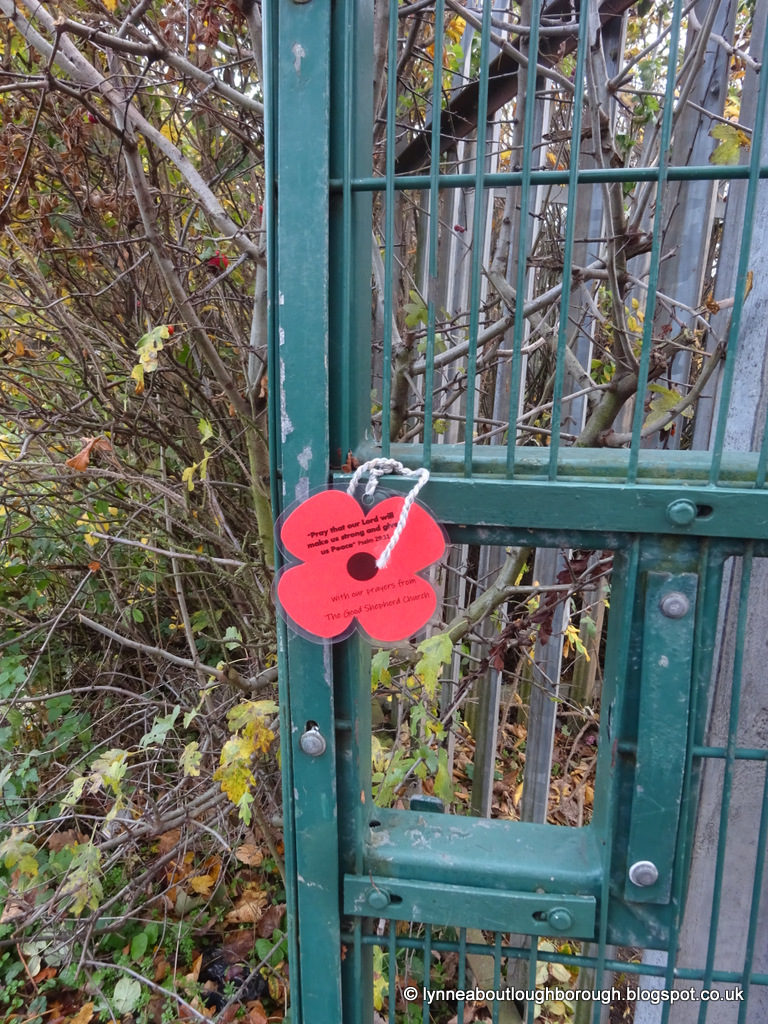
Remembrance poppy at the cemetery

Waymarker on new estate Epinal Way

December 2020
Canal near Nottingham Road bridge

Christmas lights in the market place

Winter Wonderland

You are welcome to quote passages from any of my posts, with appropriate credit. The correct citation for this looks as follow:

Dyer, Lynne (2021). A strange year in Loughborough. Available fromhttps://lynneaboutloughborough.blogspot.com/2021/01/a-strange-year-in-loughborough.html  [Accessed 3 January 2021]

Take down policy:
I post no pictures that are not my own, unless I have express permission so to do. All text is my own, and not copied from any other information sources, printed or electronic, unless identified and credited as such. If you find I have posted something in contravention of these statements, or if there are photographs of you which you would prefer not to be here, please contact me at the address listed on the About Me page, and I will remove these.

You can leave comments below, but do check back as my reply will appear here, below your comment.

Thank you for reading this blog. 
Lynne