Monday, 7 November 2022

The case of the Burton Street pillar box

I remember years ago, the nearest pillar box on my journey into town used to be the one on the corner of Park Street and Burton Street. In those days, of course, I used to write and send many, many letters, whereas today, most of my communication is done via email – apart from Christmas cards and birthday cards. 

I remember standing on the corner of the street posting letters into the pillar box, whose aperture was actually on the roadside. I also remember thinking how beautiful and rather unusual this box was, for it wasn’t the more commonly seen, rounded box, but a more ornate and differently shaped one. But can I for the life of me remember exactly what it was? 

The reason I say this is because the fate of that lovely pillar box was unfortunate. 

The dramatic headline: 

Postbox is flattened” 

appeared in the Loughborough Echo of 24 December 1999, and I remember the day well. 

The article continued:

“A post box on Burton Street in Loughborough was knocked down when a lorry collided with it.

The incident, which occurred on December 20, was reported to the Royal Mail sorting office, Nottingham Road.

[A spokesperson] from the office said, “The box was knocked off the post, but our maintenance staff are dealing with it.””

I have not been able to find a newspaper report describing the replacement for the pillar box, but I do know that it was replaced, as there is still a pillar box in that position. 

However, although the pillar box was actually replaced, it was replaced with a like-for-like one. Gone was the beautiful Victorian box, and in its place appeared a rather more ubiquitous EIIR rounded box, made by Carron. The replacement box was also rotated, so the aperture was no longer on the roadside, but now allowed the letter-poster to stand on the pavement whilst posting the letter.

The new box on Burton Street

Maker's mark on the new box on Burton Street

The new box on Burton Street looking splendid!

What is so frustrating for me is how much I took the original box for granted, despite admiring it every time I used it! So, I do not know if it was a Penfold box, or another style of Victorian box. Does anyone have an memories of this box or any photographs that would help me identify the style of the original box?

Was it a Penfold?

A Penfold box in Monmouth, 2018

A Penfold box in Caerleon, 2005

A Penfold box in Tenby, 2011

Or was it more like this one, at Warwick?

Warwick, 2017

____________________________________

posted by lynneaboutloughborough

With apologies for typos which are all mine!

_______________________________________________

Thank you for reading this blog. You are welcome to quote passages from any of my posts, with appropriate credit. The correct citation for this looks as follows:

Dyer, Lynne (2022). The case of the Burton Street pillar box. Available from: https://lynneaboutloughborough.blogspot.com/2022/11/the-case-of-burton-street-pillar-box.html [Accessed 7 November 2022]

Take down policy:
I post no pictures that are not my own, unless I have express permission so to do. All text is my own, and not copied from any other information sources, printed or electronic, unless identified and credited as such. If you find I have posted something in contravention of these statements, or if there are photographs of you which you would prefer not to be here, please contact me at the address listed on the About Me page, and I will remove these.

Blog archive and tags:
If you are viewing this blog in mobile format, you will not be able to easily access the blog archive, or the clickable links to various topics. These can be accessed if you scroll to the bottom of the page, and click 'View Web Version'. Alternatively, there is also a complete list of posts, which when clicked will take you to the page you are interested in.  
 
Thank you for reading this blog. 

Lynne     

Friday, 4 November 2022

A is for acorns

If you’re like me and you love nothing more than scuffing your way through fallen autumn leaves, then you might have noticed considerably more acorns lying beneath the branches of the oak trees than we’ve seen for a while. 


When I last did this in earnest, I was looking more at the oak trees, in preparation for writing an entry in ‘Loughborough A-Z’ which eventually turned out like this:

"Q is for … Quercus Petraea

The Outwoods, an area popular with Loughborough people, is an ancient woodland populated with native oak trees of the sessile variety, Quercus Petraea. The Holywell Woods also hosts Quercus Petraea, along with the native pedunculate oak, Quercus Robur, and ash and silver birch. The leaves of Quercus Petraea have stalks but the acorns don’t, while the leaves of Quercus Robur don’t have stalks, but the acorns do. The English Oak tree is one of the locally sourced, native species of memorial trees available at the Natural Burial Ground in nearby Prestwold and is also used to make memorial benches."

This year, 2022, however, the leaves have fallen far earlier in the year than I can ever remember, possibly due to the lack of rain, and the need for the tree to put all its energy into its trunk, branches, and seeds. When I saw so many acorns dropping, I did wonder if I simply hadn’t been paying enough attention in previous years, but I was relieved to learn that this wasn’t the case! 

I had forgotten that this year was likely to be a mast year, a year in which the oak tree intentionally produces more acorns than in the previous 3 or 4 years, perhaps to ensure that there are far too many to be eaten by squirrels and other creatures, so that there is more chance more oak trees will grow. This mast year happens every 4 or 5 years, and is followed by low acorn production in subsequent years.

Fallen oak leaves, March 2020


However, it appears that 2020 was also a mast year, and that was only 2 years ago. And, in November 2021, the Woodland Trust expressed its concern for the native oak tree, as lack of rainfall can cause oak trees to be more likely to decline. The Tree Council, however, suggest that while there can be several consecutive years of low acorn production, it is rather more unusual to see mast years together, but nevertheless they have suggested that most oak trees seem to be doing well this year.  

So look out in 2026 or 2027 for a bountiful crop of acorns, maybe some new, infant trees, and hopefully some very healthy adult trees!

Autumn leaves on Steeple Row, 2013

____________________________________

posted by lynneaboutloughborough

With apologies for typos which are all mine!

_______________________________________________

Thank you for reading this blog. You are welcome to quote passages from any of my posts, with appropriate credit. The correct citation for this looks as follows:

Dyer, Lynne (2022). A is for Acorns. Available from: https://lynneaboutloughborough.blogspot.com/2022/11/a-is-for-acorns.html [Accessed 4 November 2022]

Take down policy:
I post no pictures that are not my own, unless I have express permission so to do. All text is my own, and not copied from any other information sources, printed or electronic, unless identified and credited as such. If you find I have posted something in contravention of these statements, or if there are photographs of you which you would prefer not to be here, please contact me at the address listed on the About Me page, and I will remove these.

Blog archive and tags:
If you are viewing this blog in mobile format, you will not be able to easily access the blog archive, or the clickable links to various topics. These can be accessed if you scroll to the bottom of the page, and click 'View Web Version'. Alternatively, there is also a complete list of posts, which when clicked will take you to the page you are interested in.  
 
Thank you for reading this blog. 

Lynne 

Sunday, 30 October 2022

Loughborough's letterboxes Pt 5

Last time in this letterbox series, we looked at EIIR pillar boxes in Loughborough, and before that in Parts 1-3, we investigated our anonymous box, the Victorian pillar boxes, and the EVIIRs, GRs, and GVIRs. Today, let's have a look at other types of letterboxes, like lampboxes and wallboxes, from across the years.

Wallboxes

One of our best wallboxes is the one on the Midland Mainline railway station, but sadly, it's only in view if you happen to be on Platform 1. I wonder how much use it gets, given that it's so well hidden?! Anyway, it's a beautiful VR box, although I can't tell who made it, as the photo I took some time ago is a bit blurry, and the box has been repainted so many times, the maker's mark has lost its definition.
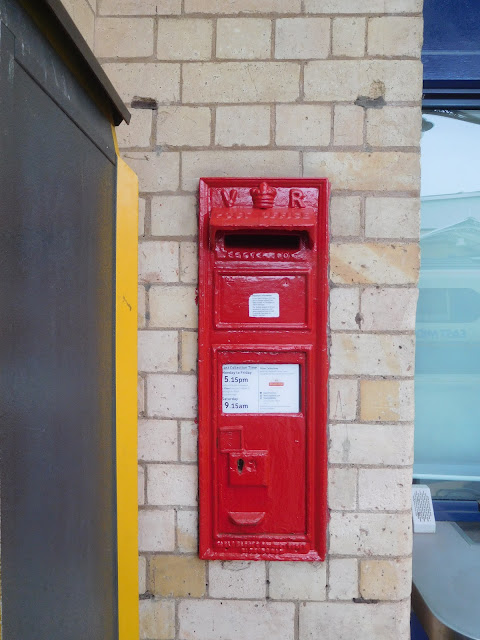
The VR wallbox at the railway station on Platform 1

As far as I know we only have another two wallboxes, both of which carry the GR cipher, so they were installed between 1910 and 1936. 

The box in the wall at the bottom of Beeches Road, at its junction with Leicester Road, is on the side of the Lifestyle Express minimarket, which many will remember as Maher's Off-Licence, and which many years ago used to be the home of the Clemerson family, and was once known as the Paul Pry. The box was made by Derby Castings, which was the name used by the Handyside company, from Derby who made some of the pillar boxes we've seen in earlier posts. Derby Castings was operating from 1931-1933, so this box can be dated quite closely:


The GR wallbox at the bottom of Beeches Road

The other GR wallbox is pretty spectacular, and always well-looked after, and sometimes the crown is highlighted in gold. This is another wallbox at a railway station, although this one is at the Great Central Railway on Great Central Road, and unlike the one at the mainline station, this one is actually outside the station. This one was made by W. T. Allen.


The GR wallbox outside the GCR station in 2014

Detail of the maker's mark on the GR box outside the GCR station

Lampboxes

As you might expect from the name, the lampbox was originally designed to be attached to a lamppost, but very few today are, and are mostly supported on their own stick. They were initially placed in more rural areas, or areas where the volume of mail didn't warrant having a larger, pillar box. All the lampboxes I've found so far date from 1952-2022, and bear the EIIR cipher - except one! Most have been made by Carron, and one by Carronade, but there are a few where I haven't been able to identify the maker, while there is one that was made by Machan.

The ones on Manor Road, Meadow Lane at its junction with Ratcliffe Road (outside a corner shop that used to be a post office), Montague Drive, Nanpantan Road, Toothill Road at its junction with Cambridge Street (outside the corner shop), and the one on Woodhouse Lane, Nanpantan outside the Longcliffe Care Home, are all very, very similar, if not the same. Here's the one on Toothill Road:

Lampbox on Toothill Road at its junction with Cambridge Street

The lampbox on Park Road, at its junction with Bowling Green Way, and almost opposite what used to be a post office, is slightly different as the marker's mark (Carron) is a separate piece of metal, screwed into the box, rather than being embossed. This is also the case with the box on Tuckers Road, although the maker here is Machan:

Carron lampbox on Park Road at its junction with Bowling Green Way

Machan lampbox on Tuckers Road


Meanwhile, over on Highland Drive, a new type of lampbox has been installed - it has no maker's mark, seems to be made from a material other than cast iron, has a metal plate screwed in that says 'Royal Mail', and the royal cipher - EIIR - is a silver-coloured plate, attached separately. 
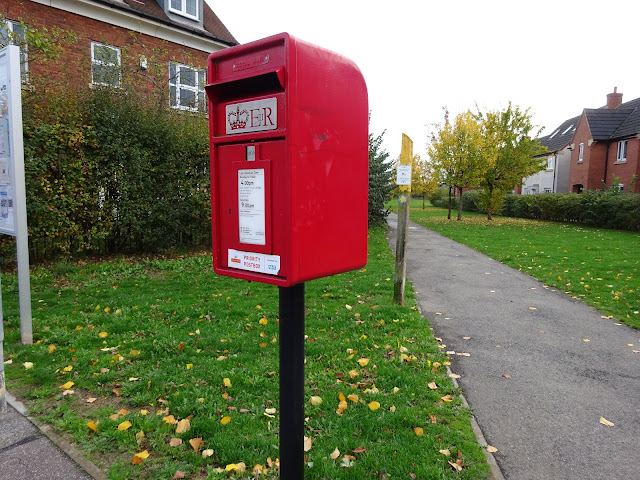

Lampbox on Highland Drive


Close-up of the Highland Drive lampbox

And here's the one that is different and to my mind, is far and away the most beautiful of the lampboxes I've come across! The lampbox in Woodthorpe comes the closest to its original support as I've seen - it's attached to the side of a wooden stake, rather than being on its own post. It carries the GR cipher, and therefore probably dates from between 1910 and 1936, and whereas most of the EIIR ones are an upright oblong shape, that round down towards the back, the Woodthorpe box is an upright oblong, with a curved top. Here's some pics that'll make more sense than my words!!!

The EIIR lampbox on Montague Road from the side


Woodthorpe GR lampbox attached to a post


A close-up of the Woodthorpe GR lampbox

A view of the Woodthorpe GR lampbox from the side


That's just about covered wallboxes and lampboxes! Pop back to the blog later, to find out about some quirky postboxes, and maybe a story about a rather special pillar box!

If you want to look back over earlier posts about Loughborough's letterboxes, here are the links:

Part 1 - the anonymous pillar box

Part 2 - the Victorian pillar boxes

Part 3 - pillar boxes 1910-1952 

Part 4 - EIIR pillar boxes

____________________________________

posted by lynneaboutloughborough

With apologies for typos which are all mine!

_______________________________________________

Thank you for reading this blog. You are welcome to quote passages from any of my posts, with appropriate credit. The correct citation for this looks as follows:

Dyer, Lynne (2022). Loughborough's letterboxes Part 5. Available from: https://lynneaboutloughborough.blogspot.com/2022/10/loughboroughs-letterboxes-pt-5.html [Accessed 30 October 2022]

Take down policy:
I post no pictures that are not my own, unless I have express permission so to do. All text is my own, and not copied from any other information sources, printed or electronic, unless identified and credited as such. If you find I have posted something in contravention of these statements, or if there are photographs of you which you would prefer not to be here, please contact me at the address listed on the About Me page, and I will remove these.

Blog archive and tags:
If you are viewing this blog in mobile format, you will not be able to easily access the blog archive, or the clickable links to various topics. These can be accessed if you scroll to the bottom of the page, and click 'View Web Version'. Alternatively, there is also a complete list of posts, which when clicked will take you to the page you are interested in.  
 
Thank you for reading this blog. 

Lynne

Friday, 28 October 2022

Herbert Morris Empress Road

Many years ago, the Loughborough Archaeological and Historical Society produced a journal in which they listed properties that were being altered or demolished. Although this was in the 1960s, and there was much development in the town, it was still possible for the Society to comment upon such works, and that in nearby villages. 

Today, this task would be impossible! Developments and alterations are so numerous, it's unlikely anyone could keep up. So, as the plan to demolish the Herbert Morris East works buildings on Empress Road, first mooted in 2015 has now been re-submitted (comments due by 3rd November), earlier this week I decided to photograph the bits that were on public view, so there is a record of the building (for as long as this blog is available).

The building is of interest from a historical point of view for many reasons, not least because of it being the place where a Zeppelin bomb fell in 1916. I've written about this extensively before - in the Loughborough Zeppelin Trail, photos of the factory in this post about a Zeppelin Walk led by a friend of mine in 2014, an account of a series of commemorative plays that took place across town in 2016, a post about a commemorative walk in 2016, and a good friend of mine wrote a guest blogpost about Zeppelin L20. Of course, as a working factory, the business produced machinery that is still in use today, across the country, and probably the world.

Please bear with if the photos take a long time to load - I haven't had time to edit them for the blog.

Looking along Empress Road from Great Central Road

Looking along Empress Road

Part of the factory building on Empress Road

Part of the factory on Empress Road

View of part of the factory on Empress Road

Beside Moor Lane bridge

View along the canal

View along the canal

View along the canal

Morris machinery still in action locally


____________________________________

posted by lynneaboutloughborough

With apologies for typos which are all mine!

_______________________________________________

Thank you for reading this blog. You are welcome to quote passages from any of my posts, with appropriate credit. The correct citation for this looks as follows:

Dyer, Lynne (2022). Herbert Morris Empress Road. Available from: https://lynneaboutloughborough.blogspot.com/2022/10/herbert-morris-empress-road.html [Accessed 28 October 2022]

Take down policy:
I post no pictures that are not my own, unless I have express permission so to do. All text is my own, and not copied from any other information sources, printed or electronic, unless identified and credited as such. If you find I have posted something in contravention of these statements, or if there are photographs of you which you would prefer not to be here, please contact me at the address listed on the About Me page, and I will remove these.

Blog archive and tags:
If you are viewing this blog in mobile format, you will not be able to easily access the blog archive, or the clickable links to various topics. These can be accessed if you scroll to the bottom of the page, and click 'View Web Version'. Alternatively, there is also a complete list of posts, which when clicked will take you to the page you are interested in.  
 
Thank you for reading this blog. 

Lynne             

Monday, 24 October 2022

Loughborough's letterboxes Pt 4

Welcome to Part 4 of this series on letterboxes in Loughborough! First, I have managed to confirm that the VR pillar boxes on Forest Road and Moor Lane which I covered in Part 2, were made by Andrew Handyside! Here's the proof from the front of the Moor Lane box:

Andrew Handyside Victorian pillar box on Moor Lane

In Part 3, we had a look at pillar boxes from the reign of Edward VII, George V, and George VI, so now we'll move on to pillar boxes installed during the reign of Queen Elizabeth II. Important to note, however, that when she came to the throne, there were still new GVI boxes available, and this supply would have been used up first, before new boxes with the EIIR cipher were made and installed.

I must admit, considering how much Loughborough has grown in size over the past 70 years, I was surprised that there weren't more EIIR pillar boxes, although, of course, there are different styles of posting boxes, as well as different kinds of posting boxes from this era. 

Some EIIR boxes once had directional markers on their top, like the one on Ashby Road, at its junction with Ashby Avenue:


Missing directional marker on the Ashby Road EIIR box

Most of the pillar box tops seem to be of the fluted design:

Fluted top, Derwent Drive

and I have only found one box so far, that doesn't have a fluted top:

Burton Street (thereby hangs a tale for another day!)

So far we've seen round pillar boxes, but there are also several square boxes dotted around Loughborough. These were first manufactured in 1996, and are for franked mail only, hence them mostly being on industrial estates and business parks: 

Square box on Prince William Road, which stands next to a K box

As for manufacturers, most of our pillar boxes were made by Carron, but we do have at least one made by Abbot. These boxes, known as K boxes were introduced in 1980. The Woodbrook Road box is one such, and although it's not always possible to get behind a box to look at the maker's mark, it's likely that the box on Prince William Road, and the one on Mount Grace Road might also be Abbots, but the one in Gorse Covert shopping centre, and the one outside the post office off Epinal Way, near Park Road, are by 'Carronade'.

K box on Woodbrook Road, where there used to be a post office

K box on Woodbrook Road

Maker's mark on Woodbrook Road K box

We also have a couple of pillar boxes made by Machan, one of which seems to be dated 2008 (which is contemporaneous with the building of the housing estate (Fairmeadows) in which it is sited). This type of pillar box dates from the 1990s, when this more traditional shaped post box replaced the K box, and the words Post Office were replaced with Royal Mail. 

A Machan EIIR pillar box on High Street outside the former King's Head

Maker's mark on the High Street pillar box


Pillar box on Haddon Way

Maker's mark on Haddon Way pillar box


Just as an aside, our sorting office, down on Nottingham Road, was built in 1966, and bears the EIIR cipher:


Well, I think that's about all I can fit into one blog post, but there is plenty more to say about letter boxes in Loughborough! Pop back to the blog for the next letter box installment, which will cover lampboxes and wallboxes from all eras!

If you want to look back over earlier posts about Loughborough's letterboxes, here are the links:

Part 1 - the anonymous pillar box

Part 2 - the Victorian pillar boxes

Part 3 - pillar boxes 1910-1952 

____________________________________

posted by lynneaboutloughborough

With apologies for typos which are all mine!

_______________________________________________

Thank you for reading this blog. You are welcome to quote passages from any of my posts, with appropriate credit. The correct citation for this looks as follows:

Dyer, Lynne (2022). Loughborough's letterboxes Part 4. Available from: https://lynneaboutloughborough.blogspot.com/2022/10/loughboroughs-letterboxes-pt-4.html [Accessed 24 October 2022]

Take down policy:
I post no pictures that are not my own, unless I have express permission so to do. All text is my own, and not copied from any other information sources, printed or electronic, unless identified and credited as such. If you find I have posted something in contravention of these statements, or if there are photographs of you which you would prefer not to be here, please contact me at the address listed on the About Me page, and I will remove these.

Blog archive and tags:
If you are viewing this blog in mobile format, you will not be able to easily access the blog archive, or the clickable links to various topics. These can be accessed if you scroll to the bottom of the page, and click 'View Web Version'. Alternatively, there is also a complete list of posts, which when clicked will take you to the page you are interested in.  
 
Thank you for reading this blog. 

Lynne